To log this Earthcache as Found, you must send a message with answers to the questions.
Please send your best answers via private message. I will reply to all messages.
You are allowed to log immediately, however, if no answers are received within a reasonable time frame, your log will be deleted.
Questions are below the write up. Enjoy!
450 Million Years Ago...
It was the Paleozoic era and the age of Pangea. Southern Manitoba was part of a warm, shallow inland sea, located just south of the equator. Organisms, such as corals, sponges, gastropods, trilobites and algae burrowed through the bottom of a soft, limey, muddy sea seeking food and refuge from predators; traces of their passage left behind.
The more tightly packed surrounding sediment, primarily calcium carbonate, lithified first, leaving the many burrows untouched. Later, magnesium rich waters percolated through the rock depositing dolomite in the burrows, but it could not penetrate the tightly cemented limestone.
It is the preserved, complex branches of burrows or trace fossils of these magical sea creatures that created Tyndall Stone's beautiful mottling, and that give Tyndall Stone its unique, one of a kind appearance.
The Tyndall Stone is quarried in Manitoba and takes its name from the town of Tyndall, 30 km northeast of Winnipeg.
Canada is the only source in the world for this stone and is used in the construction or facing of many major buildings in Canada. The Houses of Parliament in Ottawa and the Legislative Buildings in Winnipeg, Regina and Edmonton are prime examples. It is also featured on the exterior of the Canadian Embassy in Berlin.
Corals
Catenipora was a colonial tabulate coral. Individual corallites which form the colony grew as a vertical tube with elliptical cross-section and joined along the edges to give the appearance of a chain, hence the common name Chain Coral.
Calapoecia was a colonial tabulate coral in which the vertical tubes of the corallites are separated from each other by a calcareous mesh.
Grewingkia was a solitary rugose coral. Individuals were separate and grew in the shape of a slightly curved cone rather like a cow's horn, hence the common name Horn Coral. In cross-section the fossil shows a circular to elliptical shape with septa radiating from the centre. In vertical section it shows an elongated curved triangular shape with septa running along its length. I say it looks like a little ghost!
Receptaculitid
Receptaculitids were animals with a similar life style to modern sponges. They are now extinct.
Fisherites was a large form which grew in the shape of a hollow irregular sphere, the walls of which were double and made up of small hexagonal plates and rods. In some sections the arrangement of the plates resembles a sunflower blossom hence the common, but erroneous name, Sunflower Coral.

Cephalopods
Cephalopods are the group of animals to which present day Nautilus, squids and octopuses belong. The individual lived at one end of its shell in a body chamber and extended its body out of the aperture, the open end of the shell. The rest of the shell was divided into septal chambers by septa. The chambers were connected by a siphuncular tube through which the animal could control its buoyancy. Genera and species are differentiated mainly by size, shape, siphuncular position and internal structure.
Armenoceras had a long straight shell of medium size with a central siphuncular tube bordered by prominent calcareous deposits.
Cyclendoceras had a large straight shell with a relatively wide offset siphuncular tube bordered by curved septal ends.
Cyrtogomphoceras had a stubby shell with pronounced curvature. The body chamber showed a constricted aperture and the offset siphuncular tube was bordered by incurved ends of the septa.
Diestoceras had a stubby straight shell with a constricted aperture and the offset siphuncular tube was bordered by incurved ends of the septa.

Gastropods
These are Snails and their shells grew in a spiral form.
Maclurina grew very large and its shell was a flat spiral.
Hormotoma was medium sized with a high spiral shell which cut vertically shows an overall triangular outline containing smoothly curved elliptical to circular cross-sections.
Reference materials:
dfp.mediacooks.com/fossils/
These are a few other buildings which also feature Tyndall Stone. All are within walking distance from the Bess:
- Court of King's Bench – across the street south on Spadina Crescent
- Avenue Building – two blocks west on the southeast corner of 3rd Ave and 21st Street
- Board of Education – two blocks west on the northeast corner of 3rd Ave and 21st Street
"Hunting High and Low" - is the debut studio album by Norweigan new wave band A-Ha released in 1985
To log this Earthcache
- locate the fossils in the following images. They are the North and South walls which I have marked (in red) in the image of the Bessborough hotel. The fossils can be easily viewed from the sidewalk and are no higher than 7 feet.
Submit your answers in a private message.
Please DO NOT send photos in the private message, post them in your log note.
You are allowed to log immediately after answering the questions, however, logs without submitted answers (within a reasonable time) will be deleted. If you are traveling please make a note in your log if answers are to follow. Thanks
The Bessborough
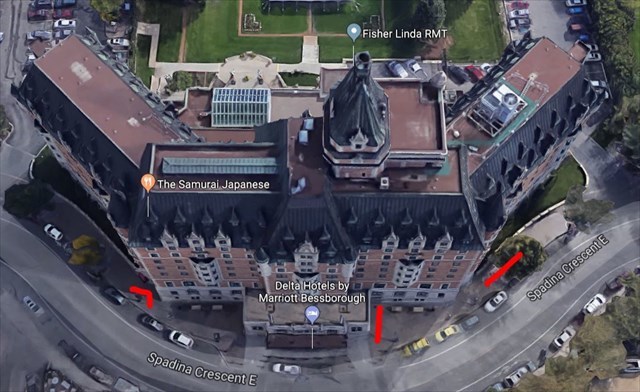
Questions:
1. Identify the fossil in image #1 - what is it? Locate it on the North side wall and measure the diameter in centimeters.
2. Identify the fossil in image #2 – what is it? Locate it on the North side wall. How long is it in centimeters?
3. Image #3 – What type of fossil is it? How high up on the South side wall is it located? Note: this area may be restricted during the winter months. Please respect the barricade and if you can't see the fossil, then explain why the barricade is there?
4. Image #4 - Can you determine what it is? Where on the south side wall is it located? Note: this area may be restricted during the winter months. Please respect the barricade and instead explain why the barricade is there?
5. Image #5 – Describe the largest fossil you find on the first bench seat. What is the diameter in centimeters?
6. Optional - Post an image of a personal item, or another fossil that you found during your visit. Include this in your online log.
IMAGE #1

IMAGE #2

IMAGE #3

IMAGE #4

IMAGE #5
