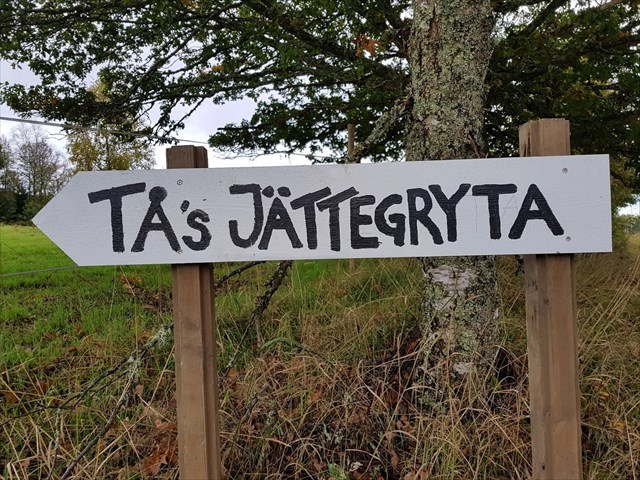
Tå's jättegryta
Jättegrytor har uppkommit under olika istider, då Sverige var täckt av ett tjockt islager. Jättegrytor finns lite varstans i Sverige och i andra länder. Förr trodde man att dessa gropar i berget var jättarnas grytor. Nu vet man bättre. Den senaste istiden, eller glacialperioden, började för omkring 110.000 år sedan och varade i Sverige fram till ca 11.000 år sedan. En jättegryta bildas genom att strömmande smältvatten har fått en sten att rotera tillsammans med grus och mindre stenar i en virvel under en längre tid. Löpstenen som urholkat en jättegryta ligger oftast kvar som en ovanligt slät, äggformad sten, antingen på dess botten eller i dess närhet. Löpstenen och gruset som nöter ned berget har varit lika hård eller hårdare än berget där jättegrytan bildats. Jättegrytor bildas i allmänhet neråt, det finns även sådana jättegrytor där stenar och grus har roterat mot en bergvägg och skapat en horisontell urgröpning. Många jättegrytor kan fortfarande vara oupptäckta eftersom de är fyllda med sten och sand. De största jättegrytorna i Norden är 8–10 meter i diameter och 20–30 meter djupa, medans många är betydligt mindre som denna.
Eng:
Giant Kettles - Tå
Giant Kettles have occurred during different ice ages, when Sweden was covered in a thick ice layer. Giant Kettles are found a bit here and there in Sweden and in other countries. Previously, they thought that these Giant Kettles in the mountain were the giants' pots. Now we know better. The last ice age, or the glacial period, began about 110,000 years ago and lasted in Sweden until about 11,000 years ago. A giant kettles is formed by flowing melting water having a rock to rotate along with gravel and smaller stones in a swirl for a long time. The pebbles that create a giant pot are usually like an unusually smooth, egg-shaped stone, either at the bottom or nearby. The stones and gravel forming in the mountain have been as hard or harder than the mountain where the giant kettle was formed. Giant kettles are generally formed downward, there are also giant kettle where rocks and gravel have rotated against a rock wall and created a horizontal ripening. Many giant kettles can still be undiscovered because they are filled with stones and sand. The largest giants in the Nordic region are 8-10 meters in diameter and 20-30 meters deep, while many are considerably smaller like this.