A nice cup of coffee often helps awaken a geocacher to start the day for caching. While many drink it, few seem to know the background of it. No one knows exactly how or when coffee was discovered, but there are many theories and legends. There are two main theories that it was at either the end of the ninth century or at the beginning of the 14th century. This geocache is thus dedicated to all the tasty combinations of coffee. Be careful of the landscaping. Feel free to practice CITO and leave no trace.
The coffee plant has red, cherry-like fruit with white blossoms that smells like jasmine.

The legend tells that this shepherd and monk were in a region called Kaffa which is a province on the southwestern side of Ethiopia. It is assumed that coffee is named after this region. However, contrary to popular belief, the word "coffee" does not originate from Kaffa - the place of origin of the plant. Instead it seems the word "coffee" derives its meaning from the Arabic word "qahwa" which means wine. This is because as coffee spread, people referred to it more as a drink instead of as a plant or region. /p> <<p> Regardless of the veracity of the monk ledgend or the original meaning of the word, it is seems to be clear that the highlands of Ethopia was the first place coffee was discovered. (Although there is debate about in Sudan and Kenya about its first use in culture). It quickly spread to Yemen. Özdemir Pasha, the Ottoman Governor of Yemen, who had grown to love the drink while stationed in that country shared it with Sultan Suleiman the Magnificent who ruled in Istanbul. Since the leader of the empire liked it, the culture and people quickly followed.
During coffee's time in the palace of the Ottoman empire, a new method of drinking coffee was discovered. The fruit was roasted over a fire then finely ground. These grounds were then slowly cooked with water on the ashes of a charcoal fire. This is the first modern example of coffee around the year 1555 which quickly enhanced the drink and made coffee even more renown. In the Ottoman empire, coffee moved from the houses to the rich to public by means of coffeehouses. This first one is named Kiva Han. These places promoted the idea that music, reading, and conversations were enhanced by drinking coffee. Thus coffee became nearly synonymous with the idea of experiencing culture. Obviously as merchants and travelers passed through Istanbul looking for new products or experiences, they discovered the coffee drink which soon spread to Europe and ultimately to the whole world.
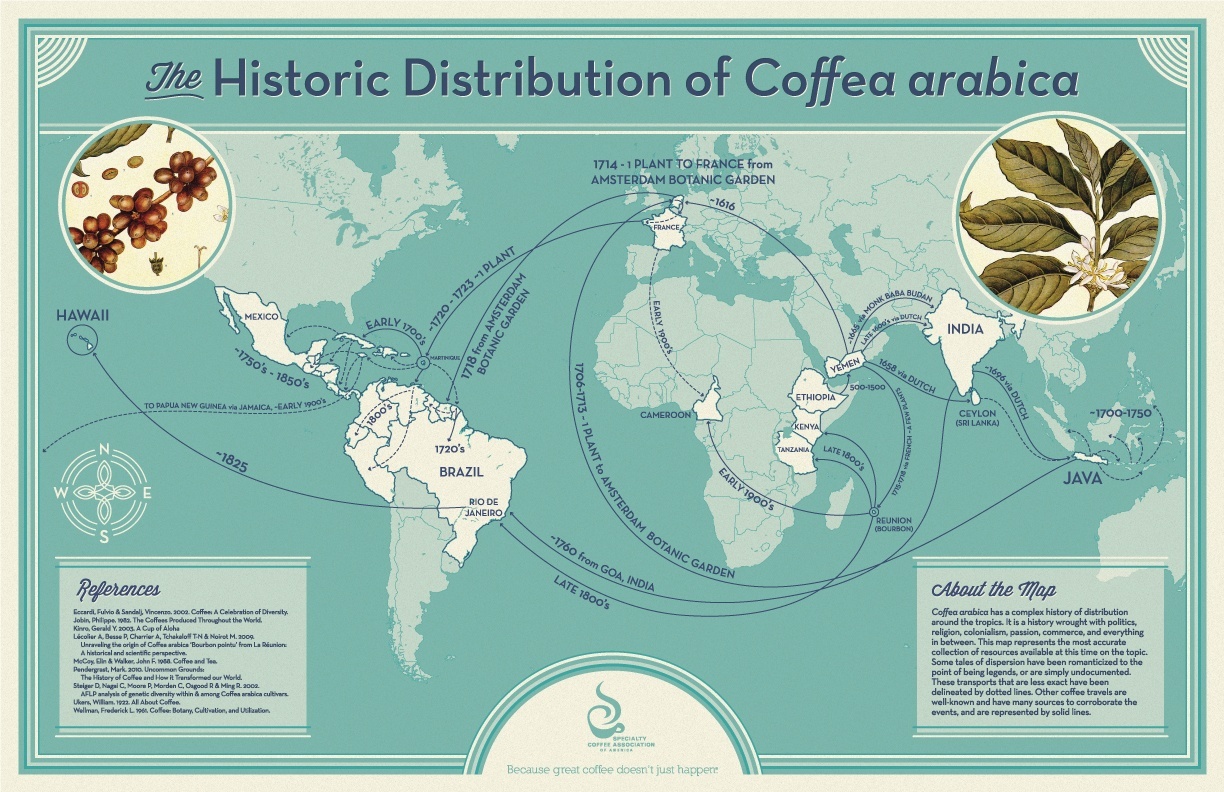
The merchants and pilgrims returning from the Middle East described and brought back this new drink. The Arabic word for this coffee drink was qahwa which was described as the "wine of Araby." By the 17th century, this new beverage was quite popular in Europe. Some people were suspicious of this drink from a foriegn land and called it the “bitter invention of Satan.” The local clergy condemned coffee when it came to Venice in 1615. The controversy was so great that Pope Clement VIII was asked to intervene. After tasting the beverage for himself he found the drink so satisfying that he gave it papal approval. The connection to culture and the pope's approval quickly moved coffee to the centers of social activity and communication in the major cities of England, Austria, France, Germany and Holland.
It is believed that in 1635 Venice had the first European coffee sold by street vendors as a novelty drink. Paris had a winery that sold coffee in 1649 (although their first real coffeehouse, Café de Procope, opened in 1676). The first known coffee to make it to England was a visiting man from Turkey explained the culture of coffee at Oxford. Students and teachers formed the "Oxford Coffee Club" to partake in this beverage and conversation. It is believed that by 1684 there were over 300 coffeehouses in London. The oldest known coffee house in Europe is the "Café Procope” in Paris, France. The second oldest known coffee shop is in Leipzig, Germany. It is called the “Coffe Baum” and gave out free coffee for the first year.
In the mid-1600's, coffee was brought to the New World. It first appeared in New Amersterdam later called New York by the British. The first coffeehouse in New York was "The King's Arms" which opened in 1696. Though coffee houses rapidly began to appear in the colonies, tea continued to be the favored drink. It was not until 1773 when the colonists revolted against the tea tax imposed by King George III. The revolt, known as the Boston Tea Party, would forever change the American drinking preference to coffee. Thomas Jefferson said that "coffee is the civilized world's favorite drink."Coffee in the America's also helped to develop various regions which could grow coffee such as Java, Jamaica, and in Brazil. Today, Brazil is the number one producer of coffee in the world, accounting for 35% of global coffee production.
By the mid 19th century, coffee had become one of the most important commodities in world trade. Today coffee is the second most sought commodity in the world (after oil). Many drink coffee in order to sharpen one's awareness. But it still often used in many cultures as a way to share a few minutes and socialize.
Bibliographic Information:
· Coffee Bean image,
( https://okapicoffee.com/wp-content/uploads/2016/12/gzcof6tnrkg-mark-daynes.jpg ).
· Coffee Bean map,
( https://coffeebeansdelivered.com.au/wp-content/uploads/2015/04/historical-distribution-of-coffee.jpg ).
· Go Coffee Go's article, "The History of Coffee"
( https://www.gocoffeego.com/professor-peaberry/history-of-coffee/850 ).
· Image of Coffee Plant,
( https://www.turkishcoffeeworld.com/v/vspfiles/assets/images/other/img.sasasphp.jpg ).
· The National Coffee Association's article "History of Coffee"
( http://www.ncausa.org/About-Coffee/History-of-Coffee ).
· Turkish Coffee and Tea World's article, "History of Coffee and how it spread to the world."
( https://www.turkishcoffeeworld.com/History-of-Coffee-s/60.htm ).

Some drink coffee to wake up. Others use coffee to promote conversations. Regardless of your interest in coffee, this cache is for all people and is easily accessible.
You must sign the log to claim the find. No exceptions and no excuses. Blank logs may be deleted without notice. Avoid the use of acronym only logs.
*** Note this area is popular and busy most times. Retrieve the cache and replace the cache with care. Bring your own writing utensil.
Congrats to FTF Co-finders Weseeketh and PondScum69. They found it 23 minutes after it published!
Honorable mention goes to PapawTexas, QuadWrays, and bnpeltier. All of whom found it within minutes (or at least shortly after) the first finders.