 |
POLISH DESCRIPTION
|
Tasiemce dostają się do wnętrza człowieka w dość skomplikowany sposób. Przebywają przy tym podróż, podczas której trzykrotnie się przeobrażają.
Najpierw dorosły tasiemiec żyjący w jelitach człowieka składa jaja – tysiące jaj – które wydostają się na zewnątrz w odchodach żywiciela. Jaja te są dość wytrzymałe, ale w bogatych krajach zostają po prostu spuszczone z kupą w ubikacji i to jest ich koniec. W biednych krajach jednak ścieki są czasem wylewane na pola uprawne lub w pobliżu ludzkich domów i jaja mogą zostać zjedzone przez krowę lub świnię.
W ciałach tych zwierząt, nazywanych żywicielami pośrednimi, z jaj wykluwają się małe haczykowate drobinki, które przedostają się do krwi i płyną w niej, aż dotrą do mięśnia. Tam znowu się przeobrażają, tym razem w jajowate pęcherzyki – larwy, zwane wągrami.
Tasiemiec nie może rosnąć ani składać jaj w krowie czy świni. Larwa musi zatem czekać… aż mięsień stanie się niedogotowanym kawałkiem wołowiny czy wieprzowiny na talerzu jakiegoś pechowca. Larwa zostaje wówczas połknięta z mięsem, a w jelitach wyskakuje z pęcherzyka. Tam może wreszcie osiąść, dorosnąć i złożyć jaja.
JAK ODNALEŹĆ KESZA ?
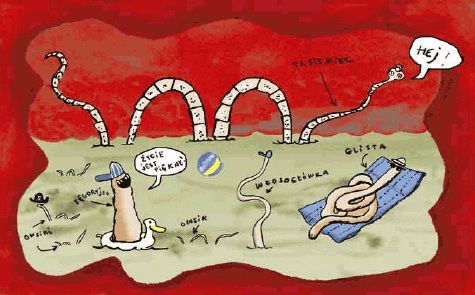
1. Policz litery w nazwie „główki” tasiemca, służącej mu do przyczepienia się do ciała żywiciela – to Twoje X.
2. Udaj się pod współrzędne N 53.06.[X-4][X-2][X-1] E 018.00.[X][X-5][X]
3. Stań twarzą w stronę, w którą patrzy koń. Skręć 10 stopni w lewo i przejdź ok. 25 metrów. Tam możesz szukać kesza.
 |
ENGLISH DESCRIPTION
|
Tapeworms get inside a human body in a rather complicated way. They take a journey during which they transform three times.
First a full-grown tapeworm living in the intestines of a man lays eggs - thousands of eggs - which get out in the stool of the host. These eggs are quite durable, but in rich countries they are simply dropped off in the toilet and that is their end. In poor countries, however, sewage is sometimes poured into farmland or near human homes and eggs can be eaten by a cow or a pig.
In the bodies of these animals, called intermediate hosts, small hooks are hatched from the eggs, enter the bloodstream and flow into it until they reach the muscle. There they transform again, this time in egg-shaped bubbles - larvae, called thistles.
But the tapeworm cannot grow or lay eggs in a cow or a pig. The larva must therefore wait ... until the muscle becomes an undercooked piece of beef or pork on a plate of some unlucky. The larvae are then swallowed with meat and the gut pops out of the follicle. There it can finally settle, grow up and lay eggs.
HOW TO FIND THE CACHE ?
1. Count the letters in the name of the "head" of the tapeworm - this is your X.
2. Go under the coordinates N 53.06.[X-3][X-1][X] E 018.00.[X+1][X-4][X+1]
3. Turn in the direction where the horse is looking. Turn 10 degrees to the left and go approx. 25 meters. There you can start searching for the cache.
Źródło: „Robale czyli co nas zżera. Przegląd pasożytów”, N. Davies
