
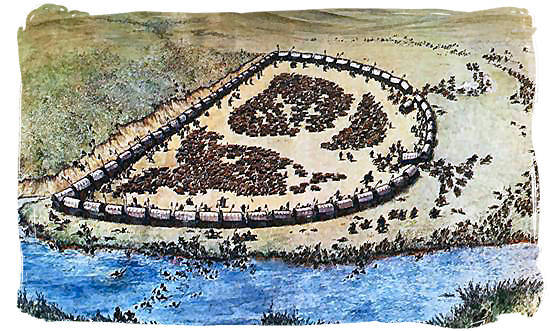
16 December is a day of great significance in South Africa due to two historical events that took place. The first of these was in 1838, when the Battle of Blood River took place between the Voortrekkers and the Zulus. The Voortrekkers, having moved into the interior of South Africa during the Great Trek, were eager to settle on land. The region that they intended to settle on was already inhabited by the Zulu people. The Voortrekker leader, Piet Retief was eager to negotiate with the Zulu chief Dingane. Having misunderstood Retief's intentions, Dingane planned an ambush and murdered Retief and his party of 100 people. This act culminated in the Battle of Blood River, in which 470 Voortrekkers, having the advantage of gunpowder, defeated the 10 000 strong Zulu army.
Also have a look at the cache that is placed at the battlefield site GC1F0P8: Tonteldoos V - Die Slag van Bloedrivier
The second historical event that took place on 16 December was in 1961, when Umkhonto we Sizwe (MK) was formed. This was the military wing of the African National Congress (ANC), which was launched to wage an armed struggle against the apartheid government. Prior to its formation, the ANC had largely approached the fight against apartheid through passive resistance, but after the Sharpeville Massacre in 1960, where peaceful protestors were indiscriminately shot by police, passive resistance was no longer seen as an effective approach in bringing apartheid to an end. MK mostly performed acts of sabotage, but its effectiveness was hampered by organizational problems and the arrest of its leaders in 1963. Despite this, its formation was commemorated every year since 1961.
Initially 16 December was celebrated by Afrikaners as Dingaan's dag (Dingane's Day). This was in celebration for what Voortrekkers viewed as a 'victory' over Zulu warriors near the Ncome River in KwaZulu Natal, the Battle of Blood River. During their trek into Natal, Afrikaners were led by W.J. Pretorius and S.A. Cilliers, "to enter into a covenant with God". When the Zulu attack was repelled by the Voortrekkers, it was viewed as a confirmation of God's ratification of that covenant. This resulted in the establishment of Day of the Covenant. In 1864 the General Synod of the Afrikaners' Natal Churches agreed that 16 December would henceforth be celebrated as an ecclesiastical day of thanksgiving by all its congregations. The following year the Executive Council of the South African Republic declared that 16 December must be a public holiday in this Boer Republic. In 1894 the Government of the Free State also declared 16 December to be a public holiday.
After the South African War the unification of the Cape Colony, Natal and the two Afrikaner Republics of the Transvaal and Orange Free State, an act was passed by parliament in 1910 enacting 16 December as a national holiday (Dingaan's Day) throughout the Union of South Africa with effect from 1911. In 1952 the name of the day was changed from Dingaan's Day to Day of the Vow (Day of the Covenant).
From 1910, Africans who felt excluded from the benefits of universal suffrage after the end of the South African War launched counter events on December 16. These events were meetings and protests aimed at challenging racial discrimination and expressing disdain at continued subjugation of black people. The 16th of December, particularly in the 1920s and the 1930s became a day that highlighted divisions in the country. For white people, particularly Afrikaners, the date symbolized a 'victory' over African people, for those opposed to white domination and racial discrimination; the date became a rallying point for protests.
The African National Congress (ANC), (together with the South African Communist Party (SACP), the South African Indian Congress, the Coloured People's Congress (CPC) and the Congress of Democrats (COD), had been engaged in peaceful acts of resistance which aimed at forcing the government to eventually recognize the rights of Black people in South Africa. However, in the 1950s and early 1960s the South African government reinforced repressive measures to further isolate the country's black people by passing various pieces of legislation. It was the implementation of these repressive measures by the state which precipitated the need to change tactics and the manner in which the ANC, SACP and the Congress Alliance had been approaching the struggle for freedom and equality.
In the early 1960s the ANC, the SACP, COD, CPC and the SA C mooted the idea of an armed struggle. At an ANC Working Committee meeting in June 1961 Mandela presented the proposal for a military wing for discussion. On 16 December 1961 uMkhonto we Sizwe (MK) (Spear of the Nation) the military wing of the ANC announced its existence by launching its first acts of sabotage. On that date several acts of sabotage were committed through bomb blasts against government structures in Johannesburg, Port Elizabeth and Durban.
Between December 1961 and June 1963 more than 200 installations were attacked with a majority of these being in the Eastern Cape. This may be because Port Elizabeth was the centre of sabotage training for MK cadres. On 1 August 1990, MK suspended the armed struggle as negotiations for a democratic South Africa gathered momentum.
After the first democratic elections in 1994, December 16 continued to form part of the history of post apartheid South Africa. On 16 December 1995 the name was changed once more and was celebrated as a public holiday known as the Day of Reconciliation. The establishment of December 16 as a public holiday was an attempt to strike a balance between a divided past and promoting national unity and reconciliation in a new political dispensation.