The Ovens Natural Park is a great place to visit with your family. The scenery is spectacular and the hike along the Cliff Trail to the sea caves is definitely worth it. The terrain isn't too challenging and the return trip can easily be done in less than an hour with lots of time to stop and take photos. You can also kayak along the coastline for a totally different view of the Ovens.

The Ovens Natural Park is open daily from mid-May until late September or early October depending on the weather and it is privately owned and operated by the Chapin family. There is an admission fee to get into the park. There is camping available as well as a museum regarding the gold rush along with other amenities.
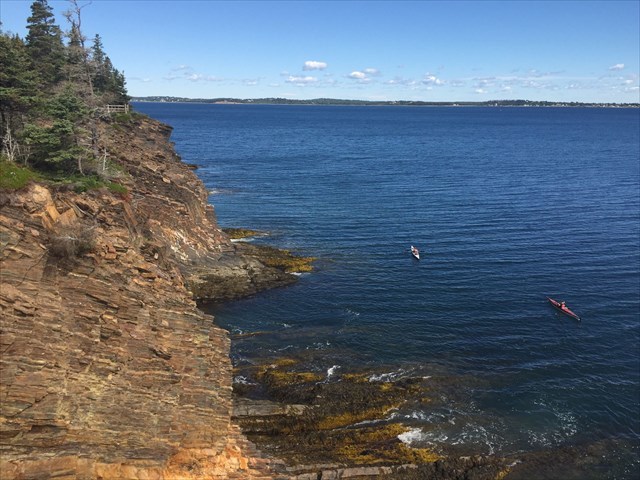
Sea Cave Formation
Sea caves, also known as littoral caves, are formed in ocean cliffs due to the pounding of waves. Sea caves can occur on almost any coastline where the waves break directly on the cliff. This erosion is due to mechanical forces rather than chemical erosion which is responsible for many inland caves. If there is a weakness in the rocks which make up the cliff then it will erode over time due to the force applied by the constant action of the waves. Over time the caves grow larger due to the hydraulic pressure which builds up from each wave. As cracks and fissures are formed, they grow wider and deeper due to the hydraulic power of the waves within a confined space and the compression of air within. This process is aided by the abrasive force of sand suspended in the waves and small rocks.
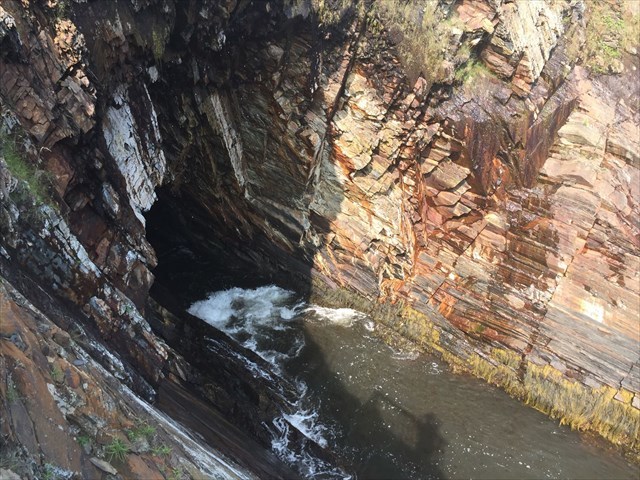
In some places, a blowhole might be formed. This can either be a hole in the roof of the cave to allow the force of the waves to be released as a jet of spray or alternatively, a cave that is partially submerged can expel large amounts of sea water as air compressed by the water rapidly expands and propels the retreating surf into the sky. There are reports of the spray reaching up to 80 feet in height here when the conditions are just right and there are many photos capturing this phenomenon.
The walls of these sea caves are rough and irregular, as the slate is eroded and fractured off piece by piece. In the picture below you can see a baby cave being formed beside the cave on the left.
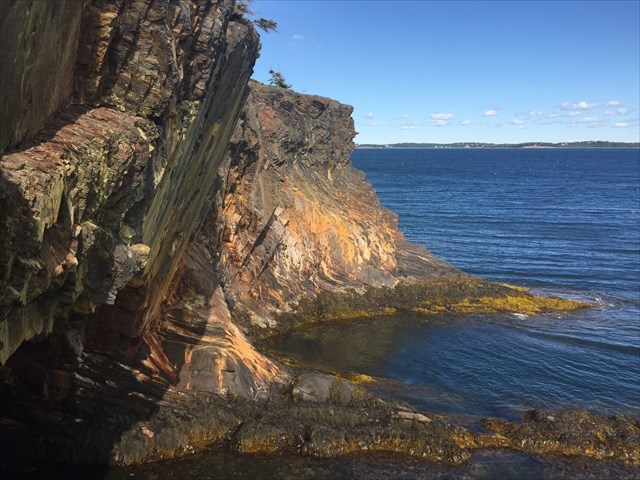
Littoral caves can be formed in many different types of rock, ranging from sedimentary to metamorphic to igneous, but caves formed in igneous rock tend to be larger due to its greater strength. The cliffs around the Ovens are comprised of metamorphic slate which contain seams of quartz, some of it hiding gold.
The Gold Rush
Gold was discovered here on June 13, 1861 resulting in an instant gold rush. Within a month a town of 600 people sprung up and 82 shore claims were worked along Cunards Beach. Shore lots sold for as high as $4,800. At the peak of the rush, the town was home to over a thousand miners and there were hotels, stores and even a bank. Within 3 years though the boom was over and the town only lasted 6 years but a small refining operation continued until the 1920’s. Gold panning along the shore still continues today.
To log this Earthcache, e-mail answers to the following questions to the cache owner.
Question 1: To answer this set of questions, please go to the coordinates for the virtual stage of this earthcache.
- What kind of stones are found here?
- What were these stones used for?
Question 2: To answer this next set of questions, please go to the reference point for Tucker's Tunnel
- How wide is the sea cave which Tucker's Tunnel leads to?
- Describe the type of rock on the walls of the tunnel in terms of texture and appearance.
- Is this rock igneous, sedimentary or metamorphic?
Question 3: From June until December 1861, the Ovens yielded how much in gold?
Question 4: How did Cannon Cave get its name?
Question 5. Optional - feel free to post a picture of you or your GPSr near any of the sea caves. Please do not include a picture of the interpretive signs though.
Logs will be deleted if an e-mail containing the correct answers isn't received within 1 week. Also, please be respectful of the area when you are visiting. Thanks!! I hope you will enjoy your visit to the Ovens and also learn something in the process!
Acknowledgements:
Thanks goes out to the management and staff of the Ovens for approving this earth cache!
References:
“Sea Caves.” Ovens Natural Park, www.ovenspark.com/.. N.p., n.d. Web. 04 Oct. 2017.
"Cliff Trail Interpretive Tour" [Brochure]. (n.d.) Nova Scotia.: The Ovens Natural Park.
The Editors of Encyclopædia Britannica. “Sea Cave.” Encyclopædia Britannica, Encyclopædia Britannica, Inc., 7 Aug. 2009, www.britannica.com/science/sea-cave.
"Sea Cave." Wikipedia. Wikimedia Foundation, n.d. Web. 08 Oct. 2017.
