Dartmoor National Park has a wealth of mining heritage including tin, copper, silver, lead and more recently uranium. Tin is of course the most well known of these mined natural resources, with the history of extraction dating back thousands of years.
This EarthCache focuses on the Ramsley copper mine, also referred to as 'Emily Mine' on the 19th century Ordnance Survey map (c. 1880s). Extraction started in the site at 1850 AD until it was finally closed in 1909 AD. The mine was a vital source of income for the area, and the local workforce, with the decline of the Devon cloth industry had led to hard times. The mine shaft was build on the steep hill side, and burrowed into hill side. This mine shaft into the hill side was protected with a retaining wall. On the site there were several ancillary buildings used for the extraction and refinement of the copper ore mined, these include a number of surviving building footings and the impressive chimney stack at the posted coordinates. To feed the mine with water a leat was constructed taking water from the Blackton Brook just east of Shilley Pool.
The site was originally powered by a 50 foot diameter water wheel, which was used to pump water from the mine. In the late 1800's steam powered engines were added to the site providing extra power. To the west of the chimney, and the other surviving buildings, there are extensive spoil heaps from the extracted material. This is a mixture of the processed material and other rocks that were extracted to get to the copper lodes. The spoil heaps are rich in arsenic and this means that little will grow on them giving good views of the material making up the spoil heaps.
At this site there are two main rock types that can be seen. One of these is used in for building material, and is not the underlying geology of the site, and the second is found in the spoil heaps, and is the material extracted from underground by the mining techniques. These are the descriptions of the two types of rocks.
Granite is a light coloured rock and can occur in different colours, including grey (the most common colour) and reddish grey. It contains crystals, largely made up of quartz like material, that are large enough to be visible to the naked eye. The composition of granite is largely quartz (can look almost glassy), feldspar crystal (commonly white or pink), mica (small black flecks) and other minerals.

Mudstone, as its name suggests, is stone that is formed on material that used to be mud. They form when fine, clay like, particles are deposited in water. It is a very fine grained rock that is usually black or dark grey-brown in colour. It is often relatively soft and crumbly for a stone. The clay particles that form these rocks are smaller than 0.05 mm and cannot be seen by the naked eye. This gives mudstone the appearance of being smooth, as rocks go, both in appearance and feel.

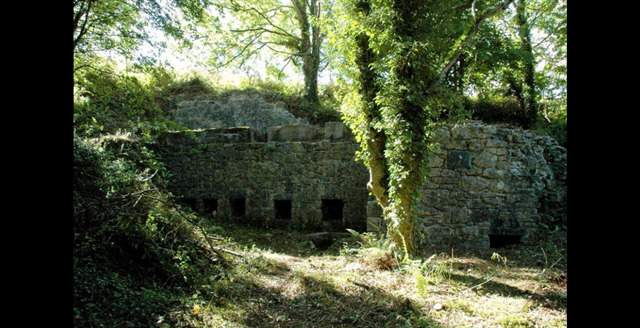
One of the ancillary buildings
The Extraction Process
About two thirds of the copper found on Earth is found in igneous (volcanic) rocks, with a further quarter occurring in sedimentary rocks. Within these rocks the material is found in 'lodes', which are veins of metal ores. Mines would common find these lodes and then chase them for as long as they were deemed to be economically viable. The lodes that were worked at this mine were brought closer to the surface by the Sticklepath Fault, which runs from the north to the south coast of Devon. The rock containing the copper would be removed by hand and brought to the surface. Once above ground the rock then started the extraction process to remove the precious copper from the waste rock material.
The first step in this processing is the crushing of the rocks and ore. This was done by a combination of crushing by hand by the labourers and water or steam power stamps. Initially the ore would have been roughly crushed by the labourers, a process called spalling.
After spalling the ores were washed and sorted by hand. This job required both high levels of concentration and knowledge and was often a job performed by the younger women/girls.
The selected and washed ores would them undergo two further breaking down. The first of these was performed by the 'Cobbers'. They would break down the ore into pebble sized pieces using short handed hammers. After this the 'Buckers' would use flat-faced hammers to grind the cobbed ore into fine powder.
In cases where either the ore was of very poor quality of particularly difficult to work with mechanical stamping would have replaced much of the hand crushing of the ore. This was achieved by both water, and later, steam powered stamps that stamped the ores against mortar stones. On Dartmoor these mortar stones were commonly made from granite, as it is resilient to ware and also readily available. A large number of these mortar stones are known to still exist on Dartmoor, sometimes being found in unusual locations such as reused in walls.
The final process in extracting the copper from the ore is smelting. Smelting of copper requires the heating of the copper ore to a sufficient temperature, 1100 to 1200°C. The reducing atmosphere created, which is rich in carbon monoxide rather than oxygen, changes the copper compounds to metallic copper. The waste material from this process is called slag, and often looks like cooled molten material. This, along with rocks displaying burning are commonly found in spoil heaps at mine sites where smelting has occured.
To log this EarthCache go to the posted coordinates and the spoil heap waypoint and send me a message or email answering these following questions. I have also added two other reference points for interesting things along the route, these do not need to be visited/stopped at to complete this EarthCache
1) Look at the chimney, what materials have been used to construct it, not including any cement/mortar?
2) What can be found at the base of the chimney on the western side?
Go to the spoil heap waypoint
3) Describe what materials (such as rock type) make up the spoil heaps.
4) Is there evidence for smelting occurring at Ramsley Mine, and if so describe them.
5) Estimate how steep the slopes of the spoil heaps are down the hill to the west.