HERITAGE VALUE
The cemetery grounds, which include some of the oldest trees in Wolfville, consist of several grass-covered interment areas, and separate family burial plots enclosed with stone pillars and iron links. The cemetery’s large grounds and mature trees provide a quiet oasis on one of Wolfville’s busiest streets. The land, grave stones, wall and fence are included in the municipal designation.
The Old Cemetery is valued for its spiritual and cultural significance to the town of Wolfville, with its carved tombstones providing additional historic and artistic value. In essence, the cemetery serves as a record of the lives of the diverse townspeople who have lived in Wolfville since the town was founded. The gravestones signify an enduring association with the past by displaying the epitaphs, symbols, and carvings that chart over two centuries of spiritual life in the community.
The earliest cemetery in Wolfville and the only burial ground available to citizens until 1818, the Old Cemetery interred people from all denominations. The earliest tombstone dates to 1774, and among the people interred in the cemetery are: Nathan DeWolf (1729-89), the founder of Wolfville; Peter Bishop (1736-1825), the first minister of the Wolfville Baptist Church; Professor Isaac Chipman, the builder of Acadia University; and Rev. Edmund Albern Crawley (1799-1888), the founder-in-chief of Acadia University, one of its first two professors, and the designer of the first college building.
The cemetery is also valued for the primitive folk art designs found on many gravestones, some of which showcase the work of the Horton Carver (fl. 1783-1793), who is said to have been Scottish stone carver James Hay. Many of his sandstone grave markers are unique to the Horton-Wolfville area.
Types of Grave Markers
Footstones/Markers- In early times sometimes just a small marker was used to denote a grave or planting a tree or shrub. They would have been made out of minerals like slate or other stones that were locally available at the time.
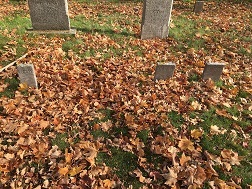
Fieldstones or earthstones- The earliest markers for graves were natural fieldstone, some unmarked and others decorated or incised using a metal awl. Typical motifs for the carving included a symbol and the deceased's name and age.
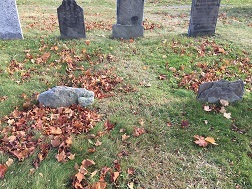
Granite- Granite intrusive igneous rock, which is formed when magma cools and solidifies under the earth's surface. The rock is composed of a mixture of feldspar, mica and quartz. The colour of the granite will depend on the colour of the components. Feldspar may range from pink, through brown to green. A hard stone and requires skill to carve by hand. Modern methods of carving include using computer-controlled rotary bits and sandblasting over a rubber stencil. Leaving the letters, numbers and emblems exposed on the stone, the blaster can create virtually any kind of artwork or epitaph.
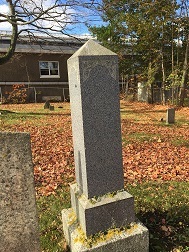
Marble- is a metamorphic rock that forms when limestone is subjected to the heat and pressure of metamorphism. It is composed primarily of the mineral calcite (CaCO3) and usually contains other minerals, such as clay minerals, micas, quartz, pyrite, iron oxides, and graphite. Under the conditions of metamorphism, the calcite in the limestone recrystallizes to form a rock that is a mass of interlocking calcite crystals. A related rock, dolomitic marble, is produced when dolostone is subjected to heat and pressure.
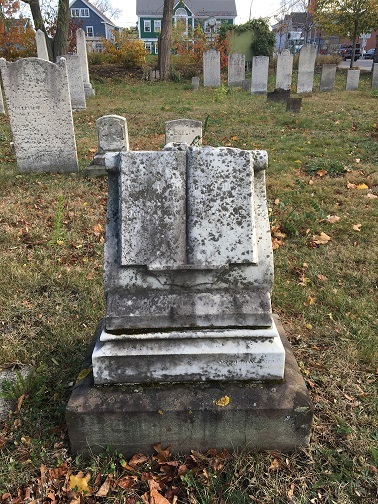
Limestone is a sedimentary rock composed largely of the minerals calcite and aragonite, which are different crystal forms of calcium carbonate (CaCO3). Most limestone is composed of skeletal fragments of marine organisms such as coral, forams and molluscs.
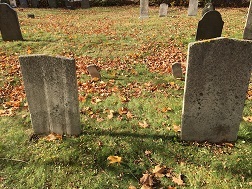
SANDSTONE- Sandstone is durable, yet soft enough to carve easily. Some sandstone markers are so well preserved that individual chisel marks are discernible, while others have delaminated and crumbled to dust. Delamination occurs when moisture gets between the layers of the sandstone. As it freezes and expands the layers flake off. Sandstone (sometimes known as arenite) is a clastic sedimentary rock composed mainly of sand-sized minerals or rock grains. Most sandstone is composed of quartz and/or feldspar because these are the most common minerals in the Earth's crust. Like sand, sandstone may be any color, but the most common colors are tan, brown, yellow, red, gray, pink, white and black. Since sandstone beds often form highly visible cliffs and other topographic features, certain colors of sandstone have been strongly identified with certain regions.
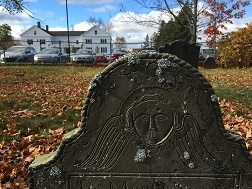
SLATE- Slate can have a pleasing texture but is slightly porous and prone to delamination. It takes lettering well, often highlighted with white paint or gilding. It is popular because of it durability and attractive appearance. Slate is a fine-grained, foliate metamorphic rock that is created by the alteration of shale or mudstone by low-grade regional metamorphism.Slate is composed mainly of clay minerals or micas, depending upon the degree of metamorphism to which it has been subjected. The original clay minerals in shale alter to micas with increasing levels of heat and pressure. Slate can also contain abundant quartz and small amounts of feldspar, calcite, pyrite, hematite, and other minerals.
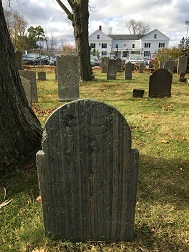
Iron grave markers and decorations were popular during the the Victorian Era in the United_Kingdom and elsewhere, often being produced by specialist foundaries or the local blacksmith. Cast iron headstones have lasted for generations while wrought ironwork often only survives in a rusted or eroded state.
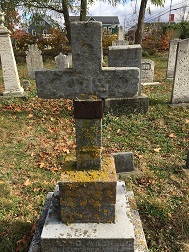
White Bronze- Actually sand cast zinc, but called white bronze for marketing purposes. Almost all, if not all, zinc grave markers were made by the Monumental Bronze Company of Bridgeport, CT, between 1874 and 1914. They are in cemeteries of the period all across Canada. They were sold as more durable than marble, about 1/3 less expensive and progressive.
Weathering:
Weathering is the breakdown of rocks via the environment. Weathering can happen in 3 different ways:
1. Chemical weathering – e.g dissolution by acid rain. Chemical reactions break down the bonds holding the rocks together, causing them to fall apart, forming smaller and smaller pieces. Chemical weathering is much more common in locations where there is a lot of water. This is because water is important to many of the chemical reactions that can take place. Warmer temperatures are also more friendly to chemical weathering. The most common types of chemical weathering are oxidation, hydrolysis and carbonation.
2. Mechanical weathering - e.g. freeze thaw action .Takes place when rocks are broken down without any change in the chemical nature of the rocks. The rocks are essentially torn apart by physical force, rather than by chemical breakdown. The forces that break rocks down can be numerous, and include such things as pent up energy as the Earth’s crust slowly moves. When great amounts of pressure build up, the resulting mechanical effect can be that very large joints, or faults are created.The most common type of mechanical weathering is the constant freezing, and thawing of water. In liquid form, water is able to penetrate the many holes, joints, and fissures within a rock. As the temperature drops below 32 ° F, this water freezes. As water freezes, it expands, becoming about 10% larger than it was in liquid form. The result is that the holes and cracks in rocks are pushed outward. Even the strongest rocks are no match for this force.
3. Biological weathering – e.g lichen growth. The word ‘bio’ means life. Thus biotic weathering is any type of weathering that is caused by living organisms. Most often the culprit of biotic weathering are plant roots (from lichen, moss etc). These roots can extend downward, deep into rock cracks in search of water, and nutrients. In the process they act as a wedge, widening and extending the cracks.
To log this Earthcache visit the cemetery and enjoy wandering about. It is a nice place in the midst of town. Caution is always used while in cemeteries. Restoration work is on going here at present. Please answer the following questions and send in a timely manner to my profile or email.
1.Upon entering the fenced in cemetery look to the left and note the large monument by the tree. Estimate how tall it is and what do you think it is made of? What is the date on this one and is there a lot of weathering or lichens present.
2. On the right side when entering there a marker with an open book. Do you think part is made of Marble and is it fairly smooth?
n45 05.483 w064 21.891
3. Near to this one you will see a monument with a cross on it with iron around the cross. Note types of stone and how many kinds of stone make this one.
4. Are you still able to read the sandstone grave markers from 1700's?
5. Why might they have decided to use sandtone as a headstone?
6. [REQUIRED] In accordance with the updated guidelines from Geocaching Headquarters published in June 2019, photos are now an acceptable logging requirement and WILL BE REQUIRED TO LOG THIS CACHE. Please provide a photo of yourself or a personal item here to prove you visited the site.