Groundwater Bore
The first comprehensive groundwater bore database was assembled by the Geological Survey of Victoria (GSV) in the late 1960s, with the introduction of the Groundwater Act 1969. Up until the mid 1980s the bore locations were plotted on mapsheets and the individual bore records kept in hardcopy. From the mid 1980s onwards a digital database, compiled from the existing records of all Government bores and private bores, was progressively assembled on mainframe computers. From 1969, a permit to drill groundwater bores was required, and the information captured by the licensing process was added to the database. This included groundwater investigation or observation bores drilled by other government agencies such as the State Rivers and Water Supply Commission (SRWSC) and the Soil Conservation Authority (SCA) and subsequent equivalents, although these agencies also kept their own bore databases.
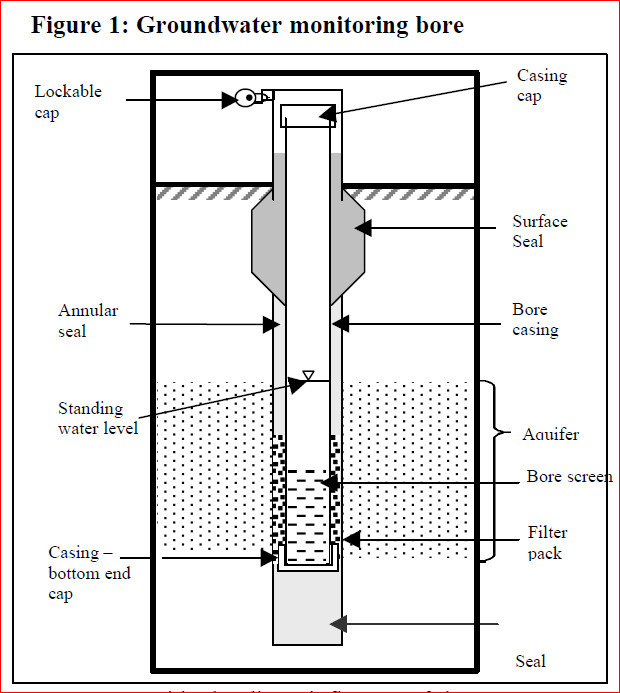
Source: "History of groundwater bore data", VVG
Water Quality Index
Water quality of any specific area or specific source can be assessed using physical, chemical and biological parameters. The values of these parameters are harmful for human health if they occurred more than defined limits. Therefore, the suitability of water sources for human consumption has been described in terms of Water quality index (WQI), which is one of the most effective ways to describe the quality of water.
Figure 1: Rating of Water Quality
|
WGI Value
|
Rating of Water Quality
|
Grading
|
|
21.005
|
Excellent water quality
|
A
|
|
37
|
Good water quality
|
B
|
|
53.078
|
Poor water quality
|
C
|
|
76 – 100
|
Very Poor water quality
|
D
|
|
143
|
Unsuitable for drinking purpose
|
E
|

***Congratulations to chooknchunk on FTF***