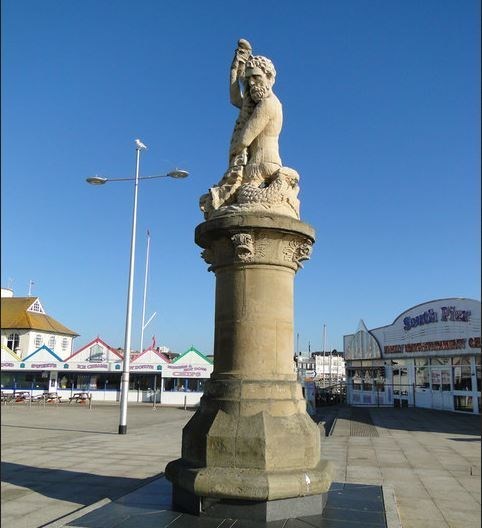
Bath Stone Triton
. . .
. . .
The meaning with this earthcache is to get to know the bath stone a little better, an Oolitic Limestone.
. . .
Limestone is a sedimentary rock comprising at least 80% calcium carbonate (CaCO3). Limestones can be deposited in both marine and fresh water environments, the former being more common, and can take many forms such as described below.
. . .
As mentioned the Bath Stone is a type of limestone, and it is one of many limestone formed during the Jurassic Period. Limestone is a part of the bedrock, the ancient superficial deposits to be found on the surface of the earth across the United Kingdom.
. . .
. . .
And Portland is just one of its famous oolitic limestone relatives and, like Portland, Bath has given its name to a stage of Geological time known as the *Bathonian. The area we now call Bath was earlier under shallow sea water. Slowly and over time tiny grains of calcium carbonate rolling around on the bottom of the sea began to pick up layers of lime, it started to grow in size and got more and more compact together. Over the next 150 million years (approx), pressure from mounting layers of sediment caused those grains to form the namesake limestone that the area is widely renowned for today.
* In the geologic timescale the Bathonian is an age or stage of the Middle Jurassic. It lasted from approximately 168.3 Ma to around 166.1 Ma. The Bathonian age succeeds the Bajocian age and precedes the Callovian age.
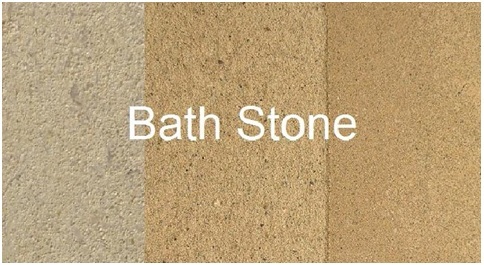
The egg-shaped ooliths in Bath Stone are typically relatively large, imparting a visibly coarse texture to much of the stone. The matrix typically comprises coarsely crystalline calcite or ‘calcite spar’, which results in a closed, dense texture. Oolitic limestone is a carbonate rock made up mostly of ooliths (or ooids) which are sand-sized carbonate particles that have concentric rings of CaCO 3. **Oolites consist of ooids of diameter 0.25–2 mm. Rocks composed of ooids larger than 2 mm are called pisolites. They frequently contain minute fragments of shell or rock, and sometimes even decayed skeletons of marine life.
** Oolite or oölite (egg stone) is a sedimentary rock formed from ooids, spherical grains composed of concentric layers.
The oolitic structure of Bath stone and its sparry calcite matrix are not strongly bound to one another and when the stone is fresh with a bit of moisture (or ‘quarry sap’) it is relatively soft. Thus it could be cut from the ground using hand picks and saws efficiently enough to make it a viable building material. Like the statue base that you see here at gz.
. . .
To log this cache.
To get to log this cache you will have to visit and answer the questions which are related to the coordinates given the earthcache.
When answers are collected, send them to CO for verification. I will accept answers sent via email or through the Message Centre.
You can log immediately answers are sent CO. If there are any questions about your answers CO will contact you.
Logs without answers to CO or with pending questions from CO will be deleted without any further notice.
Please do not include pictures in your log that may answer the questions.
. . .
Questions
1. Answer the questions under by visiting the Coordinates.
A. Describe the surface and the texture of the stone, what color is it? (light/medium colored/dark). And can you say anything about its origin? What conclusions can you deduce from your observations?
B. Why do the stone have pitted holes in its surface?
C. What percentage of calcium carbonate would you say is comprising in a sedimentary Limestone?
D. What period of time does the displayed Limestone come from? (Use the diagram above from the cache text, and pick your answer from the right hand side, saying: Period.)
2. (It’s voluntary to post a photo from your visit.)
