The Wish, Stone Sofa
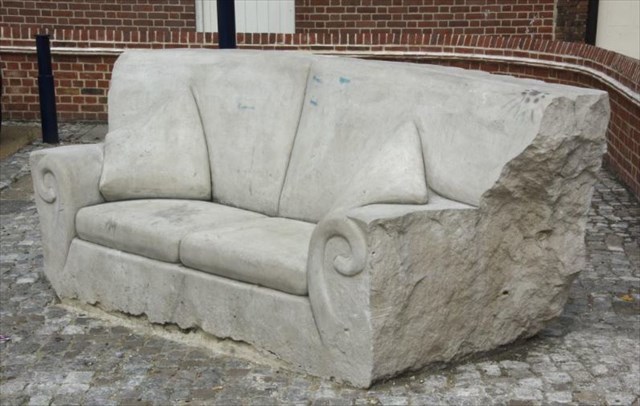
At GZ you will see that the spaces are filled with three major sculptural projects. The three steel wishbone/hooks are set within one circle facing inwards with the pair of herring baskets to one side in another separate space. The herring baskets are unique to Great Yarmouth (swills) and were cast from replicas (including a number of breaks) by a local basket maker-Terry Bensley. The limestone armchair stands at an angle to the line of the main path through from South Quay.
(More information on the art further down. BUT first the earth lesson.)
Sedimentary Rocks
Approx 75% of the Earth’s continental crust is covered by sedimentary rocks. Sedimentary rocks form from other rock particles like igneous, metamorphic or sedimentary. When weathering, surroundings, chemical or physical mechanisms into smaller particles the parent rock undergoes. These particles are transported by ice, air or water. Deposition takes place as a result of a lowering of energy, organic biochemical activity or chemical changes.
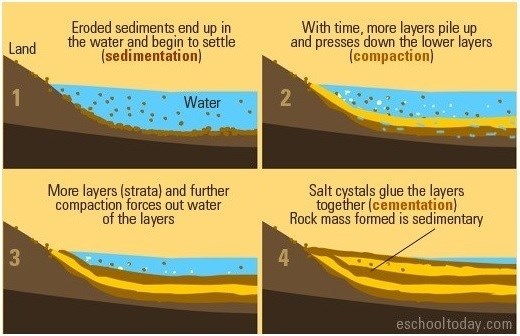
Once deposited, the sediments over time, are lithified or said easier turned into rock through compaction by decrease in rock volume due to the weight of overlying sediment and cementation (chemical precipitation in pore spaces between grains which "glues" the rock together). The primary mineralogical and textural characteristics of the rock can be modified as the sediments are buried deeper in the earth's crust and undergo an increase in both temperature and pressure. These low-pressure, low-temperature changes are termed diagenesis.
Portland stone
Portland stone From the Tithonian stage of the Jurassic period quarried on the Isle of Portland, Dorset you will find the limestone that is named Portland Stone. Here the quarries consist of beds with white-grey limestone separated by chert beds. This stone has been used for buildings throughout the British Isles, and at well known places such as St Paul's Cathedral and Buckingham Palace. It has also found its way out worldwide. This Portland stone is used in the United Nations headquarters building in New York City for example.
Portland Stone has formed in a marine environment. Mainly on the floor of a shallow, warm, sub-tropical seas, and probably near land evidenced by the fossilized driftwood. When the seawater is warmed up by the sun, the capacity to hold dissolved gas will be reduced, consequently dissolved carbon dioxide (CO2) is released into the atmosphere as a gas. Calcium and bicarbonate ions within the water will then be able to combine, to form calcium carbonate (CaCO3) as a precipitate. The process of lime scale build up in a kettle in hard water areas is similar to this. Calcium carbonate is the principal constituent of most limestones. Billions of minute crystals of precipitated calcium carbonate (called calcite) accumulated forming lime mud called micrite which covered the sea floor. Small particles of sand or organic detritus, like shell fragments, formed a nucleus, which became coated with layers of calcite as they were mixed and rolled around in the muddy micrite. The calcite gradually accumulated (by accretion) around the fragments of shell in concentric layers, forming small balls of less than 0.5 mm diameter. This is a similar way as having a snowball growing in size while it rolling around in the snow. Over time, countless billions of these balls, known as "ooids" or "ooliths" (from Greek meaning "egg-shaped" or "egg-stone"), became partially cemented together or lithified by more calcite, to form the oolitic limestone we now call Portland Stone. Fortunately, the degree of cementation in Portland Stone is such that the stone is sufficiently well cemented to allow it to resist weathering but not so well cemented that it can't be readily worked (cut and carved) by masons. This is one of the reasons why Portland Stone is so favoured as a monumental and architectural stone.
To log this cache.
To get to log this cache you will have to read the cache text and visit the coordinates given. After that you will have to answer the questions which are related to the text and the coordinates given.
When answers are collected, send them to CO for verification. I will accept answers sent via email or through the Message Centre.
You can log immediately after answers are sent the CO. If there are any questions about your answers CO will contact you.
Logs without answers to CO or with pending questions from CO will be deleted without any further notice.
Please do not include pictures in your log that may answer the questions.
Questions
1. Answer the questions under by visiting the Coordinates.
A. How many million years ago was it formed in the shallow seas?
B. Describe the texture and color of the stone and its surface.
C. Are there any fossils to be spotted in the stone? If so, where, and what do they look like?
D. Optional: Sit down, have a rest and relax.
2. Take a photo of yourself, the group or your GPS when logging the cache.
Without revealing any answers!
(It’s voluntary to post a photo in your online log)
The Wish, Stone Sofa, and the art area around.
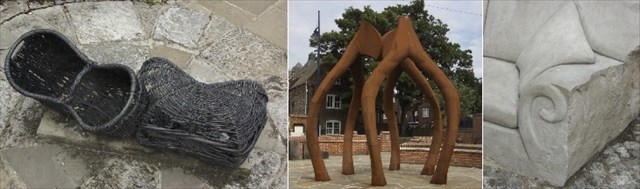
Long notice by Alison Atkins outlining the evolution of the hooks, now described as the Wish because of their resemblance to wishbones, and their relationship to Great Yarmouth's fishing past is set on an inside wall.
The derelict space has been turned into a well designed small urban park whose low curved brick walls create a series of spaces between the planting. It serves to link the Nelson Museum on South Quay with the Rows. The spaces are filled with three major sculptural projects. The three steel wishbone/hooks are set within one circle facing inwards with the pair of herring baskets to one side in another separate space. The herring baskets are unique to Great Yarmouth (swills) and were cast from replicas (including a number of breaks) by a local basket maker-Terry Bensley. The limestone armchair stands at an angle to the line of the main path through from South Quay. Young offenders from the area helped produce it; unfortunately (March 2015) this had not, as hoped, prevented vandalism
The site was derelict as a result of being bombed in 1943 and underwent a complete transformation completed by and retained the design retains the footprint of the original medieval rows. The scheme involved young offenders (13-18) who helped to carve the stone sofa and kept a video record of the project.
