SSC#5: Martello Tower #2 - Design & Construction
This is the 5th cache of a 9-cache circuit hidden on the lower slopes of Simonsberg (548m), the northernmost peak of the Swartkop Mountains range which runs from Simon’s Town to Smitswinkel. The caches form a potential 4km circuit on a mix of good tar road, stony sandy jeep tracks, sandy/rocky trails and steep indistinct gravelly/bushy trails marked by occasional cairns. The D/T ratings reflect the shortest route to the cache. Remember this is snake country so watch out where you put your feet and use a hiking stick to prod ahead as necessary.
The cache, one of three based on this historical building, is a small camo-taped tablet pot hidden at this shady grove of trees giving a rare direct line of sight to the Simon's Town Martello. It should be pretty easy to spot the tower tucked amongst the other naval buildings -being the only circular one.
It was hidden in recognition of SLAIN's cache GC5A7FF Martello Tower hidden on 5/8/14 and archived on 10/1/16 after some 26 finds.
To reach the cache location: a) turn south off Runciman Drive at park at S 34 11.719 E 18 26.315 onto Harbour Heights Drive and follow this up and around to the end and park in the off-road space available at S 34 11.814 E 18 26.444. Walk the small distance up to the tarred path and follow this west up to the cache location, or b) park at the end of Dorian at S 34 11.803 E 18 26.552 at the end of Dorian Close. From here simply follow the tarred track past the barrier (and past the location of GC7FJKK Martello Tower Redux #1: Origins – see also for waypoints) up to the cache.
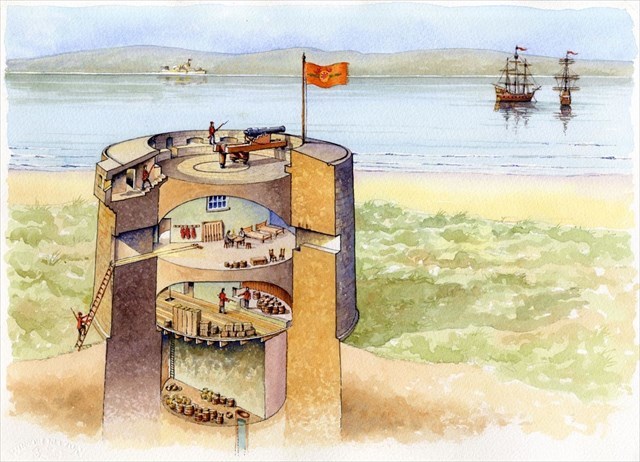
The towers were up to 12m high and 12-15m in diameter with walls about 2.4m thick. In some locations, where a cannon attack from the land side was thought very unlikely, rooms were not built in the centre, but more to the landside, allowing thicker walls on the sea side.
Entry was by removable ladder to a door about 3-4m from the base above which was a machicolated (slotted) platform which allowed for downward fire on attackers. The flat roof or terreplein had a high parapet and a raised platform in the centre with a pivot (sometimes a converted cannon) for a cannon that would traverse a 360° arc. Some towers were designed to carry more than one gun, with each having a more limited arc of fire. The walls had narrow slits for defensive musket fire.
 The interior of a classic British Martello tower consisted of two storeys (sometimes with an additional basement). The ground floor served as the magazine and storerooms, where ammunition, water, stores and provisions were kept. The garrison of 15-25 men and one officer lived in a casemate on the first floor, which was divided into several rooms and had fireplaces built into the walls for cooking and heating. The officer and men lived in separate rooms of almost equal size.
A well or cistern within the fort supplied the garrison with water and an internal drainage system linked to the roof enabled rainwater to refill the cistern.
See here and here for more fascinating info on the towers (including their history and location around the world) and on the 'oldest' one at Simon's Town.
See here for a photo blog on a mission to visit every remaining Martello tower on the south coast of England in 2 days.
The Martello Towers built around the world are in one of four conditions: a) completely disappeared (eg. ruined/demolished and removed) b) present but in some state of ruin (either abandoned completely or as a stabilised ruin to prevent further deterioration c) restored to more or less original condition (such as the one in Simon's Town) d) restored and converted into another use - such as a dwelling (see opposite or in the Gallery for photos of an award-winning conversion in Suffolk, England).