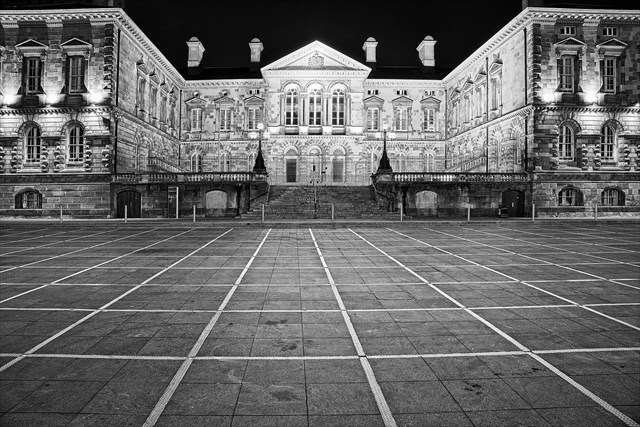
The Customs House was built in 1857 and, like many buildings constructed in the 19th century, was designed by architect Charles Lanyon in the Italianate style. Up to the 1950s, the front steps served as Belfast’s Speaker’s Corner.
Types of Rock
Igneous rocks are formed when hot magma from volcanoes cools down. The grain size of igneous rocks depends on the speed at which the magma cooled: slower cooling leads to larger grains.
Sedimentary rocks are formed very slowly over millions of years when sediments (tiny pieces of rocks and animal skeletons) are pushed together underwater. Some sedimentary rock contains fossils.
Metamorphic rocks are formed when igneous or sedimentary rocks are altered due to heat or pressure.
Glasgow Freestone
The building’s primary stone is Giffnock Sandstone, also known as Glasgow Freestone. This is a sandstone formed during the Carboniferous, the geologic period that spans 60 million years from around 358.9 million years ago to 298.9 million years ago. During this time, Scotland,much like Ireland, was located close to the equator and experienced tropical conditions.
During this time, muds, sands and silts were deposited in river deltas. These deposits were pushed together in layers and eventually formed Giffnock Sandstone. The name Glasgow Freestone comes firstly from the region of Scotland it originates. The ‘freestone’ part comes from its uniformity of texture, which often sees it used in carved detailing on buildings. Quarrying of the stone was ended in the late 19th century.
Giffnock Sandstone is generally fine to medium-grained and is light in colour, with darker grains visible. Weathering can lead to oxidation of iron minerals that can be present in the surface, which results in a rust-brown layer. If this layer is broken, the underlying stone can decay quite rapidly.
To log this earthcache, please send me answers to the following questions, via the message center:
1. Given the above description of Glasgow Freestone’s formation, is this rock type igneous, metamorphic or sedimentary?
2. Do you see signs of weathering on the building? Where?
3. Do some parts of the building appear more weathered than others? Please compare two places.
4. Why do you think this is?
5. According to the information sign, up to how many people would come to listen to Jim Larkin speak?
Please do not wait to log your find. I will contact you if there is any problem with your answers.
Happy EarthCaching!