Melbourne has a long history with trams dating back to the late 1800's right through to present day. During that time there has been a lot of changes but the service just kept getting better.
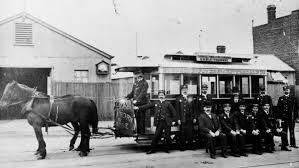
Horse trams.
Melbourne's first tram was a horse tram from Fairfield railway station to a real estate development in Thornbury; it opened on 20 December 1884, and was closed by 1890. Seven horse tramlines operated in Melbourne.
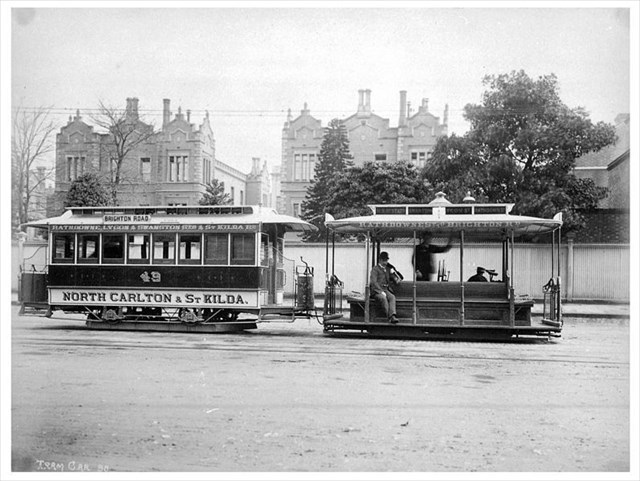
Cable trams.
Melbourne's cable tram system has its origins in the MTOC, started by Francis Boardman Clapp in 1877, with a view to operate a Melbourne tram system. After some initial resistance, he successfully lobbied the government who passed the Melbourne Tramway & Omnibus Company Act 1883 on 10 October 1883, granting the company the right to operate a cable tram system in Melbourne. Although several lines were originally intended to be horse trams, and the MTOC did operate three horse tram lines on the edges of the system, the core of the system was built as cable trams.
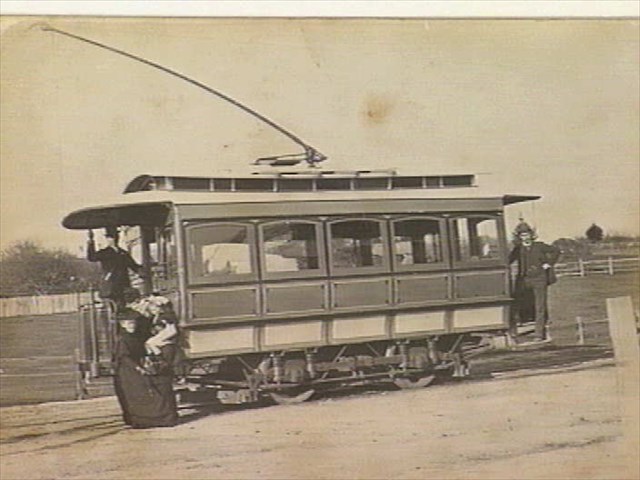
First electric trams.
The first electric tram in Melbourne was built in 1889 by the Box Hill and Doncaster Tramway Company Limited—an enterprise formed by a group of land developers—and ran from Box Hill railway station along what is now Station Street and Tram Road to Doncaster, using equipment left over from the Centennial International Exhibition of 1888 at the Royal Exhibition Building. The venture was marred with disputes and operational problems, and ultimately failed, with the service ceasing in 1896.
After this venture failed, electric trams returned on 5 May 1906, with the opening of the Victorian Railways Electric Street Railway Electric Street Railway from St Kilda to Brighton, and was followed on 11 October 1906 with the opening of the North Melbourne Electric Tramway & Lighting Company (NMETL) system, which opened two lines from the cable tram terminus at Flemington Bridge to Essendon and Saltwater River (now Maribyrnong River).
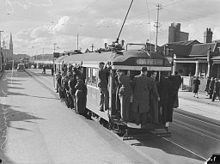
Melbourne & Metropolitan Tramways Board.
The Melbourne & Metropolitan Tramways Board (MMTB) was formed in July 1919 to take control of Melbourne's cable tram network, six of the seven electric tramway companies, and the last horse tram. By 1940, all cable and horse tram lines had been abandoned or converted to either electric tram or bus operation.
Metropolitan Transit Authority and Public Transport Corporation.
The MMTB, along with the metropolitan railway assets of VicRail, were absorbed into the newly formed Metropolitan Transit Authority (MTA) on 1 July 1983, while the regional assets of VicRail were absorbed by the State Transit Authority (STA). The MTA was formed to co-ordinate and operate the Melbourne public transport system, during 1986–87 an integration of rail, tram and bus divisions took place, with the operations, maintenance and administration of these departments fully integrated by 11 April 1988.
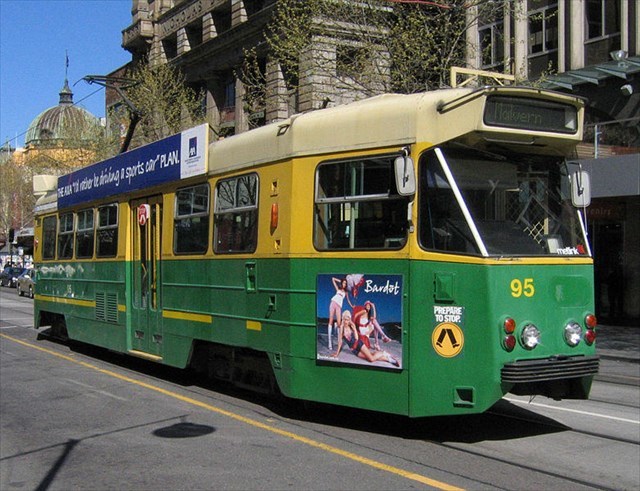
The MTA introduced a new green and yellow livery and uniform design, with a new logo, showing the integration of Melbourne's public transport system, replacing the MMTB logo, and introduced a new time-based integrated ticketing system, for all modes of Melbourne's public transport.
An Automatic Vehicle Monitoring system was introduced in 1985, improving communication with drivers and allowing tracking of trams throughout the network. This reduced tram bunching and improved reliability of tram services.
Recent
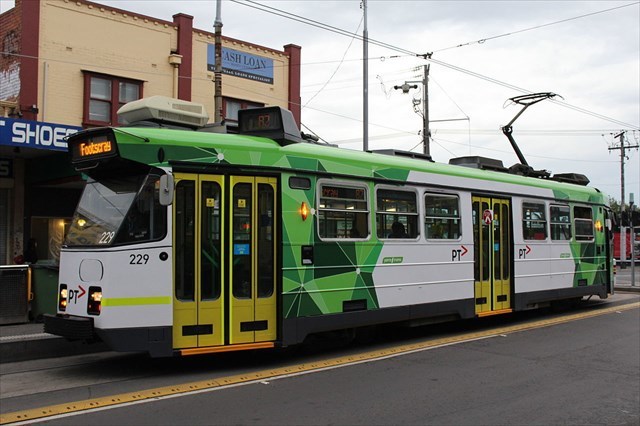
A part of the privatisation process, franchise contracts between the state government and both private operators included obligations to extend and modernise the Melbourne tram network. This included acquiring new tram rolling stock, in addition the existing tram fleet was refurbished. Swanston Trams (M>Tram) introduced 59 new Combino (D-class) low-floor built trams by Siemens, at a cost of A$175 million, and invested approximately A$8 million in refurbishing their fleet, while Yarra Trams introduced 36 Citadis (C-class) low-floor trams from Alstom, at a cost of A$100 million, and invested A$5.3 million refurbishing their fleet.
A Must Do while you are in town.
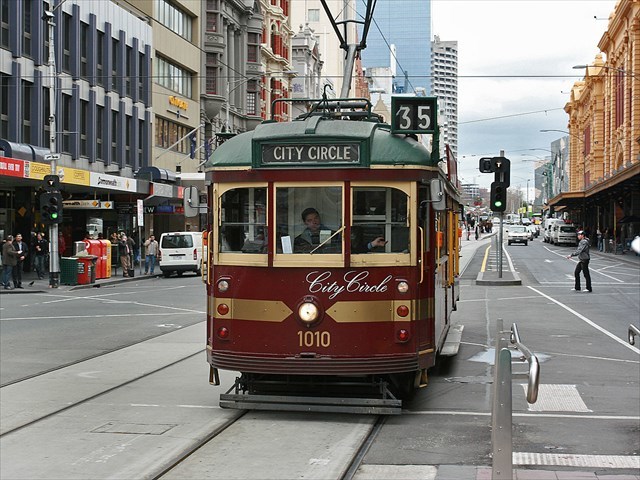
Take a ride on one of the iconic Melbourne City Circle W Class Trams.
They are free and are an excellent way to learn about the inner city via recorded tutorials.
Now for the Cache.
At this location you should be standing at the end of a tram stop. You should be looking at a yellow sign with a 30K speed restriction.
What are the only class of trams permitted to use this section of rail?
Translate the letter into a number.
This number we will call Z
A = Z
B = Z x 2 + 1
C = Z x 2
D = Z - 4
E = Z - 1
The cache is located at S37° 45.AAB E144° 58.CDE.
We hope you enjoy your visit.