Every one knows or have heard of Bourke and Wills but nothing much is said about John King who was the only one of the 4 that made it to the Gulf and survived the journey.
Robert O'Hara Burke was appointed leader of the Victorian Exploring Expedition with Landells as second-in-command. William John Wills was surveyor and astronomical observer and John King was appointed as one of the Expedition Assistants on a salary of £120 a year.
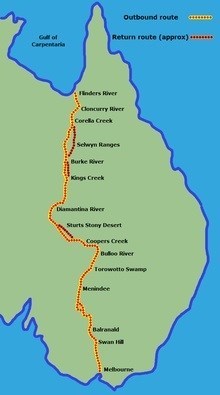
The expedition left Melbourne on Monday, 20 August 1860 with a total of 19 men, 27 camels and 23 horses. They reached Menindee on 16 October 1860 where Landells resigned following an argument with Burke. Wills was promoted to second-in-command and King was placed in charge of the camels.
Burke split the expedition at Menindee and the lead party reached Cooper Creek on 11 November 1860 where they formed a depot. The remaining men were expected to follow up from Menindee and so after a break, Burke decided to make a dash to the Gulf of Carpentaria. Burke split the party again and left on 16 December 1860, placing William Brahe in charge of the depot on Cooper Creek. Burke, Wills, King and Charley Gray reached the mangroves on the estuary of the Flinders River, near where the town of Normanton now stands, on 9 February 1861. Flooding rains and swamps meant they never saw open ocean.
Already weakened by starvation and exposure, progress on the return journey was slow and hampered by the tropical monsoon downpours of the wet season. Gray died four days before they reached the depot at Cooper Creek and the other three took a day to bury him. They eventually reached the depot on Sunday, 21 April 1861 to find the men had not arrived from Menindee and Brahe and the Depot Party had given up waiting and left just 9 hours earlier. Brahe had buried a note and some food underneath a tree which is now known as the Dig Tree.
Burke, Wills and King attempted to reach Mount Hopeless, the furthest extent of settlement in South Australia, which was closer than Menindee, but failed and returned to Cooper Creek. While waiting for rescue Burke and Wills died of exhaustion and starvation. The exact date of their deaths is uncertain, but has generally been accepted to be 28 June 1861.
King survived with the help of Aborigines until he was found on 15 September by Edwin Welch, the surveyor in Alfred William Howitt's Victorian Contingent Party. Howitt buried Burke and Wills before returning to Melbourne.
In 1862 Howitt returned to Cooper Creek and disinterred Burke and Wills' bodies, taking them first to Adelaide and then by steamer to Melbourne where they were laid in state for two weeks. On 23 January 1863 Burke and Wills received a State Funeral (Victoria’s first) and were buried in the near by Melbourne General Cemetery.
After the expedition
Edwin Welch returned King to Melbourne. When they arrived at the end of November 1861 King was hailed as a hero and mobbed by the admiring colonists of Victoria. King received a gold watch from the Royal Geographical Society and a pension of £180 a year from the Victorian Government.
He was present at the inauguration of the Burke & Wills statue on the corner of Collins and Russell Streets in Melbourne on 21 April 1865, the fourth anniversary of their return to Cooper Creek.
King lived with his sister, Elizabeth in St Kilda. Elizabeth moved to Kew and King purchased two houses on Octavia Street, St Kilda.
On 22 August 1871 he married Mary Richmond nee Bunting (aged 21) of County Tyrone (his cousin?) at the Wesley Church, Melbourne. Mary had been married and had a child, but was widowed in 1867.
King never fully recovered from the privations suffered while on the Expedition and he died prematurely of pulmonary tuberculosis on 15 January 1872 aged 33.
He is buried in the Plot Number 339, Compartment A in the Weslyan Section of Melbourne General Cemetery, not far from here.
Now for the Cache.
NOTE Parking is difficult around WP1 and we strongly suggest you use the parking coordinates and enjoy the walk to the monument.
Read the cache page information.
Head to WP 1 will have you near a magnificent old eucalyptus tree, this area would have been flourishing with these great trees back in 1860, but that is not why we are here.
Go to the nearby Memorial commemorating the start of this ill fated journey and find the Plaque that is embedded in the ground.
Q1/. The number of letters in the second work of the plaque = A
Q2/. The plot number where King is buried plus 16 = B (should be easy if you have been paying attention)
WP 2 is at S37° 45.AAA E144° 55.B
Once at WP 2 you should see another monument with some interesting information on it.
You will need to find the date the monument was presented by the mayor of Essendon.
From this date you will need to work out:-
4th number = A
3rd number minus 1 = B
3rd number = C
1st number minus 1 = D
The cache is located at:-
S37° 45.ABC E144° 52.BAD
We hope you enjoy your visit.