De visita por tierras manchegas, nuestra tierra de origen, queremos descubrir a los visitantes de esta zona uno de los mayores símbolos de Puertollano, esta Fuente Agria conocida en toda la comarca.
LA FUENTE AGRIA

Es el monumento más representativo de Puertollano. La referencia documental más antigua de esta fuente data de 1575, bajo el reinado de Felipe II. Este rey mandó redactar un documento, Relaciones Topográficas, en el que se recoge esta cita pronunciada por el Rey cuando probó las aguas de esta fuente: «esta villa tiene agua dentro della, la que ha menester para su gasto y beber, en moderada cantidad de pozos y que tiene junto a la dicha villa una fuente que se llama la Fuente Aceda porque el agua della es agria y sale la dicha agua encima de tierra hirviendo hacia arriba ordinariamente sin cesar».
Parece que en la Edad Media no había costumbre en Puertollano de beber de esta fuente, que era considerada impotable, y no es hasta la primera mitad del siglo XVII cuando empiezan a utilizarla para bebida. Había también manantiales de agua dulce de litros por minuto de caudal, o de pocos litros por segundo. Eran la Fuente de la Santa, al pie del Cerro de Santa Ana, Fuente de los Cinco Caños, Fuente del Pilar, Fuente del Prior y alguna otra. Había también un pequeño manantial de agua dulce a 20 pasos de la Fuente Agria. Sin embargo, el suministro mediante estas fuentes siempre fue deficitario, por lo que los habitantes de esta población tenían pozos de agua dulce para sus necesidades cotidianas, sin que dejase de ser el agua un problema en el abastecimiento.
En el siglo XVII el doctor Alfonso Limón Montero, natural de Puertollano, fue uno de los primeros estudiosos en hablar sobre las propiedades terapeúticas y beneficiosas del agua agria para diversas afecciones, publicando en 1697 una obra llamada Espejo cristalino de las aguas de España. Por influjo de este libro se creó en 1817 el cuerpo de Médicos Directores de aguas minerales y Balnearios de España y el uso de esta agua se generalizó, llegando a conocerse en todo el contexto nacional.

Sobre el año 1850 se publicó en Madrid un documento llamado Ensayo práctico sobre la acción de las aguas minerales que daba a conocer sus efectos beneficiosos en la salud. El prestigio alcanzado por el agua agria fue tal que en 1894 llegó a ser embotellada con el nombre de “agua acidulo alcalino-ferruginosa de Puertollano”, y siendo vendida al precio de 38 céntimos de peseta la botella, aludiendo a que su uso era beneficioso frente a afecciones crónicas, problemas intestinales o enfermedades cutáneas porque, en aquella época, se decía que la ingesta del agua agria ayudaba a activar la circulación, estimulaba el sistema nervioso y favorecía la digestión, además de ser beneficiosa para la piel.

Fuente Agria alrededor de 1900.
En el año 2008 la Fuente Agria dejó de producir agua, y aunque no es la primera vez que ocurre esto en su larga historia (ya anteriormente, por diversas razones, en 1860, 1865 y 1950 dejó de manar agua), sí es la más recordada. Se enviaron hidrogeólogos y obturadores para estudiar el problema y solucionarlo. Dicho problema se debía a que el nivel freático de Puertollano está muy próximo al suelo de edificación y la construcción de edificios de los años 70 había provocado daños en el manantial. En 1974 la demolición de la antigua plaza de toros provocó un gran anegamiento de material ferruginoso en el espacio que ocupaba dicha plaza. Posteriormente, en los años 90, la construcción del nuevo Auditorio y la remodelación de la cercana Casa de Baños menguaron la cantidad y calidad del agua.
En noviembre de 2008, con el inicio de construcción de un nuevo inmueble en la calle Ave María, muy cercana a la Fuente Agria, se produjeron nuevos problemas con la producción de agua de la fuente. Se hicieron varias plantas subterráneas para aparcamiento en dicho inmueble y empezó a menguar el caudal, hasta que en la madrugada del 11 de Diciembre de ese año dejó de manar agua. Hubo una gran polémica social en Puertollano y finalmente se replanteó este edificio con una sola planta subterránea. Desde entonces el agua sigue brotando aunque, eso sí, con menos calidad que el agua obtenida años atrás.
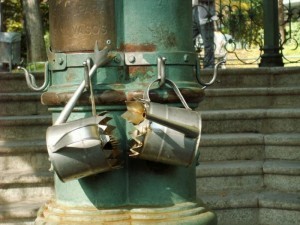
Respecto a la estructura que cobija esta fuente, originariamente la fuente no era tal, sino que se trataba de una laguna de agua roja que servía para regar las huertas. Hacía 1609 era una arqueta de madera fortalecida con otra de piedra y cal. En 1733 se encerró la arqueta en una especie de templete sólido, en el que se colocó una puerta. En 1827 se cubrió la mencionada arqueta con una tapa de madera forrada de hierro, quedando así el manantial perfectamente cerrado. Durante 1878 se proyectan las primeras grandes obras de la Fuente Agria. La caja del manantial sería de una sola pieza sobre un hexágono (posteriormente un octógono) con cuatro escalones (actualmente 9). La actual estructura o templete que podemos observar actualmente data de 1905, siendo restaurado en 1920. Típicos eran los jarros de agua para que los transeúntes pudieran degustar el agua de esta fuente con sus bordes llenos de puntas para forzar al sediento a beber a chorro del caño del jarro.
Características hidrogeológicas de la Fuente Agria
Distribuidas por toda la región volcánica del Campo de Calatrava y sus inmediaciones aparecen una veintena de manantiales y pozos llamados popularmente Hervideros, en cuyas aguas de carácter ferruginoso (contienen hierro) se desprenden burbujas de gas carbónico que proporcionan al agua su carácter ácido. Este flujo de CO2 procede de capas profundas de origen volcánico residual, representando la fase póstuma del volcanismo terciario y cuaternario que afectó a esta zona.
De todas estas peculiares manifestaciones hídricas, algunas semitermales y utilizadas como balnearios durante los siglos XIX y XX, la más famosa y conocida es esta Fuente Agria de Puertollano, situada en pleno casco histórico de esta ciudad. Se trata de una surgencia a presión que procede de la descarga bajo los depósitos miocenos del acuífero rodeado y canalizado por rocas cuarcitas del cerro de Santa Ana.
Es un manantial de agua minero-medicinal que surge a 20 º C de temperatura y tiene un caudal bastante constante de 0,5 L/s y no acusa los estiajes, lo que parece sugerir un origen relativamente lejano y profundo. Sus aguas son bicarbonatadas y magnésicas (que le confieren carácter alcalino), contienen hierro y unos 1800 mg/L de CO2. Este elevado contenido en CO2 le confiere una gran capacidad para la disolución de los minerales silicatados que forman las rocas paleozoicas adyacentes, favoreciendo la disolución del hierro presente.
La Casa de Baños
Cercana a la Fuente Agria se encuentra la Casa de Baños, antiguo balneario de agua agria medicinal que se abastecía de las aguas mineromedicinales que provenían de la Fuente Agria. La entrada de los baños de Puertollano en el contexto nacional se produjo a partir de 1817, fecha de creación del cuerpo de Médicos-Directores de Aguas Minerales y Baños de España. La construcción del balneario está ligada al General Narváez (Presidente del Consejo de Ministros, Capitán General del Ejército y Duque de Valencia), que se aficionó a los baños de agua ferruginosa debido a las propiedades curativas que poseía el agua en diversas afecciones (ver Galdós, Episodios Nacionales, Narváez).
En un principio, este balneario estaba compuesto por cuatro piletas individuales y dos baños colectivos. Con el paso del tiempo, las piletas se cambiaron por tres bañeras de mármol, y uno de los baños colectivos se transformó en una fuente debido al escaso caudal. El periodo de baño era desde el 18 de junio al 31 de agosto, ya que las bañeras se encontraban expuestas al aire libre y sólo se utilizaban durante el verano. El edificio constaba de dos plantas; en la planta inferior se situaban los dos baños colectivos, uno para hombres y otro para mujeres y las cuatro pilas individuales. También se encontraban los vestuarios masculinos y los despachos del médico-director y del arrendador del edificio. En la planta alta se situaba el salón de baile y lectura, así como los vestuarios femeninos. Fuera del edificio se encontraba la caldera para calentar el agua.
El precio de los baños dependía de si el agua a tomar era fría o caliente. Al igual que el precio, las horas de toma del baño diferenciaba el estatus social de los bañistas, ya que a primeras y últimas horas del día, los baños eran utilizados por la gente menos pudiente debido a que la temperatura del agua a estas horas era más baja que en las horas del mediodía. Al no existir establecimientos públicos de residencia para los centenares de personas que cada año venían a Puertollano se recurría a casas particulares.
El caché:
Para registrar este caché deberás contestar a las siguientes preguntas:
Las coordenadas iniciales te sitúan en esta Fuente Agria, situada en pleno Paseo de San Gregorio de Puertollano.
Cuestión 1. ¿Qué compuestos químicos contiene este agua de la que se dice que es “el agua acidulo alcalino-ferruginosa de Puertollano”?
Cuestión 2. ¿A qué se debe el alto contenido en hierro de estas aguas? ¿De qué tipo de minerales lo obtiene?
Cuestión 3. Observa atentamente la zona del suelo en la que cae constantemente el agua de la fuente y descríbela con tus palabras. ¿A qué se debe que se encuentre así?
Cuestión 4. Observa cómo el agua agria cae desde los cuatro grifos que tiene la fuente. ¿Cuál es el caudal de agua que de ellos sale?
Puedes hacer un sencillo experimento para medirlo: coge un recipiente (una botella de plástico de 0,5 L o similar puede servir) y mide el tiempo que tarda la botella en llenarse de agua. Divide el volumen de la botella entre el tiempo que tarda en llenarse y tendrás el caudal de agua en Litros por segundo si el volumen de la botella está medido en Litros y el tiempo lo mides en segundos. Si la botella es de 0,5 L el caudal medido, en L/s, será 0,5 L entre el tiempo, en segundos, que tarda en llenarse.
Cuestión 5 (opcional). Prueba el agua de esta fuente para que valores por ti mismo su sabor y hazte una foto en esta fuente y envíala junto con las respuestas a las demás cuestiones sin revelar ninguna de las respuestas a las preguntas planteadas.
IMPORTANTE: Para registrar este Earthcache, por favor, enviadnos un mensaje con las respuestas a las preguntas anteriormente formuladas. Si no se cumple esto, el log podría ser borrado. No es necesario esperar a nuestra respuesta de aprobación para hacer el “found”, pero sí es necesario enviar las respuestas.
English version
Visiting the lands of La Mancha, our homeland, we want to discover to visitors one of the greatest symbols of Puertollano, the well-known in the whole region Fuente Agria (Sour Font).
FUENTE AGRIA (SOUR FONT)
This font is the most representative monument of Puertollano. The oldest documentary reference of this font dates from 1575, under the reign of Felipe II. This king ordered the writing of a document, “Topographic Relations”, which includes this sentence from the King when he tasted the waters of this font: "this town has water inside to drink, in moderate quantity of wells and, next, it has a font called “Font Aceda” because its water is sour and this water rises above Earth boiling upwards ordinarily without ceasing”.
It seems that in the Middle Age there was no usual in Puertollano to drink wáter from this source, which was considered impotable, and it is not until the first half of the seventeenth century when they begin to use it for drinking. There were also freshwater springs of liters per minute of flow, or of few liters per second. They were the Fountain of the Saint, at the foot of the mountain of Santa Ana, Fountain of the Five Caños, Fuente del Pilar, Fountain of the Prior and some other. There was also a small freshwater spring 20 steps from Fuente Agria. However, the supply through these sources was always deficient, so that the inhabitants of this population had fresh water wells for their daily needs, without water being a problem in the supply.
In the seventeenth century Dr. Alfonso Limón Montero, native of Puertollano, was one of the first scholars to talk about the therapeutic and beneficial properties of sour water, publishing in 1697 a work called “Crystal Mirror of the waters of Spain”. By influence of this book the Medical Directors of mineral waters and spas in Spain was created in 1817 and the use of this water became widespread, becoming known throughout the national context.
About 1850 a document was published in Madrid called “Practical test on the action of the mineral waters” that made to know its beneficial effects in the health. The prestige reached by the sour water was such that in 1894 it was bottled under the name of "acidic alkaline-ferruginous water of Puertollano", being sold at the price of 38 cents of a peseta per bottle, alluding to its use as beneficial against chronic conditions, intestinal problems or skin diseases because, at that time, it was said that the intake of sour water helped to activate circulation, stimulated the nervous system and favored digestion, as well as being beneficial for the skin.
In 2008, Fuente Agria stopped producing water, and although this is not the first time in its long history (previously, for various reasons, in 1860, 1865 and 1950 it stopped flowing), it is the most remembered. Hydrogeologists and obturators were sent to study the problem and solve it. This problem was due to the fact that the groundwater level of Puertollano is very close to the building floor and the building construction of the 70s had caused damage to the spring. In 1974 the demolition of the old bullring caused a great flooding of ferruginous material in the space occupied by the bullring. Later, in the 90s, the construction of the new Auditorium and the remodeling of the nearby Casa de Baños (Bath’s house) diminished the quantity and quality of the water.
In November 2008, with the start of the construction of a new building on Ave María Street, very close to the Fuente Agria, new problems occurred with the production of water from the source. Several underground plants were made for parking in this building and began to diminish the flow, until it stopped in December 11th of that year it stopped drawing water. There was a great social controversy in Puertollano and finally this building was reconsidered with only one underground floor. Since then the water continues to sprout although with less quality than the water obtained years ago.
Regarding the structure that shelters this font, originally it was not such. It was a red water lagoon that served to irrigate the gardens. In 1609 it was a wooden casket fortified with another of stone and lime. In 1733 the casket was enclosed in a kind of solid temple, in which a door was placed. In 1827 the aforementioned casket was covered with a wooden cover lined with iron, thus leaving the Font perfectly closed. During 1878 the first major works of the Fuente Agria are projected. The structure would be one piece on a hexagon (later an octagon) with four steps (currently 9). The current structure or temple that we can observe today dates from 1905, being restored in 1920. Typical were the jugs of wáter: with them visitors could taste the water of this fountain with its edges full of tips to force the thirsty to drink the water by the jug's spout.
Hydrogeological characteristics of the Fuente Agria
Distributed throughout the volcanic region of Campo de Calatrava and its surroundings there appear a score of springs and wells popularly called Hervideros (boiling places), in whose ferruginous waters (containing iron) bubbles of carbon dioxide give off their acidic character. This CO2 flow comes from deep layers of residual volcanic origin, representing the posthumous phase of the tertiary and quaternary volcanism that affected this area.
Of all these peculiar hydric manifestations, some semitermales and used as spas during the 19th and 20th centuries, the most famous and well-known is this Fuente Agria de Puertollano, located in the historic center of this city. It is a pressure surgency that comes from the discharge under the Miocene deposits of the aquifer surrounded and channeled by quartzite rocks of the mountain of Santa Ana.
It is a spring of mineral-medicinal water that arises at 20 ºC of temperature and has a fairly constant flow of 0.5 L/s and does not accuse the low water levels, which seems to suggest a relatively distant and deep origin. Its waters contain bicarbonate and magnesium (which give it alkaline character), contain iron and about 1800 mg/L of CO2. This high content of CO2 gives it a great capacity for the dissolution of the silicate minerals that form the adjacent Paleozoic rocks, favoring the dissolution of the iron present.
The Bath House
Close to the Fuente Agria is the Casa de Baños (Bath House), an old sour water medicinal spa supplied by the mineral-medicinal waters that came from the Fuente Agria. The entrance of the Puertollano baths in the national context took place from 1817, date of creation of the company of Doctors-Directors of Mineral Waters and Baths of Spain. The construction of this spa is linked to General Narváez (President of the Council of Ministers, Captain General of the Army and Duke of Valencia), who became fond of ferrous water baths due to the healing properties of water in various aspects (see Galdos, National Episodes, Narváez).
Initially, this spa was composed of four individual pools and two collective baths. Later, the pools were replaced by three marble bathtubs and one of the collective toilets was transformed into a fountain due to the scarce flow. The bathing period was from June 18 to August 31, since the baths were exposed to the open air and were only used during the summer. The building consisted of two floors; on the lower floor were the two collective bathrooms, one for men and other for women and the four individual batteries. There were also male changing rooms and offices of the doctor-director and the landlord of the building. On the top floor was the dance and reading room, as well as the women's changing rooms. Outside the building was the boiler to heat the water.
The price of the baths depended on whether the water to be taken was cold or hot. Like the price, the hours of taking the bath differentiated the social status of bathers, since in the early and late hours of the day, the baths were used by low purchasing power people because the water temperature at this time was lower than in the midday hours. In the absence of public, residence establishments for the hundreds of people who came to Puertollano every year, private homes were used.
The cache:
To register this cache you must answer the following questions:
The initial coordinates place you in this Fuente Agria, located in the Paseo de San Gregorio de Puertollano.
Question 1. Which chemical compounds does this water contain which is said to be "the alkaline-ferruginous acid water of Puertollano"?
Question 2. What is the reason for the high iron content of these waters? From what type of minerals are obtained?
Question 3. Look closely at the area of the floor where the water from the fountain constantly falls and describe it with your words. Which is the reason for this aspect?
Question 4. Observe how the water falls from the 4 pipes that has the fountain and the flow that leaves them. Which is the flow of the water?
You can make an easy flow measurement as follows: take a recipient (a plastic bottle of 0.5 L or similar can be usefull) and measure the time the bottle is full of water. Divide the volume of the bottle between the time measured and you will have the flow of the water in Liters per second if the volumen is measured in Liters and the time is in seconds.
Question 5 (optional). Test the water of this source so that you value its flavor by yourself and take a picture on site (with no spoilers for the questions above) and send it along with the answers to the other questions.
IMPORTANT: To log this Earthcache, please send us a message with the answers to the questions previously formulated. If this is not true, the log could be deleted. It is not necessary to wait for our approval response to make the "found", but it is necessary to send the answers.