INTRODUCTION
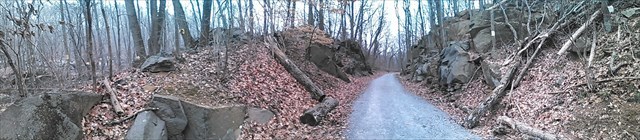
This Earthcache is located on the public Conewago Rail Trail. You do not need to leave the trail or climb on the rocks to complete the earthcache. You will be looking at the York Haven diabase in the Deodate Dike. The cache will discuss the origin of the diabase, its composition, and the origin of some of the fractures observed within the diabase.
RULES
As requested by the land manager of the rail trail. The land surrounding the trail is private property, please stay on the trail. Please be courteous of other recreation users and stay on the sides of the trail while completing the cache requirements. There is no need to climb or hike the exposures. Reports of geocachers not following this request will result in the earthcache being archived.
Bring the following to complete the cache..
1. Sketch Pad or Paper/Clipboard
2. Pencil
3. Two different colored highlighters or colored pencils
4. Measuring Tape
GEOLOGIC STORY
During the construction of the railroad (now the trail), a path had to be created through the resistant layer of igneous rock called Diabase. The diabase started as molten rock (magma) many miles below the earth's crust. The magma slowly rose up through the earth's crust, cutting across the surrounding Triassic-aged sandstones and shale. The magma cooled and solidified underneath the surface of the earth. Over a large-period of time, streams down cut through the bedrock and removed the sediment exposing the diabase as we see it today. The diabase is more resistant to erosion than the surrounding Triassic-sedimentary rocks and now makes the hill crests of the surrounding landscape.
MINERALOGY
During the cooling of the magma; two priniciple minerals began to form in the rock melt; pyroxene (black-colored mineral) and plagioclase (white-colored mineral). If you look closely at a freshly broken rock surface, you will see a "salt-and-pepper" pattern in the rock. These white and black grains are the pyroxene and plagioclase crystals. Pyroxene also contains the element iron and when exposed to the elements may begin to decompose and produce iron-oxide minerals. This weathering process produces the grayish orange soil and staining you may observe around the diabase.
FRACTURES
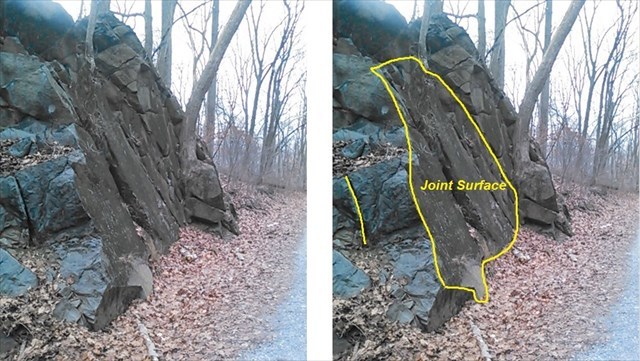
The railroad workers likely utilized the pre-existing fractures in the diabase during thier excavation of the Deodate Dike. You should notice smooth, planar fractures that cut through the rock on either side of the trail. These fractures are called joints. Some of these joints likely formed when the stress of the overlying bedrock was released when erosion removed the overlying bedrock. The removal of that overlying weight, allowed the diabase to expand and create these extension joints. This is a very slow process that probably happened over millions of years,
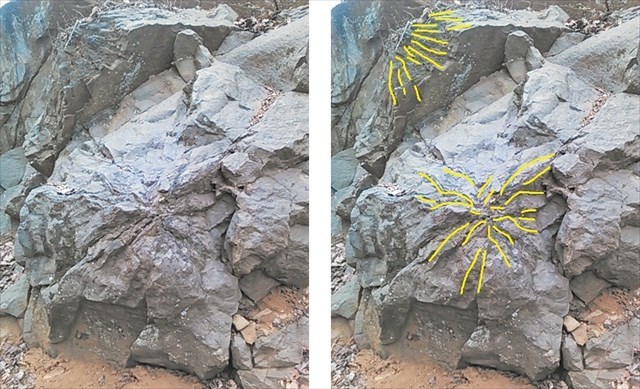
Another type of fracture observed in the diabase is a result of when the workers drilled into the rock and used explosives to push the rock apart. You can identify where the explosives were detonated by the "star-burst" pattern of the tightly-spaced, radiating fractures. If you look carefully you will see remnants of the drill borings that the explosives were placed in on some fracture sets.
REFERENCES
McLaughlin, D. B., 1965, Elizabethtown quadrangle: Triassic rock, unpublished manuscript, archived at the Pennsylvania Geological Survey.
Froelich, A. J. and Gottfried, D., 1999, Early Mesozoic igneous and contact metamorphic rocks, Chapter 12B of Schultz, C. H., ed., The geology of Pennsylvania: Pennsylvania Geological Survey, 4th ser., Special Publication 1, p. 203-209. [Co-published with Pittsburgh Geological Society.]
TO CLAIM THE EARTHCACHE
1. Draw a sketch of a section of the exposure bearing both joints and man-made explosion fractures. (Artistic ability is not judge)
2. Highlight the joints with a single color
3. Highlight the explosion fractures with another color
4. Measure the diameter of the sketched explosion fractures and place a scale bar of your measurement under the fracture on the sketch
5. Upload the sketch with your Found It log.
OPTIONAL (Not required for the find; just for fun)
1. Add additional labels to your sketch such as trees roots, soil covered area, and man-made erosion-control devices observed in the outcrop.
2. Add photos of you or your team laying on a joint
3. Add a photo of you or your team next to an explosion fracture.