This is an earthcache near Bayfront Park/Beach. Depending on who you ask, this park is also called Brownies Beach. IF YOU ARE ATTEMPTING THIS CACHE IN THE WINTER, FALL, OR EARLY SPRING, MAKE SURE YOU ARE WEARING WADERS THERE ARE SEA NETTLES IN THE WATER AND THEY HURT IF YOU TOUCH ONE. Despite the name, sea nettles are jellyfish-like, and hurt a LOT. If you are attempting this one in the winter, fall, or early spring, make sure to wear waders for protection. The parking here costs money for non-residents of Calvert County in the summer, and as of the placing of this cache, they do not accept credit cards (cash only). Please do not climb on and/or touch the cliffs, as they are being eroded and are dangerous for you and the cliff. This cache is about fossils found here, so here is some basic information.
The fossils that are found in the surf here come from the eroding cliffs nearby. The fossils in these cliffs date back to the middle Miocene period. During this time, where you are now standing would be at the bottom of a shallow ocean. Many species of fish lived here during this time, including C. Megalodon (commonly known as the Megalodon shark).
When the fish living in the ocean died, their remains sank to the ocean floor. The flesh would then disintegrate, leaving only the bones. These bones would sink down in the sediment, and lay there for many thousands of years. During this time, the sediment would harden and turn to stone around the bone. Groundwater would now gradually deteriorate the bones, causing a void in the shape of the bone to appear. Then, water rich in minerals would seep into this mould. When these minerals harden, they form the exact shape of the bone that previously sat there. This hardened cast of the bone is what we call a fossil.
Several fossil fragments from land animals have been found, most commonly of a peccary, a hog-like animal. It is extremely rare to find any complete fossils (unheard of to find a complete skeleton!) because the bones are broken up in the surf, but also, most of the animals living in this area stayed more or less within the size of a human, with the exception of whales, larger sharks, and on the rare occasion, large fish. This is mainly because of the lack of enough resources to sustain a bigger body.
If you look at the cliffs, you may notice the different colored layers. These layers are formed by compacted topsoil, and are built up over time. The coloring of the soil that dates back to the Miocene period differ in color from place to place. Here are Calvert Cliffs, the Miocene deposits are slightly tilted, with the tilt becoming more pronounced the farther south you go. Bayfront Park is at the far north of the Calvert Cliffs, meaning the tilt is not so visible.
To log this geocache, please send me the answers via message center for the following questions:
-
The teeth found here small, compared with the size of your hand. Why do you think this is so?
-
Feel some of the rocks that are in the water. Describe them. Why are some of these jagged and others smooth, and how does this relate to the size of fossils found here?
-
Observe the picture below. Why are some shark teeth black, while others are tan?
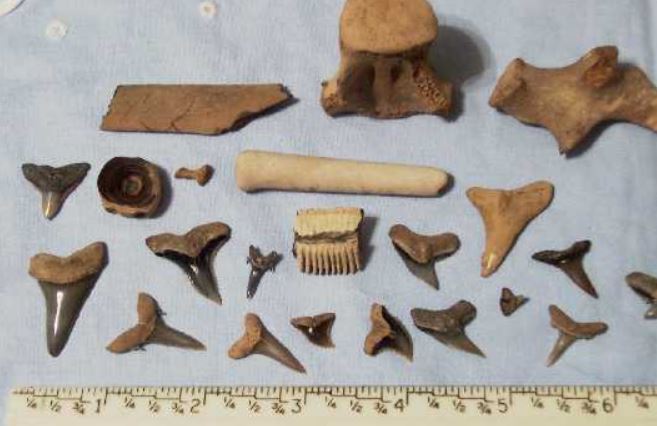
-
BONUS QUESTION (not required): If you are able to find any fossils, describe one. Does it have a single big tooth? Several serrated teeth? How long is it (approximation)?