Country houses
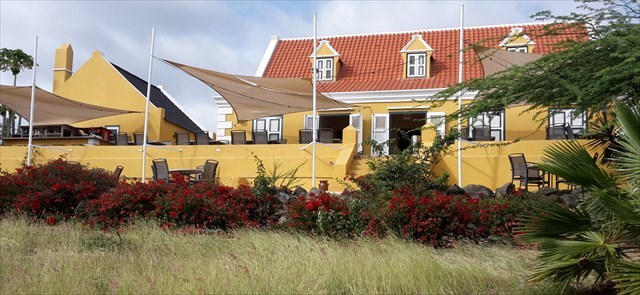 Klein Santa Martha
Curaçao Country houses, built in the 18th and 19th centuries, are usually former plantation houses. There used to be a 100 such small plantations on Curaçao. Their names are still in use as place names, such as Pannekoek, Dokterstuin, Kenepa ,Brievengat, and so on. The central pivot of each plantation was the country house, where the master lived with his house slaves. Situated around the country house were the store houses and the huts of the slaves, who were set to work on the land or in the salterns.
The villas were usually situated on a hill so that the land and the neighbouring villas were within sight. They were raised from coral with the addition of some brick stone details. The high saddle roofs were made with Dutch tiles, leading the rainwater to detached brick built collectors. A surprisingly large number of these colonial homes has survived the ages. About 55 of these land houses are still to be found, in different conditions, scattered around our island.
The 3 Country houses around this cache:
Country house Groot Santa Martha
Groot Santa Martha is one of the most complete country houses on the Island. This Countryhouse has a U-form, with a very special facade with triangle roof ending and a sadle roof. The patio is closed in the 20e century bij a big gate classic stile, inside the statue of Santa Marthat. This country house is now used as a social workshop, but you must visit it.
Country house San Nicolas
Country house San Nicolas is from 18e century. The kernel has a shield roof with dormer windows and a gallery with a roof on the long sides.
Plantation San Nicolas already existed at the end of the 17th century and was 339 hectares. Arable farming, animal husbandry and especially salt extraction took place
Country house Klein Santa Martha
The colonial home of the former plantation Klein Santa Martha was built before 1700 and is located on top of a small hill north-east of Sta. Martha Bay.
The view from the porch in the front over the Sta. Martha area and the colonial house St. Nicolas is magnificent. In comparison with many other plantations on the island, this plantation was once relatively prosperous.
Sugar-cane culture started well before 1700 and the tan containing divi-divi pod once also was an important product. The most important product though was salt from the salt pans pf Sta. Martha.
In 1805 the house was badly damaged due to the invasion by the English who went on the rampage and committed arson.
Notice the unique ventilation openings in the apex of the gable with their star-shaped decorations. The roof is covered with old Dutch tiles.
Landhuizen
De landhuizen van Curaçao, gebouwd in de 18e en 19e eeuw, zijn meestal voormalige plantagehuizen.
Er waren ongeveer honderd kleine plantages in Curaçao. Hun namen zijn nog steeds in zwang als plaatsnamen, zoals Pannekoek, Dokterstuin, Kenepa, Brievengat, enzovoort. Het middelpunt van elke plantage was het landhuis, waar de meester en diens huisslaven woonden. Gesitueerd rondom het landhuis lagen de pakhuizen en de slavenhutten. De slaven werden tewerkgesteld op het land of in de zoutwinning.
De villa’s waren meestal op een heuvel gebouwd zodat het land en de naburige villa’s in het zicht lagen. Ze waren uit koraal opgetrokken met enkele details van baksteen als toevoeging. De hoge zadeldaken werden gemaakt met Nederlandse dakpannen, die het regenwater naar stenen verzamelpunten leidden. Een verrassend groot aantal van deze koloniale huizen heeft de jaren doorstaan. Ongeveer 55 van deze landhuizen bestaan nog steeds, in wisselende conditie verkerend, verspreid over ons eiland.
De 3 landhuizen rond deze cache:
De landhuizen zorgden voor veel werkgelegenheid in de weide omgeving.
De verbouw van suikerriet startte al voor het jaar 1700 en ook de divi-divi-zaadpotten waren ooit een belangrijk product. Er vond akkerbouw en veeteelt plaats, maar het belangrijkste product was het zout uit de zoutpannen van de Sint Martha-baai.
Landhuis Groot Santa Martha
Groot Santa Martha is een van de meest complete landhuizen op het eiland. Het landhuis heeft een U-vorm, voorzien van tuitgevels met driehoekige topbeëindiging en een zadeldak. De patio is in de 20e eeuw afgesloten door een grote poort in classicistische stijl, waarin het beeld van Santa Martha staat. Het landhuis is nu voornamelijk in gebruik als sociale werkplaats, maar is zeker de moeite waard om te bezoeken, ook vanwege de vele aanwezige faciliteiten.
Landhuis San Nicolas
Landhuis San Nicolas dateert uit de 18e eeuw. De kern heeft een schilddak met dakkapellen en aan de lange zijden een galerij met lessenaarsdak.
Plantage San Nicolas bestond al aan het eind van de 17e eeuw en was 339 hectare groot. Er vond akkerbouw, veeteelt en vooral zoutwinning plaats.
Landhuis Klein Santa Martha
Het koloniale huis van de voormalige plantage Klein Santa Martha werd nog vóór 1700 gebouwd. Het ligt op de top van een kleine heuvel ten noordoosten van St. Martha-baai.
Het uitzicht vanaf de veranda aan de voorzijde van het pand over de St. Martha-baai en het koloniale huis is magnifiek. In vergelijking met vele andere plantages, was deze plantage, 480 hectare groot, ooit relatief welvarend.
De verbouw van suikerriet startte voor het jaar 1700 en ook de divi-divi-zaadpotten waren ooit een belangrijk product. Het belangrijkste product was echter het zout uit de zoutpannen van de Sint Martha-baai.
Klein Santa Martha kwam in het nieuws toen tijdens de slavenopstand in 1795 de huisonderwijzer, die als enige blanke op de plantage was achtergebleven, werd vermoord. In 1805 werd de plantage geplunderd door de Engelsen
Het landhuis heeft een zadeldak met aan beide zijden drie dakkapellen. De geveltoppen hebben een rond ventilatiegat met een sterdecoratie. Het dak heeft oud-Hollandse dakpannen. De keuken staat los van het gebouw.
Het landhuis is een paar jaar geleden volledig gerenoveerd met een verbluffend resultaat.
Let ook op de unieke ventilatieopeningen in de muren met hun stervormige ornamenten. Het dak is bedekt met Hollandse dakpannen.
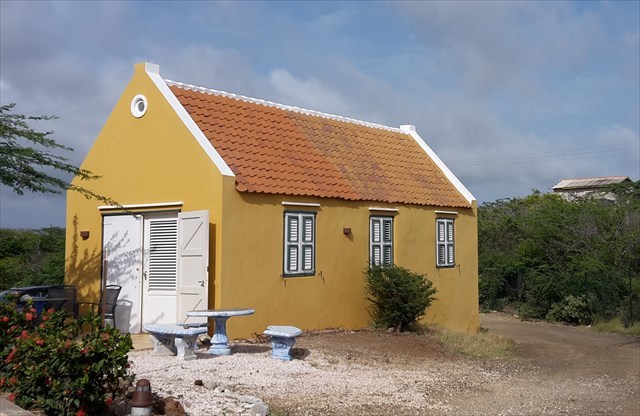 Huisje bij de cache
Landhäuser
Die “Landhuizen“ von Curacao, erbaut im 18. und 19. Jahrhundert, sind meist ehemalige Plantagehäuser. Damals existierten ca. 100 Plantagen auf Curacao. Die Namen der Plantagen gaben vielen Orten, Gegenden und Stadtvierteln Curacaos ihren Namen und werden heute noch benutzt. (Pannekoek, Dokterstuin, Brievengat etc.) Der Mittelpunkt jeder Plantage bildete das Landhaus in dem der Master mit seinen Haussklaven lebte. Um das Plantagehaus herum befanden sich Scheunen und niedrige Sklavenunterkünfte (Sklavenhütten), in denen die auf den Feldern arbeitenden Sklaven lebten.
Die Villen wurden meistens auf einem Hügel erbaut, um die benachbarten Plantagen im Blickfeld zu haben. Meist wurden sie auf Korallen und Bausteinen errichtet. Die hohen Satteldächer sind aus holländischen Ziegeln gefertigt, die das Regenwasser meist zu einem Sammelbecken führen. Ungefähr 55 von diesen Landhäusern gibt es noch, zerstreut über die ganze Insel.
Die 3 Landhäuser um diesen Cache:
Die Landhäuser sorgten für viel Beschäftigung auf dem Weidegebiet.
Der Anbau von Zuckerrohr begann vor dem Jahr 1700 und auch die Divi-Divi-Töpfe waren einst ein wichtiges Produkt. Ackerbau und Viehzucht fanden statt, aber das wichtigste Produkt war Salz aus den Salinen der Bucht Sint Martha.
Landhaus Groot Santa Martha
Große Santa Martha ist eines der komplettesten Landhäuser der Insel. Das Landhaus hat eine U-Form, mit Tüllengiebeln mit dreieckiger Spitze und einem Giebeldach. Der Innenhof wurde im 20. Jahrhundert durch ein großes klassizistisches Tor geschlossen, in dem die Statue von Santa Martha steht. Das Herrenhaus wird heute hauptsächlich als soziale Werkstatt genutzt, ist aber aufgrund der vielen vorhandenen Einrichtungen einen Besuch wert.
Landhaus San Nicolas
Das Landhaus San Nicolas stammt aus dem 18. Jahrhundert. Der Kern hat ein Dach mit Gauben und eine Galerie mit einem Dach an den Längsseiten.
Die Plantage San Nicolas bestand bereits Ende des 17. Jahrhunderts und war 339 Hektar groß. Ackerbau, Tierhaltung und vor allem Salzgewinnung fanden statt.
Landhaus Klein Santa Martha
Das Kolonialhaus der ehemaligen Plantage Klein Santa Martha wurde vor 1700 erbaut. Es liegt auf einem kleinen Hügel nordöstlich von St. Martha Bay.
Die Aussicht von der Veranda an der Vorderseite des Gebäudes über die Bucht von St. Martha und das Kolonialhaus ist großartig. Im Vergleich zu vielen anderen Plantagen war diese Plantage, 480 Hektar, einst relativ wohlhabend.
Der Anbau von Zuckerrohr begann vor dem Jahr 1700 und die Divi-Divi-Pflanzgefäße waren einst ein wichtiges Produkt. Das wichtigste Produkt war jedoch das Salz aus den Salinen der Sint Martha Bay.
Klein Santa Martha war in den Nachrichten, als während der Sklavenrevolte 1795 der Heimlehrer, der als einziger Weißer auf der Plantage zurückgeblieben war, ermordet wurde. Im Jahr 1805 wurde die Plantage von den Engländern geplündert
Das Herrenhaus hat ein Satteldach mit drei Gauben auf beiden Seiten. Die Giebel haben ein rundes Lüftungsloch mit einer Sterndekoration. Das Dach hat alt-niederländische Dachziegel. Die Küche ist getrennt vom Gebäude.
Die Villa wurde vor einigen Jahren komplett renoviert mit einem erstaunlichen Ergebnis.
Beachten Sie auch die einzigartigen Belüftungsöffnungen in den Wänden mit ihren sternförmigen Verzierungen. Das Dach ist mit niederländischen Dachziegeln bedeckt.