Certain sub-Antarctic terrestrial ecosystems have poorly developed soils and are currently experience one of the greatest rates of climate warming on the planet. Peatlands are the largest terrestrial carbon store, locking away more carbon than all the world’s vegetation combined. The long-term fate of this carbon store will play a major role in our future climate. AND quantifying the potential sensitivity of peatlands to environmental change is of vital importance.
The Falkland Islands, 12,000km2 in area, which is about 4,697 square miles, and is about the same size as the state of Connecticut. The country is made up almost entirely of peat bogs, with mountains rising up through the bog. Although the mountains are not high by most standards, they are extremely rugged, (the highest is Mount Osborne at just over 2,000 feet).
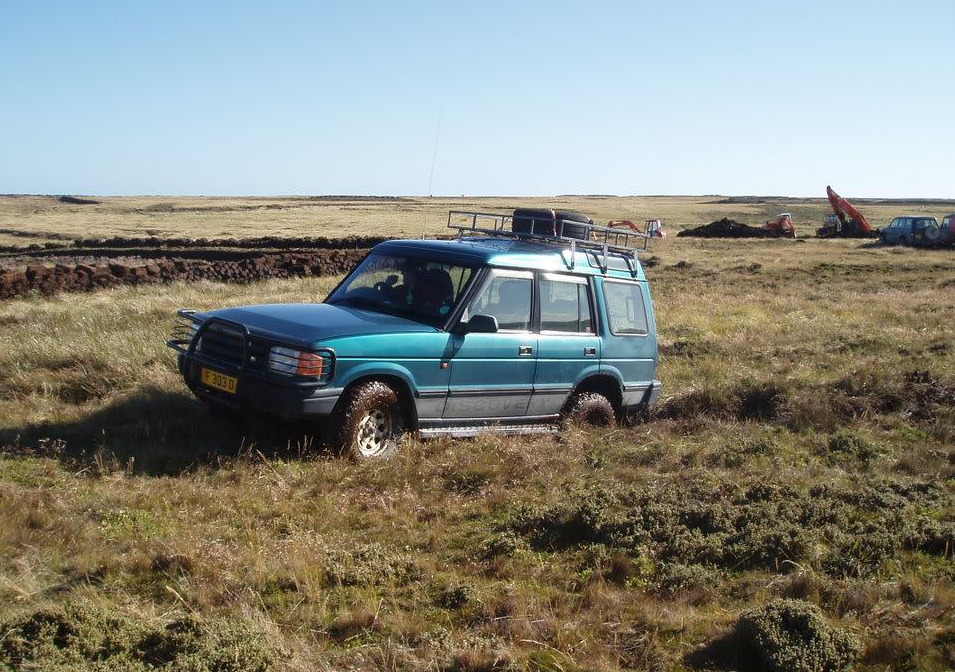
The islands have the highest proportion of land cover of peat in any of the UK overseas territories. They have a cool (2.2°C–9.4°C), temperate oceanic climate. Rainfall varies between 400–800mm, and is lowest in spring. The islands were partially glaciated and acid, organic soils have formed mainly because of low temperatures and the impervious clay-rich subsoil, creating conditions which favour water-logging.
Charles Darwin once described the Falklands landscape as "an undulating land, with a desolate and wretched aspect, is everywhere covered by a peaty soil and wiry grass of one monotonous brown color." And at first glance, only dull brownish colored grasses and ferns appear to blanket the hills as far as the eye can see.
SCIENCE BACKGROUND
As plants grow they remove carbon dioxide from the air and replace it with oxygen. Normally when they die the reverse happens as aerobic (i.e. oxygen-requiring) decomposing bacteria gain their energy and raw materials for their growth by breaking down the green plant biomass that has been built up through photosynthesis.
However, in these waterlogged marshes and reed-beds there is not enough dissolved oxygen in the boggy soil for these sorts of bacteria to thrive and so the plant material does not decay but builds up as peat. If buried very deep underground and subjected to great pressure and heat the dead plant remains would become coal.
The main vegetation types are acid grasslands dominated by Cortaderia pilosa and dwarf shrub, heathland dominated by Empetrum rubrum (diddle dee), have been little altered over the vegetation history of the islands, but scrub communities dominated by Chiliotrichum diffusum (Asteraceae) or Hebe elliptica (Plantaginaceae) would have been much more widespread before the introduction of livestock.
The predominant mosses can spread to cover large areas. Their dense mat, together with its low decomposition rate, results in peat growth under its colonies.
This results in a type of “blanket bog” perhaps peculiar to the Falklands. Rather than blanketing the whole landscape, the peat consists of ‘domes’.
In the northern hemisphere the Romans are thought to have been the first to extract peat to burn for fuel. It was cut by hand for hundreds of years between the months of April and September when the ground was at its driest.
Peat cutting is different in the Falklands, than in say Ireland, where cutting down with a hook is the method of extraction.
Falklanders cut into the banks, traditionally, on first Monday in October. They come along and mark out the bank.

Then they cut into a bank at shoulder height and below and hue out 9" x 9" x 9" blocks, then heave them up on to the side and leave it to dry.
Each one of the blocks is turned it over, so you get it dried on all sides, that called ‘rickling’, and then you put the peat blocks into a pile, that's called a ‘rickle’.
It takes three of these piles for a years supply, about 100 cubic metres. It not unusual for fires to be kept burning year around.
The peat burns a lot like wood without whole lot of ash. Peat was the main fuel on farms until the 1970s. Peat is divided into three types: low type peat, transitional type peat and high type peat. (RELATED TO LOGGING TASK)
Each type is determined by vegetative remains. For example, low type peat usually has a bigger ash percentage. The degree of decomposition of peat generally increases with depth below the ground surface,
In 2012, peat was used to heat less than 2% of houses in Stanley but almost 20% on rural (mostly farm) houses. However farm settlements are increasingly using wind for energy.
There are no figures available for the amount of peat used for fuel locally, but because of the low population density and the dispersed nature of the farm settlements, the impact of peat extraction for fuel has been low. There is a more significant problem and a global issue.
The Falkland Islands are predicted to experience up to 2.2°C rise in mean annual temperature over the coming century, greater than four times the rate over the last century.
Much research says that there is no doubt that the climate of the Falklands is changing. Over 130 years of rainfall records show that we are in a period of summer rainfall decline (and other seasonal changes) and over 50 years of sunshine records show significant increases in mean summer sunshine and temperature. Longer drought periods will decrease soil water content, impair plant growth and place increased stress on the shallow peat soils of the Islands already prone to drying out and erosion
This body of research emphasizes the importance of implementing suitable adaptation strategies to offset climate change impacts, particularly site management. Traditionally, pasture improvement through reseeding and fertilising was practiced only on a very small scale. Recently the development of pastures with improved grasses and legumes coupled with rotational grazing has received much greater priority than previously.
There are concerns that climate change predictions have indicated a steady temperature rise resulting in an unfavourable precipitation-evapo-transpiration balance and other factors may contribute to the instability of the peatlands. Now and in the future, agricultural management practices will play a key role in ecosystem services delivery and climate change mitigation in the islands
KEY REFERENCE
http://ec.europa.eu/environment/nature/biodiversity/best/pdf/fs_tefra_final.pdf
Visit the site. CONSIDER THE TASKS and then message, or email us your responses. Go ahead and log your find, but PLEASE don't put answers in your log. Upload any photos you want.
We will you contact ASAP either through the message centre or email.
ANY "FINDS" WITHOUT ACCOMPANYING ANSWERS WILL, REGRETFULLY, BE DELETED
FTF Honours to "signyred"
LOGGING TASKS
TASK 1
- What do you think influences the quality of the peat?
- How is the peat under threat?
- What action is required to address these severe threats?
TASK 2
- What sort of peat did you find? A = low type peat, B = transitional type peat or C = high type peat.?
For this test, place a saturated sample of soil about the size of a lemon in your palm and squeeze using firm pressure. Examine the extruded liquid and particulates
(A ) IS THE LIQUID CLEAR? = Then this is slightly decomposed organic material
(B ) IS THE LIQUID EXTRUDED IS CLOUDY TO BROWN IN COLOUR WITH NO ORGANIC SOLIDS. = Then the material is partially decomposed (intermediate decomposition) organic material.
(C ) IS THE LIQUID DARK AND VERY CLOUDY, OPAQUE, OR THICK OR PASTY WITH SUSPENDED MATTER? = Then is well decomposed organic material.
- How deep down did you find you sample? What does this suggest to you?