The moving dunes of Sandy Cape
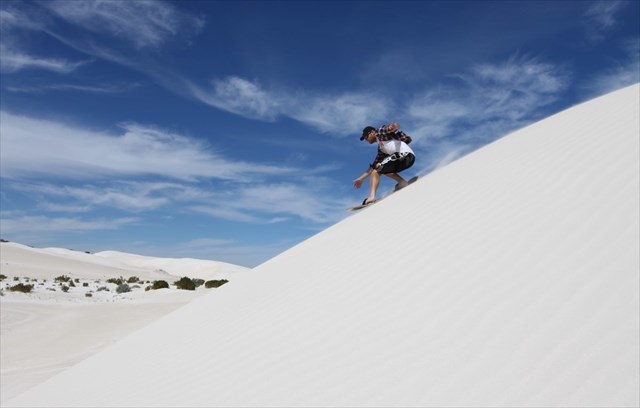
While we were on holiday in WA we discovered these dazzling moving dunes
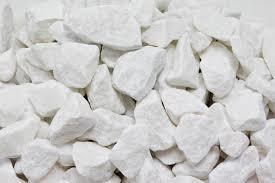
Limestone
| Limestone is a sedimentary rock, composed mainly of skeletal fragments of marine organisms such as coral, forams and molluscs. Its major materials are the minerals calcite and aragonite, which are different crystal forms of calcium carbonate (CaCO3). |
 |
About 10% of sedimentary rocks are limestones. The solubility of limestone in water and weak acid solutions leads to karst landscapes, in which water erodes the limestone over thousands to millions of years. Most cave systems are through limestone bedrock.
Limestone has numerous uses: as a building material, an essential component of concrete (Portland cement), as aggregate for the base of roads, as white pigment or filler in products such as toothpaste or paints, as a chemical feedstock for the production of lime, as a soil conditioner, or as a popular decorative addition to rock gardens.
Like most other sedimentary rocks, most limestone is composed of grains. Most grains in limestone are skeletal fragments of marine organisms such as coral or foraminifera. These organisms secrete shells made of aragonite or calcite, and leave these shells behind when they die. Other carbonate grains comprising limestones are ooids, peloids, intraclasts, and extraclasts.
Limestone often contains variable amounts of silica in the form of chert (chalcedony, flint, jasper, etc.) or siliceous skeletal fragment (sponge spicules, diatoms, radiolarians), and varying amounts of clay, silt and sand (terrestrial detritus) carried in by rivers.
How dunes are formed
| A dune is a mound of sand formed by the wind, usually along the beach or in a desert. Dunes form when wind blows sand into a sheltered area behind an obstacle. Dunes grow as grains of sand accumulate. |
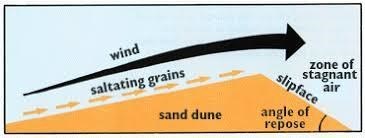 |
Every dune has a windward side and a slipface. A dunes windward side is the side where the wind is blowing and pushing material up. A dunes slip face is simply the side without wind. A slipface is usually smoother than a dunes windward side.
A collection of dunes is called a dune belt or dune field. A large dune field is called an erg. The Skeleton Coast Erg in Namibia extends 2-5 kilometers (1-3 miles) in length and across a width of 20 kilometers (12.7 miles).
Dunes can also be formed by strong currents beneath the water. Underwater dunes, called subaqueous dunes, are common in the ocean, rivers, and canals.
Shapes of Dunes
Dunes can be very large geographic features or just small bumps. Most sand dunes are classified by shape. There are five major dune shapes: crescentic, linear, star, dome, and parabolic.Shapes of Dunes
Crescentic dunes are shaped like crescents, or the shape of a wide letter C. The wide side of a crescentic dune is its windward side, with a small, semi-circular slipface on the other side. Crescentic dunes are the fastest-moving type of dune, and also the most common.
Linear dunes form straight or nearly straight lines. Some linear dunes are shaped like a wiggling snake, with regular curves. Linear dunes develop where wind pressures are nearly equal on both sides of a dune.
Star dunes have pointed ridges and slipfaces on at least three sides. Star dunes develop where winds come from many different directions. The sand dunes of the Sahara Desert ergs are star dunes.
Dome dunes are the rarest type of dune. They are circular and do not have a slipface. The wind can blow material onto the dune from any side.
Parabolic dunes are similar to crescentic dunes. Their shapes are roughly the same, but the slipface of a parabolic dune is on its inward side. Parabolic dunes are also called blowouts, because winds blow out the center of the dune, leaving just a rim on the outside.

Migration of dunes in Western Australia
The sand dune area Sandy Cape used to be one large dune migrating from the south but split into two dunes between 1982 and 2002. The larger eastern sand dune is 80ha in area and has already blown across the access track to Sandy Point. Consequently that road was closed and a new road was built south of the sand dune to access the coast. The smaller western dune appears to be becoming stabilised with vegetation colonising it. No action is recommended.
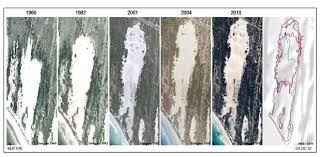
To measure the migration rate of the dunes from 1960 to 2010, each dune nose was identified and used as the basis for measurement. Due to the complex dune morphology within the study area, blowouts on the nose or limb of the dunes can occur and migrate at a different rate than the rest of the dune or of an adjacent lobe of the dune. In order to provide a reasonable measurement of the migration rate, the location of the nose was determined at several points across the front of the dune and these determinations used to measure the migration rate
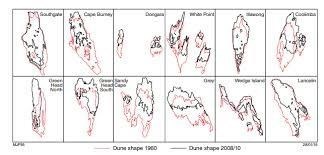
source: www.dmp.wa.gov.au, www.nationalgeographic.org, wikipedia
To log this earthcache:
1. Explain the color of the dunes
2. Explain how the dune can move, about how many meters per year do you think?
3. What type of dunes are these?
4. In what wind direction is the dune moving?
5. Estimate the height of the tallest dune.
6. What kind of trouble do you think can the moving dunes in the area causing?
7. (Optional) Post a photo with you and/or your team standing on the moving dune.
You are welcome to log your answers straight away to keep your TB's and Stats in order but please message us with your answers within 1 week of your log. Cacher’s who do not fulfil the Earth Cache requirement will have their logs deleted.

| I have earned GSA's highest level: |
 |