
NOTE ... Unless you have a senior pass, there is a $25 fee to enter the park.
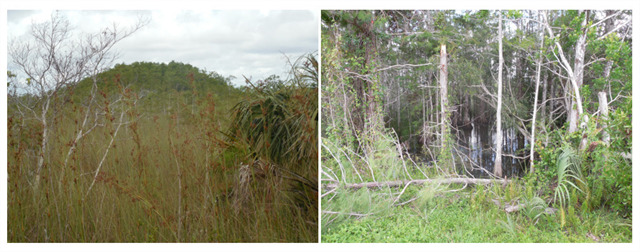
Due to the negative impact on the domes by human exploration, permission has been granted to view both the dome profile (posted coordinates) and the dome interior (waypoint coordinates) only from the road.
EARTHCACHE REQUIREMENTS
Each cacher must send his/her own answers BEFORE logging a find. Enjoy the journey (learning adventure) as well as the destination (smiley earned). Remember to take only pictures and leave only footprints. To get credit for this Earthcache, complete the following tasks:
1. MESSAGE …. At the posted coordinates, you can view a cypress dome. ... a. Based on observation - What is your estimate of the size of the dome? NOTE - You may choose which calculation you prefer (Dome Footprint -or- Dome Area) .... b. Based on reading - What is the size of the wetland depression?
2. MESSAGE …. Explain how the dome shape forms.
3. MESSAGE …. At the waypoint coordinates, there is a smaller dome by the side of the road. Here you can view the interior of a cypress dome. ... a. Is the water stagnant or flowing? ... b. Give two observations of the dome interior.
4. LOG …. Post a picture of you or your signature item at or near the coordinates. This picture is your log signature.
OPTIONAL - Please respect the time and effort involved in creating this earthcache by adding A and B to your log.
A. JOURNEY OF THE MIND ... Science explains what we observe. Relate (in your own words) something you found interesting in the reading. This adds to your learning adventure and your log.
B. JOURNEY OF THE HEART ... Art shares our personal experience of what we see. Share something special you found on site, and why it is special to you. This is a memorable addition to your log and will make other hearts smile.
Journeys of Heart and Mind ...
Stories to Touch the Heart and Puzzles to Challenge the Mind / Rainbow Tree Story
C. ONLY WITH A RANGER, go swamp walking (aka slogging) to experience the many wonders of a dome interior.
Slough Slog/ Wet Walk (Reservations Required) ... Wade through the River of Grass into the shadows of a "gator hole" or a cypress dome. Wear lace-up shoes, socks and long pants that can get wet or muddy. Call (305) 242-7700 or stop by the Ernest F. Coe Visitor Center for reservations, up to one week in advance (12 and up), 1 to 2 miles, 2 hours. Strenuous.
D. Based on the rate of dissolution of limestone and the growth rate of bald cypress, estimate how long it took for this dome to form?
THANK YOU Kimberly (Park Ranger) for permission to share this learning adventure.
LIMESTONE LANDSCAPES
Rainwater is slightly acidic because it dissolves carbon dioxide from the atmosphere, forming a weak solution of carbonic acid. Rain therefore gradually dissolves limestone, creating a variety of natural features known as ‘karst’. Sinks and Springs occur when rainwater seeps down cracks in limestone and gradually dissolves it away. Caves and Caverns occur when moving water carves the limestone into passages and rooms. Solution Sinkholes occur where limestone is exposed at the surface.
A view of the limestone bedrock can be viewed from the edge of the road a short distance away.
Bedrock of the Everglades Earthcache https://coord.info/GC5QHHC ... N 25° 26.191 W 080° 42.846
DEPRESSION WETLAND
A depression wetland is an inland aquatic ecosystem which increases in depth from perimeter to central area. Depression wetlands are also known as large solution holes. The limestone bedrock is broken down over time as a result of anaerobic decomposition of organic matter. This process creates an acidic byproduct responsible for the dissolution of limestone. Cypress trees grow in the water filling these depressions. Their roots are able to break through the bedrock and take hold to grow.
CYPRESS DOME
"In a cypress dome, the overstory and the solution hole it is growing in mirror each other. The tallest trees grow in the deepest water and the smaller trees grow along the edge in the shallower water. Cypress domes, look circular in nature from above, though some look like an open hole doughnut. This happens in many cypress domes, the center of the domes have no trees. In this case, the solution hole is too deep in the center for cypress trees to become established and a collection or pond of water is common. This type of open dome is inviting to alligator flag, willow or other plants that can tolerate deeper water. As these deeper solution holes almost always hold water year-round, they are an important refuge for aquatic animals like alligators." NPS Big Cypress
The normal hydroperiod (seasonal pattern of water levels) for dome swamps is 180 to 270 days per year with water being deepest, and remaining longest, near the center of the dome. This buildup of peat is probably why trees grow faster in the center of the dome swamp. These open habitats are primarily composed of cypress trees living on poor soils. Cypress trees are well adapted to the water-logged soils of the Everglades. The roots produce "knees" that protrude above the soil, ranging from a few inches to 6 feet (several centimeters to 1.8 meters) tall.
CALCULATION OF DOME FOOTPRINT
The formula for the outside surface area of a dome is 2 times pi (3.14) times the radius squared.
CALCULATION OF DOME AREA
The dome area is measured in square feet.
1. Determine the radius of the dome. The dome's radius is the distance from the center of the dome to any point along the dome's circumference (the distance should be measured in feet).
2. Multiply the dome's radius by itself. For example, if you knew that the radius was 10 feet you would multiply 10 by 10 to get 100.
3. Multiply the result from the previous step by 6.28 (6.28 is pi multiplied by 2). Using our example from Step 2, this would give us 100 x 6.28 or 628. The result of this calculation will be the area of your dome.
To get the answer in acres, divide your answer by 43,560 sq ft /acre.
RESOURCES
http://www.fnai.org/PDF/NC/Dome_Swamp_Final_2010.pdf
http://biodiversityadvisor.sanbi.org/wp-content/uploads/2016/07/Namhla-Mbona-Classifying-wetlands.pdf
https://www.nps.gov/bicy/learn/education/cypress-swamps.htm
http://www.northpennines.org.uk/exploring/special-qualities/geology-and-landscape/limestone-landscapes/
https://wrrc.essie.ufl.edu/common/info/pdf/6_rate_of_solution_of_limestone_in_the_karst_terrane_of_florida.pdf
https://www.lakecountyfl.gov/departments/public_works/engineering/sinkhole.aspx
https://www.hunker.com/12261438/how-to-calculate-the-square-feet-formula-of-a-dome