Where do they come from:
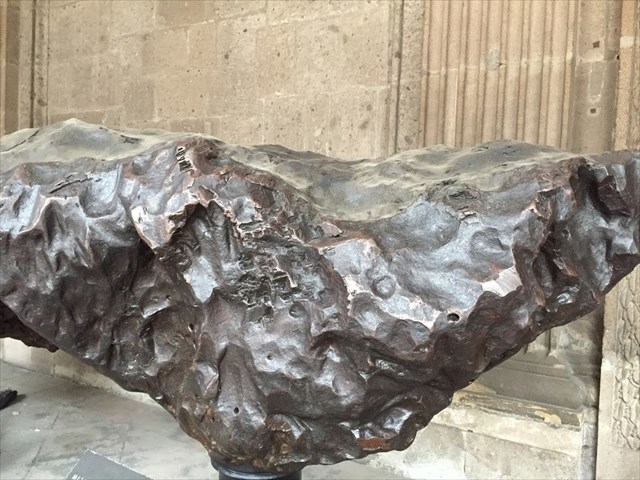
A meteorite is a solid piece of debris from an object, such as a comet, asteroid, or meteoroid, that originates in outer space and survives its passage through the atmosphere to reach the surface of a planet or moon. When the object enters the atmosphere, various factors like friction, pressure, and chemical interactions with the atmospheric gases cause it to heat up and radiate that energy. It then becomes a meteor and forms a fireball, also known as a shooting star or falling star; astronomers call the brightest examples "bolides." Meteorites vary greatly in size. For geologists, a bolide is a meteorite large enough to create a crater.
Meteorites that are recovered after being observed as they transit the atmosphere or impact the Earth are called meteorite falls. All others are known as meteorite finds. As of April 2016, there were about 1,140 witnessed falls that have specimens in the world's collections. As of 2011, there are more than 38,660 well-documented meteorite finds.
Meteorites have traditionally been divided into three broad categories: stony meteorites are rocks, mainly composed of silicate minerals; iron meteorites that are largely composed of metallic iron-nickel; and, stony-iron meteorites that contain large amounts of both metallic and rocky material. Modern classification schemes divide meteorites into groups according to their structure, chemical and isotopic composition and mineralogy. Meteorites smaller than 2 mm are classified as micrometeorites. Extraterrestrial meteorites are such objects that have impacted other celestial bodies, whether or not they have passed through an atmosphere. They have been found on the Moon and Mars.
How do they shape the surface of the earth:
An impact crater is an approximately circular depression in the surface of a planet, moon, or other solid body in the Solar System or elsewhere, formed by the hypervelocity impact of a smaller body. In contrast to volcanic craters, which result from explosion or internal collapse, impact craters typically have raised rims and floors that are lower in elevation than the surrounding terrain. Although Meteor Crater is perhaps the best-known example of a small impact crater on Earth, impact craters range from small, simple, bowl-shaped depressions to large, complex, multi-ringed impact basins.
Impact craters are the dominant geographic features on many solid Solar System objects including the Moon, Mercury, Callisto, Ganymede and most small moons and asteroids. On other planets and moons that experience more active surface geological processes, such as Earth, Venus, Mars, Europa, Io and Titan, visible impact craters are less common because they become eroded, buried or transformed by tectonics over time. Where such processes have destroyed most of the original crater topography, the terms impact structure or astrobleme are more commonly used. In early literature, before the significance of impact cratering was widely recognised, the terms cryptoexplosion or cryptovolcanic structure were often used to describe what are now recognised as impact-related features on Earth.
What impact crater you can see in Mexico Yucatan:
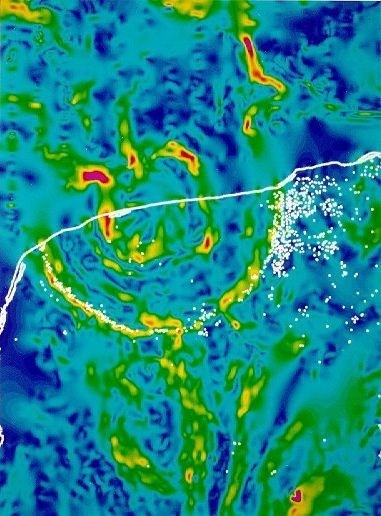
Gravity anomaly map of the Chicxulub impact structure at the Yucatan peninsula. The coastline is shown as a white line. A striking series of concentric features reveals the location of the crater. White dots represent water-filled sinkholes (solution-collapse features common in the limestone rocks of the region) called cenotes after the Maya word dzonot. A dramatic ring of cenotes is associated with the largest peripheral gravity-gradient feature. The origin of the cenote ring remains uncertain, although the link to the underlying buried crater seems clear.
Source: Mainly Wikipedia.
To Log the cache please submit the answer to the following questions to me using the email function of geocaching.com
1. Out of which area of the solar system meteorites come from?
2. Why are they attracted from planets?
3. In the entrance, you can see four different meteorites. Please add the weight of the four different meteorites.
4. What is the biggest impact crater on the world?
5. Optional: would be nice, if you would upload a photo of yourself or your gps at the location.
You will receive an answer whether you are correct.
De dónde vienen:
Un meteorito es una pieza sólida de restos de un objeto, como un cometa, un asteroide o un meteoroide, que se origina en el espacio exterior y sobrevive a su paso por la atmósfera para alcanzar la superficie de un planeta o luna. Cuando el objeto entra a la atmósfera, diversos factores como la fricción, la presión y las interacciones químicas con los gases atmosféricos hacen que se caliente e irradie esa energía. Luego se convierte en un meteoro y forma una bola de fuego, también conocida como estrella fugaz o estrella fugaz; los astrónomos llaman a los ejemplos más brillantes "bólidos". Los meteoritos varían mucho en tamaño. Para los geólogos, un bólido es un meteorito lo suficientemente grande como para crear un cráter. Los meteoritos que se recuperan después de ser observados mientras transitan por la atmósfera o impactan en la Tierra se llaman caídas de meteoritos. Todos los demás se conocen como hallazgos de meteoritos. A partir de abril de 2016, hubo alrededor de 1.140 caídas observadas que tienen especímenes en las colecciones del mundo. A partir de 2011, hay más de 38.660 hallazgos de meteoritos bien documentados. Los meteoritos se han dividido tradicionalmente en tres grandes categorías: los meteoritos pétreos son rocas, principalmente compuestos de minerales de silicato; meteoritos de hierro que están compuestos principalmente de hierro metálico-níquel; y meteoritos de hierro pétreo que contienen grandes cantidades de material metálico y rocoso. Los esquemas modernos de clasificación dividen los meteoritos en grupos de acuerdo con su estructura, composición química e isotópica y mineralogía. Los meteoritos menores de 2 mm se clasifican como micrometeoritos. Los meteoritos extraterrestres son objetos que han impactado otros cuerpos celestes, hayan o no atravesado una atmósfera. Han sido encontrados en la Luna y Marte.
¿Cómo moldean la superficie de la tierra:
Un cráter de impacto es una depresión aproximadamente circular en la superficie de un planeta, luna u otro cuerpo sólido en el Sistema Solar o en otro lugar, formado por el impacto de hipervelocidad de un cuerpo más pequeño. A diferencia de los cráteres volcánicos, que resultan de explosiones o colapso interno, los cráteres de impacto generalmente tienen bordes elevados y pisos que tienen una elevación menor que el terreno circundante. Aunque Meteor Crater es quizás el ejemplo más conocido de un pequeño cráter de impacto en la Tierra, los cráteres de impacto van desde depresiones pequeñas y simples en forma de cuenco hasta cuencas de impacto grandes, complejas y de múltiples anillos.
Los cráteres de impacto son las características geográficas dominantes en muchos objetos sólidos del Sistema Solar, incluidos la Luna, Mercurio, Calisto, Ganímedes y la mayoría de las lunas pequeñas y los asteroides. En otros planetas y lunas que experimentan procesos geológicos de superficie más activos, como la Tierra, Venus, Marte, Europa, Io y Titán, los cráteres de impacto visibles son menos comunes porque se erosionan, se entierran o se transforman con la tectónica a lo largo del tiempo. Donde tales procesos han destruido la mayor parte de la topografía del cráter original, los términos estructura de impacto o astroblema se usan más comúnmente. En la literatura anterior, antes de que se reconociera ampliamente la importancia del impacto de la formación de cráteres, los términos criptoexplosión o estructura criptovolcánica se usaban a menudo para describir lo que ahora se reconoce como características relacionadas con el impacto en la Tierra.
Qué cráter de impacto puedes ver en México Yucatán:
Mapa de anomalías gravimétricas de la estructura de impacto de Chicxulub en la península de Yucatán. La costa se muestra como una línea blanca. Una sorprendente serie de características concéntricas revela la ubicación del cráter. Los puntos blancos representan sumideros llenos de agua (características de colapso de solución comunes en las rocas calizas de la región) llamados cenotes después de la palabra maya dzonot. Un anillo dramático de cenotes está asociado con la característica más grande del gradiente de gravedad periférico. El origen del anillo de cenote sigue siendo incierto, aunque el vínculo con el cráter oculto subyacente parece claro.
Fuente: Principalmente Wikipedia.
Para registrar la caché, envíe la respuesta a las siguientes preguntas utilizando la función de correo electrónico de geocaching.com
1. ¿De qué área de los meteoritos del sistema solar provienen?
2. ¿Por qué se sienten atraídos por los planetas?
3. En la entrada, puedes ver cuatro meteoritos diferentes. Por favor, agregue el peso de los cuatro meteoritos diferentes.
4. ¿Cuál es el cráter de impacto más grande del mundo?
5. Opcional: sería agradable, si subes una foto tuya o de tu GPS al lugar.
Recibirás una respuesta ya sea que estés en lo correcto.