Johannes Brahms
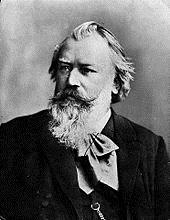
Johannes Brahms - May 7, 1833 – April 3, 1897
Brahms was a German composer and pianist of the Romantic period. Born in Hamburg, Brahms spent much of his professional life in Vienna, Austria.
Brahms composed for symphony orchestra, chamber ensembles, piano, organ, and voice and chorus. A virtuoso pianist, he premiered many of his own works. He worked with some of the leading performers of his time, including the pianist Clara Schumann and the violinist Joseph Joachim (the three were close friends). Many of his works have become staples of the modern concert repertoire. An uncompromising perfectionist, Brahms destroyed some of his works and left others unpublished.
Brahms has been considered, by his contemporaries and by later writers, as both a traditionalist and an innovator. His music is firmly rooted in the structures and compositional techniques of the Classical masters. While many contemporaries found his music too academic, his contribution and craftsmanship have been admired by subsequent figures as diverse as Arnold Schoenberg and Edward Elgar. The diligent, highly constructed nature of Brahms's works was a starting point and an inspiration for a generation of composers. Embedded within his meticulous structures, however, are deeply romantic motifs.
As a pianist, the challenge of performing his music was that he had very large hands and he wrote his music with that in mind. Consequently, the average person will find that their hands are stretched to the limit throughout the piece. Try listening to the Rhapsody, Op. 79, No. 2 in G Minor (https://www.youtube.com/watch?v=MgTH7qQdg74)