 [Nederlands]
In 2014 werd het begin van WO I herdacht. Bij deze gelegenheid hebben wij een reeks caches uitgebracht, dit langs de volledige frontlijn, van Nieuwpoort tot Mesen.
Dit resulteerde in 7 reeksen ‘veldslagen’ van elk 8 caches, met daarbij bij iedere reeks een bonus.
En daarna kwam nog het Eindoffensief, voor die ‘generaals’ die alle reeksen gelogd hadden ….
Nu zijn we 2018 en wordt het einde van WO I herdacht. Dus is het tijd om nog eens een achtste reeks online te zetten ! Deze komt echter NIET in aanmerking voor het Eindoffensief.
Hierbij enkele bemerkingen :
De caches liggen nergens verborgen op de begraafplaatsen.. De antwoorden op de vragen moeten wel regelmatig op de begraafplaatsen gezocht worden. Respecteer de stilte, aub. Maak je ook het napluizen van de aanwezige registers eigen. Je zal ze hier en daar nodig hebben.
Gelieve GEEN gebruik te maken van stickers in de logboekjes. Breng aub eigen schijfgerief mee en noteer vooral de aanwezige codes. Je zal ze nog nodig hebben !
Bezoek zeker en vast ook de bijgevoegde internetwebsite ! Daar kan je heel wat bijkomende informatie vinden : de historiek van deze reeks caches, handige hulpprogramma's, statistieken ...
Historiek
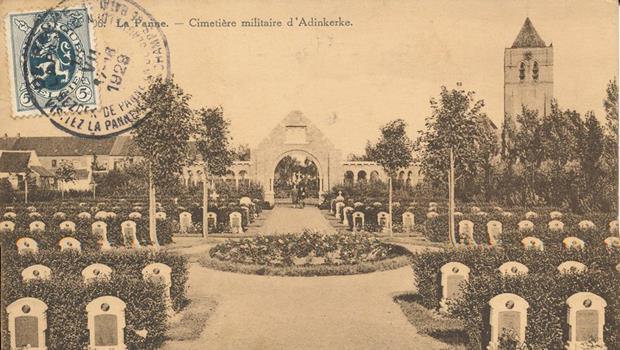
In Adinkerke werden heel wat geallieerde troepen gekantonneerd en waren er ook verscheidene medische posten. De bekendste was het militair veldhospitaal op het domein Cabour. Nabij het spoorwegstation was er ook een evacuatiehospitaal en in de Kerkweg was er een triagepost voor gewonden.
Vanaf eind september 1914 zou gestart zijn met de militaire begraafplaats in Adinkerke, als uitbreiding van het bestaande kerkhof. Rond 1920 telde de Belgische militaire begraafplaats 2.314 Belgische, 466 Franse en een aantal Britse doden. Kortelings nadien werden alle Franse (op één na) en veel van de Belgische militairen ontgraven om op een andere plaats herbegraven te worden. Er waren ook soldaten die elders ontgraven werden en een laatste rustplaats kregen in Adinkerke. Er heerste een grote variëteit aan graftekens. Dit amalgaam aan graftekens werd verwijderd toen in 1924-1925 op de militaire begraafplaats van Adinkerke - net zoals op alle andere militaire begraafplaatsen - officiële grafstenen werden geplaatst. Wanneer families geen aanvraag tot behoud van de heldenhuldezerkjes hadden ingediend, verdwenen die onherroepelijk.
In mei 1925 werd de Heldenweg (het weggetje naar de begraafplaats) verhard met brokstukken van een 140-tal heldenhuldezerkjes. Op 23 augustus 1942 werden deze brokstukken naar de IJzertoren overgebracht.
(vrij naar ‘’www.depannetheek.be’)
Uw missie
We starten deze multi aan het standbeeld voor de militaire slachtoffers van Adinkerke en Veurne-Bewesterpoort.
WP1
Wat is de familienaam van Remi (onderste rij) ? Zet deze naam om volgens A=1, B=2 …. Z=26. Dit is A.
Welke spreuk staat op dit standbeeld ? Tel hat aantal letters. Dit is B
WP2 Ga of fiets nu naar N51 04.(A*2-4) E002 36.(A+B/2+2)
Ga hier op zoek naar een soldaat met de voornaam Feodor. In welk leger was hij dienstplichtig (alleen vermelding op grafzerk is geldig) ? Zet dit om A=26, B=25 …. Z=21 Dit is C
WP3 Ga of fiets nu naar N51 04.0(B*2-5) E002 3(B*C+A*4-B-6)
Welke dokter werd tot hoofd van dit hospitaal benoemd (voor- en familienaam) ? Zet deze naam om volgens A=1, B=2 …. Z=26. Dit is D
Tot wanneer (dd-m-jjjj) bleef dit hospitaal aktief ? Tel alle cijfers bij elkaar op. Dit is E
De cache kan men vinden op N51.0((E-3)*D*2-D/2+7) E002 3(B*C+A*4-B*2+4)
[English]
2014 was the year we commemorated the start of World War I. At this occasion we published a series of caches, alongside the Belgian frontline, from Nieuwpoort to Mesen
This resulted in 7 series of 'battles' of 8 caches each, with a bonus for each series.
And then came the Final Offensive, for those 'generals' who had logged all the series ...
Now we are 2018 and the end of World War I is commemorated. So it's time to put an eigth series online again ! However, this is NOT eligible for the Final Offensive.
Here are some remarks:
The caches are never hidden at the cemeteries. The answers to the questions are mostly found at the cemeteries. Please keep your silence. Also accustom yourself to explore the registers.
Please DO NOT USE stickers in the logbooks. Bring along your own pen and note the present codes. You’ll need them.
Visit certainly our attached website. There you’ll find some extra information, the history of the caches, useful tools, statistics……
History
In Adinkerke many allied troops were hijacked and there were also several medical posts. The best known was the military field hospital on the Cabour domain. Near the railway station there was also an evacuation hospital and in the Kerkweg there was a triage post for wounded.
From the end of September 1914, the military cemetery in Adinkerke would have started, as an extension of the existing cemetery. Around 1920, the Belgian military cemetery had 2,314 Belgian, 466 French and a number of British deaths. Shortly thereafter, all French (except for one) and many of the Belgian soldiers were excavated to be reburied elsewhere. There were also soldiers who were excavated elsewhere and were given a final resting place in Adinkerke. There was a large variety of grave signs. This amalgam of gravestones was removed when official tombstones were placed on the Adinkerke military cemetery in 1924-1925, as on all other military cemeteries. When families had not filed an application for the preservation of the heroes' tributes, they disappeared irrevocably.
In May 1925, the Heldenweg (the road to the cemetery) was paved with fragments of some 140 heroes' tributes. On August 23, 1942, these fragments were transferred to the Yser Tower.
Your mission
We start this multi at the statue for the military victims of Adinkerke and Veurne-Bewesterpoort.
WP1
What is the surname of Remi (bottom row) ? Convert this name according to A = 1, B = 2 ... .Z = 26. This is A
What proverb is on this statue? Count the number of letters. This is B
WP2 Go now or bike to N51 04.(A*2-4) E002 36.(A+B/2+2)
Go here in search of a soldier with the first name Feodor. In which army was he conscripted (only mention on gravestone is valid) ? Put this at A = 26, B = 25 .... Z = 21 This is C
WP3 Go now or bike to N51 04.0(B*2-5) E002 3(B*C+A*4-B-6)
Which doctor was appointed head of this hospital (first and last name) ? Convert this name according to A = 1, B = 2 .... Z = 26. This is D
Until when (dd-m-yyyy) did this hospital stay active? Add all the numbers together. This is E
The cache can be found at N51.0((E-3)*D*2-D/2+7) E002 3(B*C+A*4-B*2+4)
[Français]
En 2014, le début de la Première Guerre mondiale a été commémoré. A cette occasion, nous avons sorti une série de caches, le long de toute la ligne de front, de Nieuwpoort à Messines.
Cela a donné lieu à 7 séries de «batailles» de 8 caches chacune, avec un bonus pour chaque série.
Et puis est venue l'Offensive Finale, pour ces «généraux» qui avaient enregistré toutes les séries ...
Nous sommes maintenant en 2018 et la fin de la Première Guerre mondiale est commémorée. Il est donc temps de mettre en ligne une huitième série ! Cependant, ce n'est pas admissible à l'Offensive Finale.
Voici quelques remarques :
Les cachettes ne sont cachées nulle part dans les cimetières et les réponses aux questions doivent être recherchées régulièrement dans les cimetières. Respectez le silence, s'il vous plaît. Vous devez également vous familiariser avec les registres existants. Vous en aurez besoin ici et là.
Veuillez NE PAS utiliser d'autocollants dans les journaux de bord. Veuillez apporter votre propre bic et noter les codes existants. Vous en aurez besoin !
Assurez-vous de visiter le site internet ci-joint ! Là vous pouvez trouver beaucoup d'informations supplémentaires: l'histoire de cette série de caches, utilitaires utiles, statistiques ...
Historique
A Adinkerke de nombreuses troupes alliées ont été détournées et il y avait aussi plusieurs postes médicaux. Le plus connu était l'hôpital militaire sur le domaine de Cabour. Près de la gare il y avait aussi un hôpital d'évacuation et dans le Kerkweg il y avait un poste de triage pour les blessés.
Dès la fin du mois de septembre 1914, le cimetière militaire d'Adinkerke aurait commencé, en prolongement du cimetière existant. Vers 1920, le cimetière militaire belge comptait 2 314 Belges, 466 Français et un certain nombre de morts britanniques. Peu de temps après, tous les Français (sauf un) et de nombreux soldats belges ont été fouillés pour être réenterrés ailleurs. Il y avait aussi des soldats qui ont été fouillés ailleurs et ont obtenu un dernier lieu de repos à Adinkerke. Il y avait une grande variété de signes graves. Cet amalgame de marques funéraires a été retiré lorsque des pierres tombales officielles ont été placées sur le cimetière militaire d'Adinkerke en 1924-1925 - comme sur tous les autres cimetières militaires. Lorsque les familles n'avaient pas déposé une demande pour la préservation des hommages des héros, elles ont irrévocablement disparu.
En mai 1925, le Heldenweg (la route menant au cimetière) était pavé de fragments d'environ 140 hommages de héros. Le 23 août 1942, ces fragments ont été transférés à la tour de l'Yser.
Votre mission
Nous commençons ce multi à la statue pour les victimes militaires d'Adinkerke et de Veurne-Bewesterpoort.
WP1
Quel est le nom de famille de Remi (ligne du bas) ? Convertissez ce nom selon A = 1, B = 2 ... .Z = 26. Ceci est A.
Quel proverbe est sur cette statue? Comptez le nombre de lettres. C'est B
WP2 aller à N51 04.(A*2-4) E002 36.(A+B/2+2)
Allez ici à la recherche d'un soldat avec le prénom Feodor. Dans quelle armée était-il enrôlé (seule mention sur la pierre tombale est valable) ? Mettez ceci à A = 26, B = 25 .... Z = 21 C'est C
WP3 aller à N51 04.0(B*2-5) E002 3(B*C+A*4-B-6)
Quel médecin a été nommé à la tête de cet hôpital (nom et prénom) ? Convertissez ce nom selon A = 1, B = 2 .... Z = 26. C'est D
Jusqu'à quand (dd-m-yyyy) cet hôpital est-il resté actif ? Ajouter tous les chiffres ensemble. C'est E
On peut trouver le cache à N51.0((E-3)*D*2-D/2+7) E002 3(B*C+A*4-B*2+4)