Welcome to the GEO-EYE SERIES!
This series consists of 45 puzzle caches. We incorporated various difficulty levels. All the caches that form the PUPIL of the eye (P1 to P6) will be the harder ones. The IRIS caches (I01 to I16) will be of intermediate difficulty, and the EYE outline (E01 to E23) will be easy ones.
And then to collect the smilies, we recommend high clearance vehicles. Especially during the rainy season, as the roads can get very muddy. But then again, that is part of all the fun!
Each puzzle will start with an eye fact, followed by the puzzle. There might be clues hidden in the eye fact :-)
EYE FACT
Keratoconus, is a condition where the cornea protrudes outward like a cone. The name comes from Greek (keratokonus) where it literally means “cornea cone.”
Keratoconus symptoms
It’s unclear why keratoconus arises in certain individuals, but we do know that it causes symptoms because of both the deformed shape of the cornea and the scarring that occurs at the high points of deformation.
Keratoconus symptoms generally start as a normal blurred vision, not unlike the blurriness from more common refractive errors or astigmatism.
The hallmark symptom of keratoconus, however, is a scattering of ghost images around an object. This can also appear as streaking or flaring distortions, and is often accompanied by sensitivity to bright lights and occasional itchiness.
Keratoconus also generally causes poor night vision. Visual distortions and blurriness are more pronounced in low light conditions, because the pupil opens to capture more light, and in doing so exposes more of the irregular surface of the cornea.
Diagnosis of keratoconus
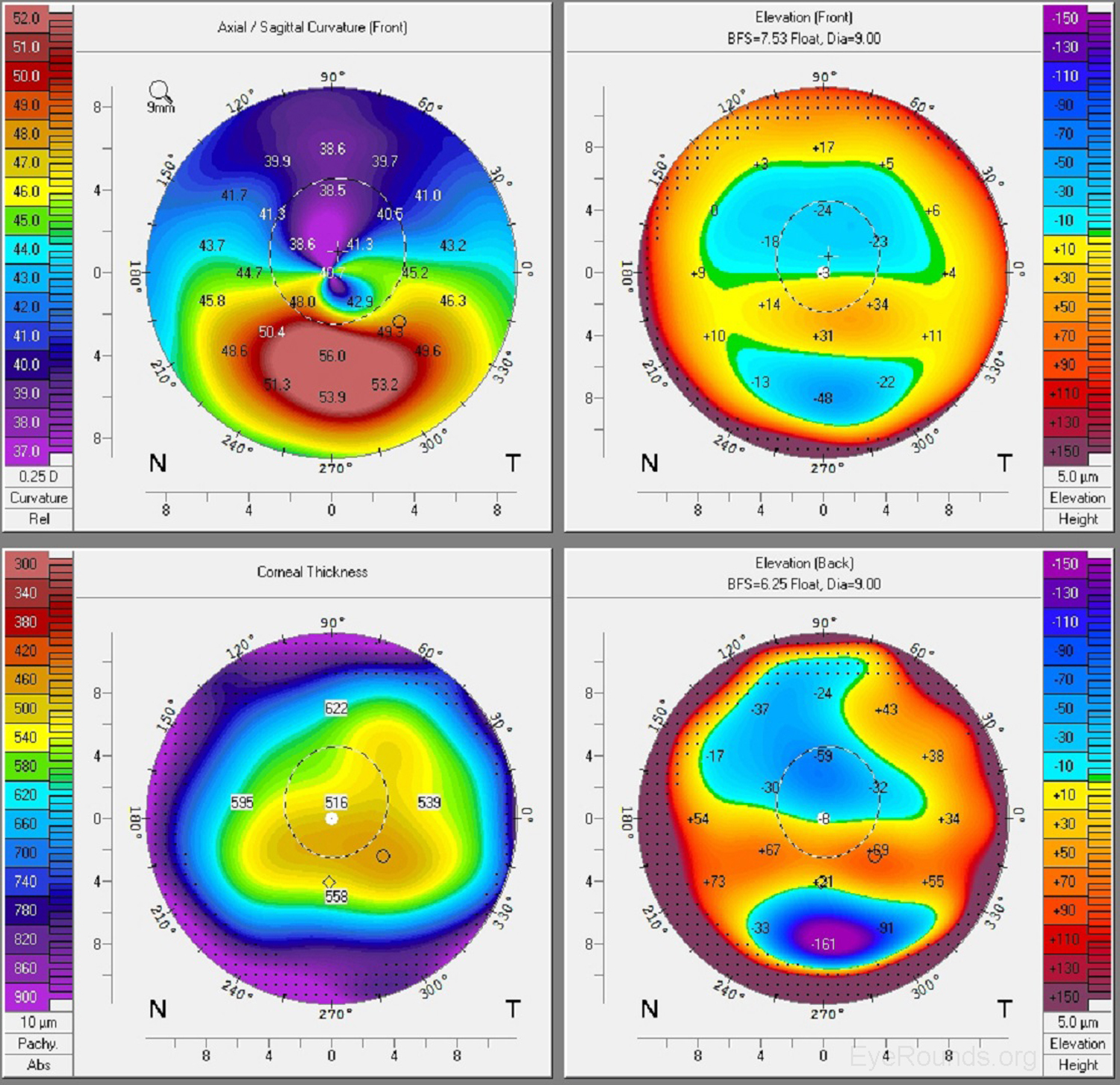
When the optometrist suspect that keratoconus might be present, they refer the patient to the ophthalmologist. A corneal topography is performed, which is a colormap of the surface of the cornea.
Treatment for keratoconus
- Eyeglasses and normal, soft contact lenses can help with the mildest cases, successfully correcting visual acuity problems. As the diseases progresses, rigid gas permeable (RGP) lenses are often fitted to correct for visual acuity, partly by conforming less to the changing shape of the cornea. Lenses for keratoconus correct the visual problems, but don’t delay the progression of the disease.
- As the disease worsens, special contacts and surgery become the most effective corrective options.
- Surgery and corneal transplants
- Corneal transplants, also known as keratoplasty, are common, safe and effective. Patients do, however, often still need some type of normal visual correction.
- In transplanting a cornea, a surgeon removes the patient’s cornea and grafts a replacement cornea from a donor. Because the cornea doesn’t have its own direct blood supply, donor corneas don’t need to be blood-type matched. Visual outcomes are generally great, regardless of the severity of the disease, surgical technique and other factors.
- Corneal ring implants, are a recent FDA-approved surgical alternative to corneal transplants. Thin arcs are inserted through small incisions in the rim of the cornea, creating a barely noticeable ring in the eye. These push against the curvature of the cornea in order to flatten the peak of the keratoconus cone, returning it to a more normal shape.
- Corneal collagen cross-linking (CXL) is a developing treatment studied in Europe and currently undergoing clinical trials in the United States. Collagen cross-links are the cornea’s natural anchors. Cross-linking treatment involves saturating the cornea with special eye drops, then activating the solution with ultraviolet light, in order to increase the amount of collagen cross-linking. While cross-linking doesn’t cure keratoconus, studies are encouraging about its potential to arrest the progression of the disease.
If you’re worried about possible or worsening keratoconus, talk to your eye doctor. Your eye doctor is your ally in assessing your visual health and your treatment options, and can do a thorough diagnosis for keratoconus. Regular eye exams are also a great way for your eye doctor to monitor your eyes and vision to keep them healthy as long as possible.
* The cache is not hidden at the posted coordinates *
To obtain the final coordinates you will have to solve the puzzle.

You can validate your puzzle solution with certitude.
