A Earth Cache:
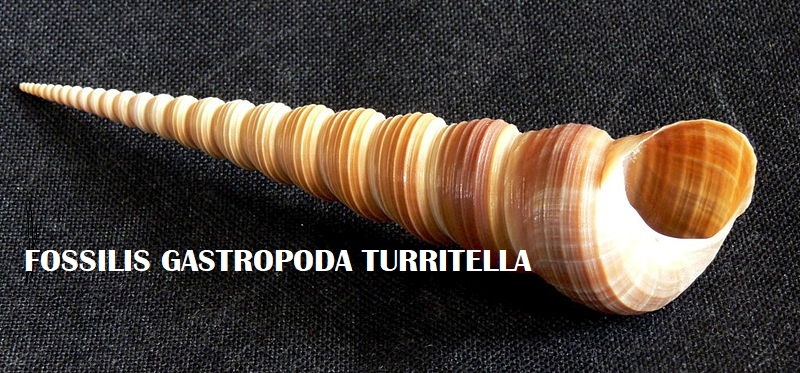
Na coordenada indicada vais-te deparar com um pequeno segmento de rocha no solo que, no entanto, dá testemunho muito vívido da presença de fósseis Turritela.
Para logares a Earth Cache deverás responder às questões abaixo via email do meu perfil
- Observa atentamente o segmento de rocha! Tomando como referência o número de fósseis de Turritela, como classificarias este extinto habitat? Muito bom! Razoável! Muito pobre!
- Do ponto de vista do processo, que tipo de fossilização está aqui presente?
Fósseis, breve introdução:
Muito resumidamente, quando os restos orgânicos, particularmente os detentores de esqueleto externo duro como alguns organismos marinhos, são depositados e envolvidos num material protetor (fundos arenosos lamacentos) que os preservam do contacto com a atmosfera, da água do mar e dos agentes decompositores biológicos, nestas condições e ao longo do tempo, esses compostos orgânicos mortos serão substituídos por minerais como por exemplo, calcite, sílica, pirite, carbono, entre outros que replicam as suas formas e geometrias. Eis um resumo do processo de fossilização!
Quanto aos seus processos, a fossilização assume três formas genéricas: Fossilização por mumificação quando ocorre a preservação da maior parte do ser vivo, incluindo as sua partes moles.
Fossilização por moldagem quando não se conserva qualquer parte do ser vivo, ficando apenas a reprodução ou molde das suas partes duras, seja a nível interno (molde interno) ou externo (molde externo).
Fossilização por mineralização quando os sedimentos que envolvem o ser vivo sofrem compressão devido ao peso dos depósitos que estão por cima.
Fóssies Turritella:
Turritela são um grupo de gastrópodes, organismos constituídos por concha única enrolada em espiral e não compartimentada que ainda persistem nos dias de hoje. Surgiram no final do período Jurássico, passagem para o Cretácico, sendo os que os registos mais consolidados situam-se no Cretácio inferior, de idade do Valanginiano, isto é, há cerca de 140m.a. atrás, sendo que vieram ocupar um nicho ecológico pós extinção das amonites e dos dinossassauros. Vivem (porque ainda existem Turritelas) em ambientes marinhos de pequena profundidade com salinidade típica ou muito próximo dela (35grs de sais por cada kilograma de água do mar) e em águas de temperatura variável (tropical a fria). O seu habitat são as “zonas bentónicas”, isto é, os fundos marinhos onde vivem semienterrados nos sedimentos alimentando-se por filtração da água, através da qual obtêm as partículas nutritivas de que necessitam para sobreviver. A sua concha espiralada e cónica contém grande número de voltas chegando a atingir um comprimento máximo de 15cm. Na atualidade esta classe do grupo dos gastrópodes habita o mar mediterrânico e o mar do Norte para onde se estenderam via oceano atlântico.
Taxinomia biológica:
Reino: Animalia
Filo: Mollusca
Classe: Gastrópoda
Familia: Turritellidae
Género: Turrritella
Fossil,
The Earth Cache:
In the given coordinate, you will come across a small rock segment in the soil which however, gives very vivid testimony of the presence of Turritela fossils.
To log in to Earth Cache you should reply to the questions below via email from my profile
- Carefully observe the rock segment! Considering the number of fossils dysplayed, how would you consider this former habitat? Very good! Reasonable! Very poor!
- From the process point of view, what kind of fossilization is present here?
brief introduction:
The word "fossil" derives from the Latin term "fossilis" which means "to be unearthed." The science that studies the fossils is Paleontology, and fossils are remains or preserved remains of animals, plants or other living things on rocks, such as body molds or parts of it, traces and footprints. Fossilization rarely occurs because the organic matter of living beings tends to be rapidly decomposed: with the death of the organism, decomposition contributes to its destruction that can either arise by the intervention of microorganisms, or by physical agents such as changes in pressure and temperature or by chemical intervention, for example, oxidation, dissolution, etc. It turns out that, sometimes the organic remains are quickly involved in a protective material that preserves them from contact with the atmosphere, sea water and decomposition agents and in this way they become fossils, that is, when the organic compounds that constitute the dead organism is replaced by other more stable in the new conditions such as calcite, silica, pyrite, carbon, among others. As for its processes, fossilization assumes three generic forms: Fossilization by mummification when the preservation of most of the living being, including its soft parts, takes place. Fossilization by molding when no part of the living being is preserved, leaving only the reproduction or mold of its hard parts, either internally (internal mold) or external (external mold). Fossilization by mineralization when the sediments that surround the living being suffer compression due to the weight of the deposits on top.
Fossil Turritella:
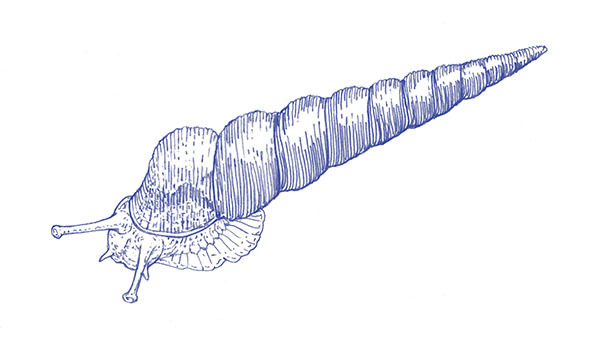
Turritella are a group of gastropods, organisms consisting of single spiral coiled shell and non-compartmentalized that still persist today. They emerged at the beginning of the Cenozoic (65 years ago to the present) and came to occupy an ecological niche post extinction of ammonites and dinosaurs at the end of the Cretaceous. They live in marine environments of small depths with typical salinity or very close to it (35grs of salts per kilogram of seawater) and in waters of variable temperature (tropical to cold). Their habitat is the "benthic zones", that is, the seabed where they live half-buried in the sediments feeding by filtration of the water, through which they obtain the nutritious particles that they need to survive. Its spiral and conical shell contains a large number of turns reaching a maximum length of 15cm. At present, this class of the group of gastropods inhabits the Mediterranean Sea and the North Sea to where they extended via Atlantic Ocean.
Biological taxonomy:
Kingdom: Animalia
Filo: Mollusca
Class: Gastrópoda
Family: Turritellidae
Genre: Turrritella
