 Nederlands Français English

 [Nederlands]
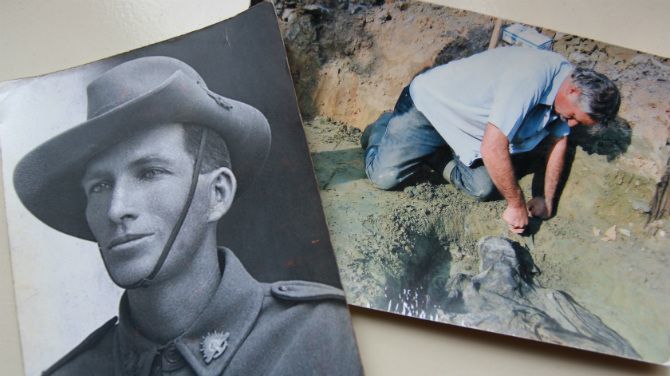
"Zijn ogen straalden in de zon, 90 jaar na zijn dood." Het was een bijzonder moment voor amateur-archeoloog Johan Vandewalle, de ontdekking van een in 1917 gesneuvelde Australische soldaat. Een emotioneel moment ook, dat zijn verdere leven mee zou blijven bepalen. Niet het minst omdat er een wel heel bijzonder verhaal aan vast hangt. In 2006 gebeurde het. Bij graafwerken voor een gasleiding in de buurt stootte de kraanman op twee schedels. Vandewalle was toen al lang met de Groote Oorlog bezig, en had zich ontpopt tot specialist in de dug-outs en ondergrondse netwerken. Hij was er door zijn alertheid en toewijding heel snel bij, bracht de politie op de hoogte en stond erop om zelf de lichamen zorgvuldig op te graven. "Hij keek me recht aan" Er bleken niet twee, maar vijf lichamen te liggen. Soldaten uit de Groote Oorlog. Ze kregen in de media de naam "Zonnebeke 5" mee. Eén slachtoffer sprong daarbij in het oog. Hij lag in een andere richting, en was bedekt met een dekzeil. Toen Vandewalle dat weghaalde, zag hij een lichaam dat nog vrij intact was gebleven. En er was iets heel speciaals aan de hand: de ogen van de soldaat staarden hem aan, ze lichtten op in de avondzon. De blik was naar het zuidwesten gericht. Het was maar voor even: het oogvlies verschrompelde al snel door het contact met licht en lucht. "De ogen keken me recht aan. Ik voelde dat hij voor het eerst in 90 jaar weer daglicht zag." Johan Vandewalle voelde meteen een soort verbondenheid met de persoon die daar bijna 90 jaar onder de grond had gelegen, onder een straat waar hij als kind honderden keren langs was gefietst. Hij groef het lichaam zorgvuldig op, iets wat hij in de kranten toen "het grootste evenement uit zijn leven" noemde. Het verhaal begon nog maar. Er werd op zoek gegaan naar het verhaal achter de soldaat. Wie was hij? Hoe was hij gesneuveld? - de soldaten droegen geen kentekens. Via DNA-technieken konden eerst twee, daarna drie soldaten worden geïdentificeerd. Er werd DNA van de lichaamsresten afgenomen, en vergeleken met DNA van een shortlist van mogelijke nakomelingen in Australië. Er was een match: voor het eerst in de geschiedenis waren via DNA-onderzoek gesneuvelde soldaten uit de Groote Oorlog geïdentificeerd. Intussen was ook het verhaal van de soldaten bekend, en meer in het bijzonder van de soldaat die Vandewalle recht in de ogen had gekeken. Het bleek te gaan om private John "Jack" Hunter, die was gesneuveld tijdens de "Slag om het Polygonebos" in september 1917. John werd op 26 september geraakt door een Duitse granaat; hij werd gevonden door zijn broer Jim, die nog probeerde om hem terug te brengen richting de eigen troepen. Maar John overleed in de armen van zijn jongere broer (foto: tekening op de zijgevel van de taverne). Hij was 28. Die rolde hem in een dekzeil en begroef hem, met de bedoeling hem later terug te vinden. Jim vond zijn broer tussen de troosteloze kale velden met eindeloos veel bommenkraters en vernielde bomen echter niet terug. Tot aan zijn dood bleef hij ervan overtuigd dat zijn broer toch teruggevonden zou worden. Het toeval wil dat hij inderdaad (alsnog) werd gevonden, en dat net in een tijdperk waarin DNA het toeliet hem ook effectief te identificeren. Anders was hij zoals vele anderen anoniem herbegraven, met het opschrift "Known unto God" op zijn grafsteen.
Bij de start van deze multi sta je op de plaats waar de "zonnebeke 5" gevonden zijn. Zoek hier een tag en maak de projectie.
Aangekomen aan waypoint 2 sta je in "Sans Souci Valley" zoals deze door de geallieerde troepen werd genoemd. Kijk nog even richting snelweg en dan zie je een persoonsbunker van duitse oorsprong.Zoek hier opnieuw een tag en als je deze gevonden hebt kan je richting logboek trekken.
[Français]
"Ses yeux brillaient au soleil, 90 ans après sa mort." Ce fut un moment spécial pour l'archéologue amateur Johan Vandewalle, la découverte d'un soldat australien décédé en 1917. Un moment émotionnel aussi, qui continuerait à déterminer sa vie future. Pas moins parce qu'il y a une histoire très spéciale qui s'y rattache. En 2006, c'est arrivé. Lors de l'excavation d'un gazoduc dans le quartier, le grutier a frappé deux crânes. Vandewalle avait longtemps été impliqué dans la Grande Guerre et s'était développé en spécialiste des pirogues et des réseaux souterrains. En raison de sa vigilance et son dévouement, il a été très rapide, a informé la police et a insisté pour déterrer les corps eux-mêmes. Il m'a regardé droit dans les yeux. Il ne semblait pas y avoir deux mais cinq corps. Soldats de la Grande Guerre. Ils ont reçu le nom "Zonnebeke 5" dans les médias. Une victime a attiré l'attention. Il était dans une direction différente et était couvert d'une bâche. Quand Vandewalle l'a enlevé, il a vu un corps qui était resté intact. Et quelque chose de très spécial se passait: les yeux du soldat le fixaient, ils s'illuminaient au soleil du soir. Le regard était dirigé vers le sud-ouest. Ce fut seulement pour un moment: la peau des yeux a rapidement diminué en raison du contact avec la lumière et l'air. "Les yeux me regardaient droit dans les yeux, je sentais que pour la première fois en 90 ans il voyait de nouveau la lumière du jour." Johan Vandewalle a immédiatement ressenti une sorte de lien avec la personne qui était sous terre depuis près de 90 ans, sous une rue où il avait fait du vélo des centaines de fois lorsqu'il était enfant. Il a soigneusement déterré le corps, ce qu'il a appelé «le plus grand événement de sa vie» dans les journaux. L'histoire a seulement commencé. Nous sommes allés chercher l'histoire derrière le soldat. Qui était-il? Comment est-il mort? - Les soldats ne portaient pas de plaques d'immatriculation. Deux, puis trois soldats ont pu être identifiés en utilisant d'abord des techniques d'ADN. L'ADN a été retiré des restes du corps, et comparé avec l'ADN d'une liste restreinte de progéniture possible en Australie. Il y avait un match: pour la première fois dans l'histoire, des soldats de la Grande Guerre avaient été identifiés par des recherches sur l'ADN. Pendant ce temps, l'histoire des soldats était connue, et plus précisément du soldat qui avait regardé Vandewalle droit dans les yeux. Il s'est avéré être privé John "Jack" Hunter, qui avait été tué pendant la "bataille de la forêt de Polygon" en septembre de 1917. John a été frappé par une grenade allemande le 26 septembre; il a été retrouvé par son frère Jim, qui essayait toujours de le ramener à ses propres troupes. Mais John est mort dans les bras de son frère cadet (photo: dessin sur le mur latéral de la taverne). Il avait 28 ans. Il l'a roulé dans une bâche et l'a enterré, avec l'intention de le retrouver plus tard. Jim a trouvé son frère entre les champs nus et mornes avec des cratères de bombes interminables et des arbres détruits. Jusqu'à sa mort, il restait convaincu que son frère serait toujours trouvé. Par coïncidence, il a effectivement (encore) été trouvé, et cela juste à une époque où l'ADN lui permettait de l'identifier efficacement. Sinon, comme beaucoup d'autres, il était enterré de nouveau, avec l'inscription «Connu à Dieu» sur sa pierre tombale.
Au départ de ce multi vous vous trouvez sur le lieu où se trouve le "zonnebeke 5". Trouvez un tag ici et faites la projection.
Lorsque vous arrivez au waypoint 2, vous êtes dans la "vallée du Sans Souci" comme l'appelaient les troupes alliées. Jetez un coup d'oeil à l'autoroute et vous verrez un bunker d'origine allemande. Trouvez une nouvelle tag et si vous l'avez trouvé, vous pouvez aller direction le logbook.
[English]
"His eyes shone in the sun, 90 years after his death." It was a special moment for amateur archaeologist Johan Vandewalle, the discovery of an Australian soldier who died in 1917. An emotional moment too, that would continue to determine his future life. Not least because there is a very special story attached to it. In 2006 it happened. When excavating for a gas pipeline in the neighborhood, the crane man hit two skulls. Vandewalle had been involved in the Great War for a long time, and had developed into a specialist in dug-outs and underground networks. Because of his alertness and dedication he was very quick, informed the police and insisted on carefully digging up the bodies themselves. "He looked straight at me." There appeared to be not two but five bodies. Soldiers from the Great War. They were given the name "Zonnebeke 5" in the media. One victim caught the eye. He was in a different direction, and was covered with a tarpaulin. When Vandewalle took that away, he saw a body that had remained quite intact. And something very special was going on: the soldier's eyes stared at him, they lit up in the evening sun. The gaze was directed to the southwest. It was only for a moment: the eye skin soon shrank due to the contact with light and air. "The eyes looked straight at me, I felt that for the first time in 90 years he saw daylight again." Johan Vandewalle immediately felt a kind of connection with the person who had been lying underground for almost 90 years, under a street where he had cycled hundreds of times as a child. He dug the body carefully, something he called "the biggest event in his life" in the newspapers. The story only started. We went looking for the story behind the soldier. Who was he? How did he die? - the soldiers did not wear license plates. Two, then three soldiers could be identified first using DNA techniques. DNA was removed from the body's remains, and compared with DNA from a shortlist of possible offspring in Australia. There was a match: for the first time in history, soldiers from the Great War had been identified by DNA research. Meanwhile, the story of the soldiers was known, and more specifically of the soldier who had looked Vandewalle straight in the eye. It turned out to be private John "Jack" Hunter, who had been killed during the "Battle of the Polygon Forest" in September 1917. John was hit by a German grenade on 26 September; he was found by his brother Jim, who was still trying to bring him back to his own troops. But John died in the arms of his younger brother (photo: drawing on the side wall of the tavern). He was 28. He rolled him into a tarpaulin and buried him, with the intention of finding him later. Jim found his brother among the dreary bare fields with endless bomb craters and destroyed trees. Until his death, he remained convinced that his brother would still be found. Coincidentally, he did indeed (yet) be found, and that just in an era in which DNA allowed him to identify him effectively. Otherwise he, like many others, was anonymous reburied, with the inscription "Known unto God" on his tombstone.
At the start of this multi you stand on the spot where the "zonnebeke 5" were found. Find a tag here and make the projection.
When you arrive at waypoint 2 you are in "Sans Souci Valley" as it was called by the allied troops. Take a look at the highway and you will see a person bunker of German origin. Find a new tag here and if you found it you can walk direction logbook.