This cache is number 24 in a series of caches situated next to New Zealand native trees and will help you to identify another tree that you will sometimes come across in your Geocaching travels off the beaten track, the first in the series away from Upper Hutt.
I rather like the Maori name for this tree, probably my favourite, which translates to 'many many weta', because the trees can often be riddled with holes that have been made by the larvae of the puriri moth and these holes are just the right size for a weta to hide in...and they do. If you haven't seen a weta (Geocachers from across the ocean may not have done so), here you are: this one is a pretty female, the males are much more ugly and ferocious-looking. No photo of a male yet.
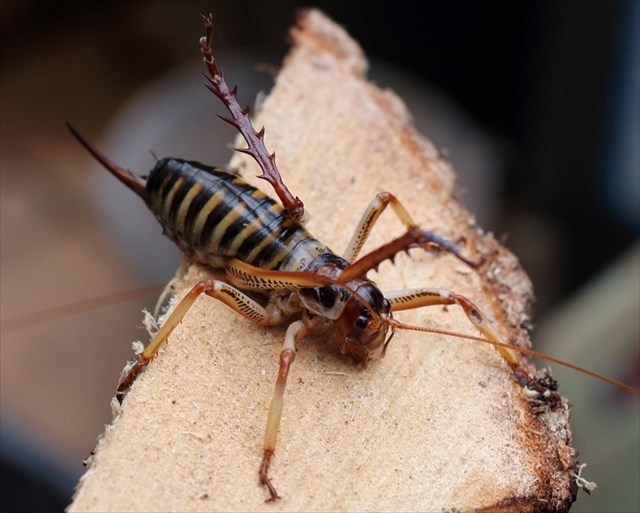
A female weta in 'keep off' pose
It is the male Wellington weta that has formidable mandibles that can deliver a very painful nip to the unwary! The female looks scary but is pretty harmless: she raises those spiky legs over her back to scare you off and jabs them at you, and makes a rasping noise too. It is usually rather effective 
Many thanks to GSEL for finding a suitable specimen of this type of tree where I could place the cache: one I had wanted to include in the series for a long time, but which had eluded me.
Why did I want to include this tree in the series so much, apart from its name? Well it all goes back to the early 1980's when our children were very young and were at kindy. The children at kindy (and their parents) were taught a new song titled 'The Putaputaweta in the Bush', which was one of those songs like Old Macdonald's Farm that gets longer and longer with each verse. That meant it took quite a few minutes to sing it and quite a bit of concentration to remember where you'd got to in the song as you sang each verse. Back in those days our family holidays were spent camping and we'd go on quite a lot of short(ish) bush walks with the children. But being under 5 years old they'd easily tire. To avoid too many niggles we would start to sing the Putaputaweta song when this happened and by the time we'd finished it the niggles would have been forgotten, for a while at least. Then we'd sing it again...
The song went like this:
There's a putaputaweta in the bush
There's a putaputaweta in the bush
In the bush
In the bush
There's a putaputaweta in the bush
There's a trunk on the putaputaweta in the bush
There's a trunk on the putaputaweta in the bush
There's a trunk
There's a trunk
There's a trunk on the putaputaweta in the bush
There's a branch on the trunk on the putaputaweta in the bush
There's a branch on the trunk on the putaputaweta in the bush
There's a branch
There's a branch
There's a branch on the trunk on the putaputaweta in the bush
There's a hole in the branch on the trunk on the putaputaweta in the bush
There's a hole in the branch on the trunk on the putaputaweta in the bush
There's a hole
There's a hole
There's a hole in the branch on the trunk on the putaputaweta in the bush
There's a weta in the hole in the branch on the trunk on the putaputaweta in the bush
There's a weta in the hole in the branch on the trunk on the putaputaweta in the bush
There's a weta
There's a weta
There's a weta in the hole in the branch on the trunk on the putaputaweta in the bush
If you don't want a nip from the weta in the hole in the branch on the trunk on the putaputaweta in the bush
If you don't want a nip from the weta in the hole in the branch on the trunk on the putaputaweta in the bush
If you don't
Want a nip
Then don't put your finger in the hole in the branch on the trunk on the putaputaweta in the bush!
So, what I wanted was to hide a micro in a puriri moth hole in a branch on the trunk on a putaputaweta in the bush and then see what stories came up in the log entries...sadly this tree didn't really have a suitable hole for me to use. Luckily for you
Putaputaweta
Common name: Marble leaf
Botanical name: Carpodetus serratus
The putaputaweta is a small forest tree that grows up to 10 metres high with a trunk up to 30 cms diameter. Its branches spread outwards in flattened tiers. It is found throughout the North and South Islands and in Stewart Island, along forest margins and stream banks and from sea level to 1000 m and, as with almost all the trees in this series, can be found in CO's garden.
Leaves
The leaves are small, thin and leathery and are broadly oval in shape. They have finely serrated margins and can be up to 6 cms long and 3 cms wide. They have distinct veins and new leaves typically have a reddish tinge on the under surface. The upper surface is varying shades of green giving the leaf a slightly marbled appearance, hence its common name: Marble leaf. Juvenile trees have smaller leaves than mature trees.
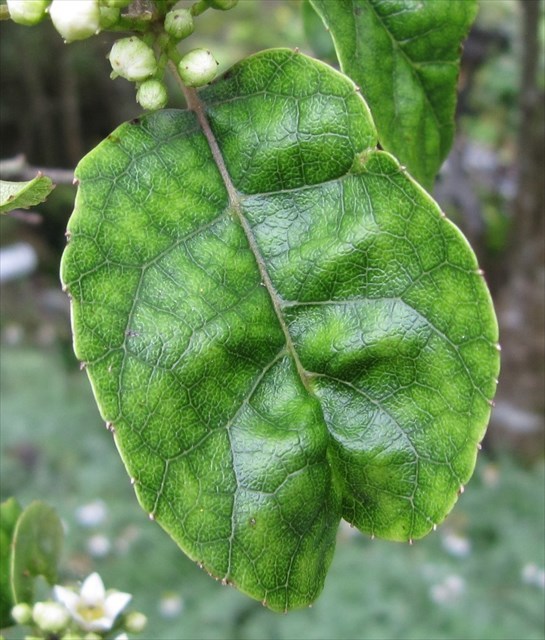
Upper surface of leaf
Flowers and Fruit
The flowers are small and creamy-white, 5 mms across, and are borne in profusion in early summer. They emit a scent like honey. They are followed by small fruits, which turn black when ripe.
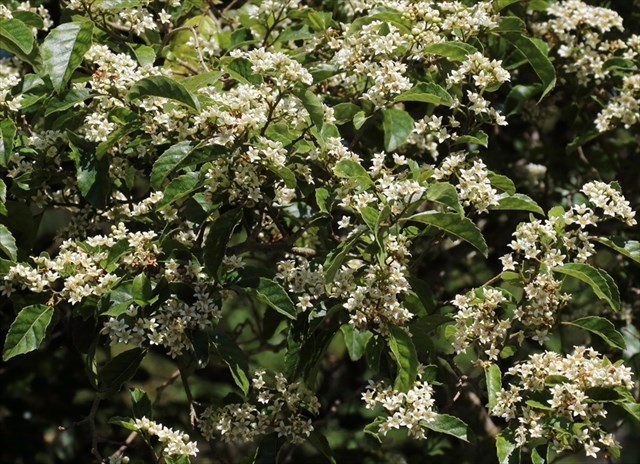
A profusion of flowers
Bark
The bark is rather knobbly and grey in colour. When you look at the tree at GZ you will also see some dark brown flat spots dotted about on the trunk and branches. Close investigation of these spots (try pressing one with your finger) will reveal that these flat spots are soft and give when you press them. They are actually made of silk covered with sawdust and have been spun by the puriri moth caterpillar across the entrance to its burrow. The burrow (the holes that the weta live in once the moth has hatched and has left home) slant upwards to start, then when the caterpillar reaches the dead centre of the trunk/branch it turns about 120 degrees and burrows down. It is pretty much impossible for a predator to hook the caterpillar out and the initial uphill slant keeps water out. Very clever of them, I reckon.
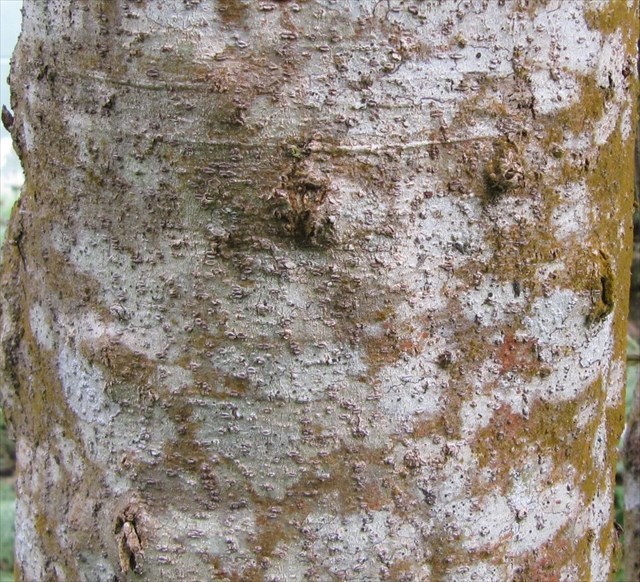
Bark on a mature tree - no moth holes
The putaputaweta at GZ
The tree at GZ is a rather small specimen with multiple trunks: more of a shrub than a decent tree, but it does mean you can easily see the marbled foliage and, if you visit at the right time of year (early summer) see and smell the flowers.
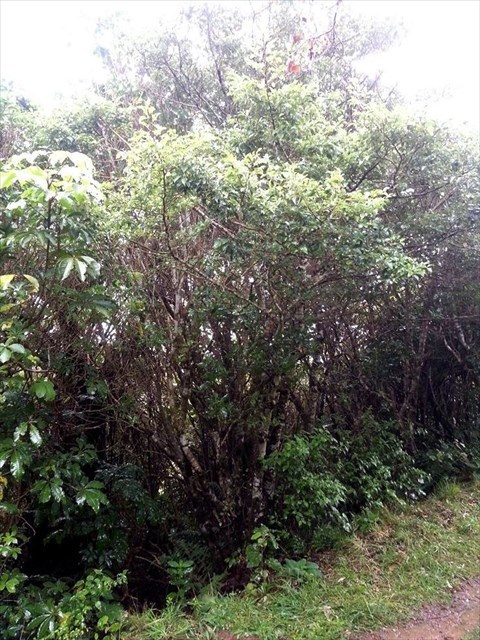
The putaputaweta at GZ
The cache
The cache is a 270 ml snaplock container and at time of placement contained a log book made from waterproof paper only. Please be sure to bring your own writing implement. There is room inside for one or two small TBs or Geocoins.
Please note that online logs that do not have a matching signature in the paper log will be deleted. No photo logs please.