https://www.youtube.com/watch?v=mo90k_8TexA
HU:
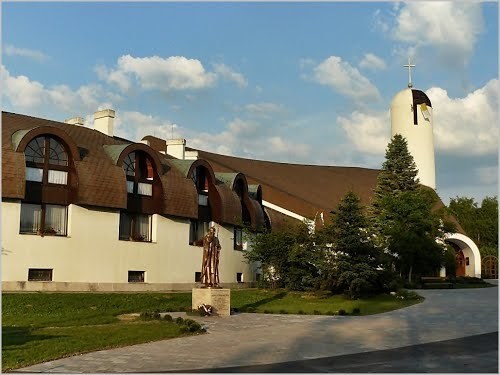
Az 1970-es évek második felében kezdődött meg Nádorváros déli részén a legnagyobb lakótelep építése. Az itt felmerülő lelki igényeket a meglévő templomok nem tudták kielégíteni, ezért szükségessé vált egy új templom építése.
1984. elején hat tervezőmérnök kapott megbízást az új építendő templom terveinek elkészítésére. 1984. szeptemberében megtartott tervbírálaton Ráskai Péter pályázata nyert elfogadást.
A tervkészítéssel párhuzamosan folyt a templom építéséhez szükséges anyagiak gyűjtése Győr városában. Vasárnaponként egy-egy templomban ismertették az új templom építésének nagyszabású tervét és kérték a hívek anyagi és önkéntes munkájukkal való támogatását. Így kovácsolódott össze egy olyan lelkes közösség, mely két éven át kivette részét az építkezésből.
Mivel a templom a lakótelep oldalán nem épülhetett, ezért a köztemető tőszomszédságában a 83-as út mellett kapott helyet. A helyszíni munkálatok 1985. március 10-én kezdődtek. 1987. június 6-ra a templom olyan mértékben elkészült, hogy szentelhetővé vált.
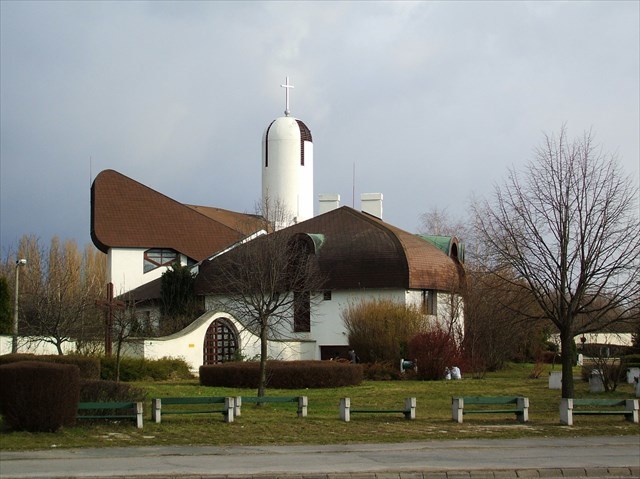
Az épület két fő egységből áll: a templomból és a plébániaépületből, ezek összes beépített alapterülete 3.000 m2. A templom alapterülete 504 m2, mely az üvegfal megnyitásával – a 102 m2-es liturgikus udvar bevonásával – növelhető.
A plébánia háromszintes épület. Az alagsorban hat hittanterem és egy nagy előadóterem szolgálja a hitoktatást és az egyházközségi életet. A középső szint a plébánia lakószintje. A tetőtér, mely szervesen kapcsolódik a templom karzatához, a fiatalok hitoktatását szolgálja, valamint lehetőséget biztosít 25 fős csoportok számára lelki gyakorlatok tartására.
A templomba a torony tövében elhelyezett előtéren át lehet bejutni. Az előtér a templom teljes lezárása mellett is nyitva tartható.
Az előcsarnokból a templomba lépve bal kéz felől Szent Rita szobra áll, míg jobb kéz felől egy ablak alatt a térdeplő Mária, a Szűzanya szobra látható. Mindkét szobor Rieger Tibor alkotása.
A szinte puritán egyszerűségű templom belső terét a meleget árasztó vörösfenyő famennyezet és a színes üvegablakok töltik meg lélekkel. A szentély két oldalán található a két legnagyobb, emberi alakokat ábrázoló színes ablak a képek alatt egy-egy Szentlélekkel kapcsolatos szentírási idézettel.
A színes üvegablakok mellett a templom komoly díszítő és tanító elemei a fafaragások, domborművek és a Szent József-szobor. Ezeket a színes ablakokhoz hasonlóan Kákonyi Asztrik ferences atya tervezte. A bejárattal szemben, a kórus feljárata és az altemplom bejárata közötti pillérről tekint le ránk és fogad bennünket a szent család őre, Szent József.
Az előcsarnokból az altemplomba haladva félúton megállhatunk a Fájdalmas kápolnában. Az evangéliumi jelenettel találjuk magunkat szemben: Jézus a kereszten, a kereszt alatt a Szűzanya és a szeretett tanítvány, János; balról az olajfák hegyi jelenet, jobbról pedig a Fájdalmas Anya domborműve, amint karjában tartja halott fia testét. Ez a kompozíció is Kákonyi Asztrik terve alapján készült.
A koporsós és urnás temetkezésre egyaránt alkalmas kripta mind a temető felől kívülről, mind a templom felől belülről megközelíthető.
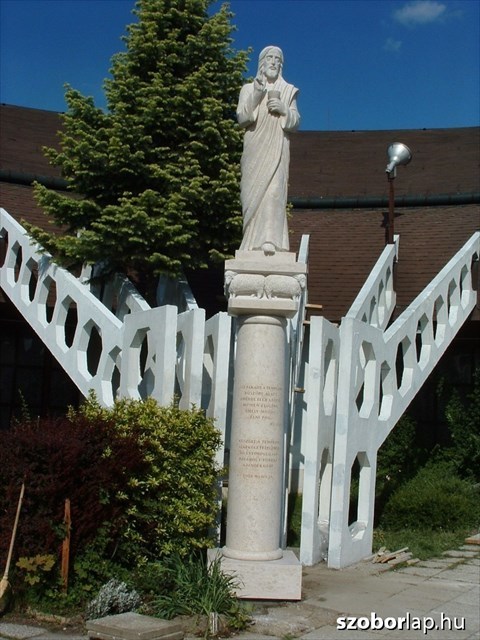
A templom alapkőletételének 20. évfordulóján került felállításra a plébánia bejárata előtt álló Krisztus-szobor. Jézus kezében kehely, az oszlopfő mind a négy oldalán 2-2 bárány látható.
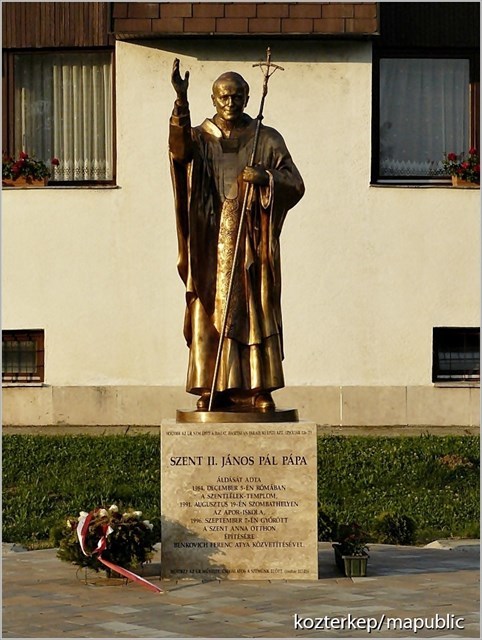
Szent II. János Pál pápa
Győr legfiatalabb templomának alapkőletételére 1985. májusában került sor, amire II. János Pál pápa adta áldását.
Az alapkőletétel 30. évfordulója emlékére állították fel – elsősorban adományból, illetve az egyházközség alapítványi támogatásával – az akkor már szentté avatott II. János Pál egész alakos szobrát a templom előtti téren.
Szent II. János Pál pápa (született: Karol Józef Wojtyła; 1920–2005) a katolikus egyház legfőbb embere volt 1978-tól haláláig. Pápai tevékenységét bizonyos kérdésekben konzervativizmus jellemezte (erkölcsi kérdések), másrészt a katolikus egyház korábbi irányvonalához képest éppen liberálisnak számított.
Támogatta a "megbékélést és együttműködést" a többi keresztyén egyházzal és felekezettel, sőt a katolikus egyház és a zsidóság közötti megbékélés terén is lépéseket tett.
II. János Pál pápa szentté avatása némileg rendhagyó. A katolikus egyház előírásai szerint legkevesebb öt évet kell várni a jelölt elhunyta után a szentté avatási eljárás elindításáig, de ugyanakkor kivételt is enged.
Az előzetes vizsgálatok után utóda 2011. május 1-jén boldoggá avatta, majd 2014. április 27-én megtörtént szentté avatása is, amihez már a Ferenc pápa írta alá a szükséges iratokat.
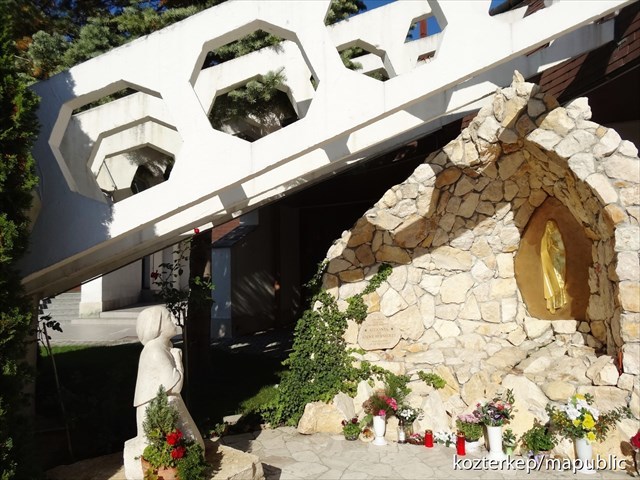
Szent Bernadett
A szobor a Szentlélek-templom bejárata mellett található.
Bernadette szegény családban született 1844-ben, Lourdes francia településen. Legidősebb gyermekként, öt testvére mellett nevelkedett. Gyermekkorában sokat betegeskedett.
Tizennégy éves korában látta első alkalommal Máriát, aki összesen 18 alkalommal jelent meg neki.
1858. február 11-én Bernadette a Gave folyócska közelében, egy barlangban sugárzó fehérbe öltözött női alakot látott, aki szótlanul rámosolygott, majd eltűnt. A szép ismeretlen három nap múlva újra megjelent, és ettől kezdve július 16-áig bezárólag még további 16 alkalommal. Február 18-án, a harmadik találkozás alkalmával már meg is szólította a lányt, és február 25-én megmutatta a gyermeknek a barlang lábánál lévő rejtett forrást. Március 26-án a Szűzanya megnyilatkozott előtte. Többször is felszólította, hogy menjen a falu papjához, és mondja meg neki, hogy építtessen templomot a forrás mellé, és tegye zarándokhellyé.
Bernadette elbeszélését hitetlenség fogadta, de a lány a legszigorúbb kihallgatások alatt is ragaszkodott kijelentései igazságához. Ezután pedig a forrás mellett valóban csodálatos gyógyulások tanúja lett a falu népe. A csodák világhírűvé tették, s ma Lourdes a világ legnagyobb Mária-búcsújáró helye, a reménység forrása, ahol még ma is sok ember meggyógyul az ott fakadó víztől, a tudomány pedig nem talál erre magyarázatot.
EN:
In the second half of the 1970s the construction of the largest residential district was started in the southern part of Nádorváros. The existing churches could not gratify the occurrent spiritual needs of the growing population so it became necessary to build a new church.
At the beginning of 1984, six architects were commissioned to prepare plans for the construction of a new church. In September 1984 the plans of Peter Ráskai were accepted.
Parallel with the planning, the collection of the necessary wherewithal for the construction was carried out in the city of Győr. Every Sunday in one of the churches the grand plan for a new church was announced and the support of the faithful was asked in money and voluntary work. That is how an enthusiastic community was forged which actively participated in the construction work for two years.
It was not possible to build the church to the side of the residential district therefore it was placed next to the cemetery along the road 83. On-site work started on March 10, 1985. The church was ready for consecration by June6, 1987.
The building consists of two main units: the church and the parsonage, all of which have a built-in area of 3.000 m2. The ground space of the church is 504 m2, which can be increased with the 102 m2 liturgical courtyard by opening the glass wall.
The parsonage is a three-storey building. In the basement there are six rooms and a large auditorium serving religious education and ward life. The middle storey is the residential level of the parish. The attic, which is linked to the church's gallery, serves young people's religious education as well as gives an opportunity for groups of 25 to hold spiritual exercises.
The church can be accessed through the parvis in the base of the tower. The parvis can be kept open even when the church is closed.
Stepping into the church from the parvis, on the left stands the statue of St. Rita, while on the right a statue of the kneeling Virgin Mary can be seen. Both sculptures were made by Tibor Rieger.
The interior of the puritanically simple church is filled with spirit by the colourful glass windows and the larch wooden ceiling that radiates warmth. The two largest colourful windows – presenting human figures and a citation from the Bible related to the Holy Spirit – can be found on the two sides of the shrine.
In addition to the colourful glass windows, the church has many decorative and teaching elements like wood carvings, reliefs and the statue of St. Joseph. Like the coloured windows, they were designed by the Franciscan Father Asztrik Kákonyi. Across the entrance, from the pillar between the stairway to the choir and the entrance to the undercroft looks down upon us the guardian of the Holy Family, St. Joseph.
Going to the undercroft from the parvis, we can stop halfway at the Painful Chapel. We find ourselves in front of the evangelistic scene: Jesus on the Cross, the Blessed Virgin and the Beloved Disciple, John under the cross; on the left is the scene of the Garden of Olives; on the right is the relief of the Painful Mother as she holds her dead son in her arms. This composition is also based on Kázonyi Asztrik's plan.
The crypt which is suited for both coffin and urnal burial can be accessed from the outside through the cemetery and from the inside through the church.
The statue of Christ, which stands before the parsonage entrance, was erected on the 20th anniversary of the foundation of the church. In the hands of Jesus there is a chalice, on the four sides of the column head 2-2 lambs can be seen.
St. Pope John Paul II
Laying of the foundation-stone of Győr's youngest church took place in May 1985 with the blessing of Pope John Paul.
In remembrance of the 30th anniversary – mainly from donations and with the support of the foundation of the ward – a whole-body statue of the already canonized Pope John Paul was erected in front of the church.
St. Pope John Paul II (born: Karol Józef Wojtyła, 1920-2005) was the cardinal person of the Catholic Church from 1978 until his death. His papal activity was characterized by conservatism on certain issues (moral questions); on the other hand, he was counted as liberal in comparison with the previous policy of the Catholic Church. He supported "reconciliation and cooperation" with other Christian churches and sects, even in the field of reconciliation between the Catholic Church and Jewry.
The canonization of Pope John Paul II is somewhat unusual. According to the requirements of the Catholic Church, it is necessary to wait for at least five years after the death of the candidate to start the sanctification process, but there can be some exceptions.
After preliminary examinations, his successor blessed him on May 1, 2011, then he was canonized on April 27, 2014, for which the necessary papers were signed by Pope Francis.
St. Bernadette
The statue is next to the church entrance.
Bernadette was born in a poor family in 1844 in Lourdes, France.
She saw Mary for the first time at the age of fourteen who appeared before her 18 times altogether.
On February 11, 1858, Bernadette saw a glowing female figure dressed in white in a cave near the Gave River, smiling silently and then disappearing. The beautiful stranger reappeared three days later and thereafter, until 16th July, for another 16 times. On February 18, at the third meeting, she addressed her, and on February 25 she showed the child the hidden spring at the foot of the cave. On March 26, the Blessed Virgin appeared before her. She repeatedly told her to go to the priest of the village and tell him to build a church next to the spring and make it a pilgrimage site.
ma Lourdes a világ legnagyobb Mária-búcsújáró helye, a reménység forrása, ahol még ma is sok ember meggyógyul az ott fakadó víztől, a tudomány pedig nem talál erre magyarázatot.
Bernadette's recital was received with disbelief, but she insisted on the truthfulness of her statements during the most intense interrogations. After that wonderful recoveries were observed by the people of the village. These wonders made the place world famous, and today Lourdes is the world's largest place of pilgrimage to Mary, the source of hope, where many people are still recovering from the water of the spring, and science can not find an explanation for it.