History of the area
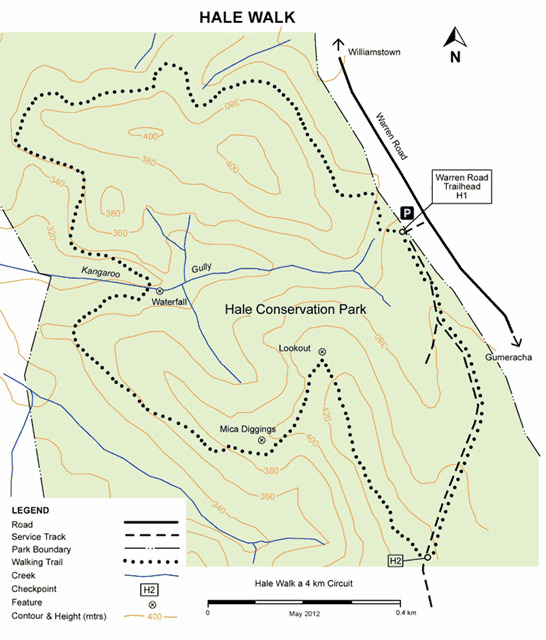
The underlying rock at Hale Conservation Park is aldgate sandstone, deposited about 800 million years ago as sand and pebbles in alluvial fans developing at the foot of an escarpment that lay to the west. This occurred within a huge depression known as the Adelaide Geosyncline. At this time a shallow sea lay to the east covering what is now eastern Australia.
About 500 million years ago this sandstone was heated and compressed as a result of movements in the earth's crust. This changed clay particles, deposited with the sand, into mica. At the same time mineral-rich fluids were injected along cracks in the sandstone to form quartz veins and pods of mixed minerals called pegmatites, which may yield gemstones such as beryl.
Mica
Mica is widely distributed and occurs in igneous, metamorphic and sedimentary regimes. Large crystals of mica used for various applications are typically mined from grantic pegmatites.
Flake mica comes from several sources: the metamorphic rock called schist as a by product of processing feldspar and kaolin resources, from placer deposits, and from pegmatites. Sheet mica is considerably less abundant than flake and scrap mica, and is occasionally recovered from mining scrap and flake mica. The most important sources of sheet mica are pegmatite deposits.
Four common mica types
Biotite a very common mineral of the mica group, occurring in black, dark-brown, or dark-green sheets and flakes: an important constituent of igneous and metamorphic rocks.
Lepidolite is a lilac-gray or rose-colored member of the mica group of minerals. It is the most abundant lithium-bearing mineral and is a secondary source of this metal.
Phlogopite is a yellow, greenish, or reddish-brown member of the mica family of phyllosilicates. It is also known as magnesium mica.
Muscovite is the most common form of mica, Its name is derived from “Muscovy Glass” which describes thick sheets of transparent mica that were once used as a glass substitute in Russia.
Some common uses for mica are electronic insulators, paints, as joint cement, as a dusting agent, in well drilling mud and lubricants, and in plastics, roofing, rubber, and welding rods
Questions
Q1 Desribe the mica you see here (ie size, colour, texture, etc).
Q2 Reading the four common types of mica above which do you think best describes what you see at GZ.
Info sourced from Wikipedia
Further park information https://www.environment.sa.gov.au/parks/find-a-park/Browse_by_region/Barossa/hale-conservation-park
IMPORTANT.;
As per the Earth Cache guidelines, once you complete the Earth Cache requirements you can post your find without delay.
BUT You will also need to verify your find by sending us a message and provide your answers to the above questions.
Above all we hope you enjoy your visit.