The coordinates will lead you to a roadside pullout along the Icefields Parkway between Lake Louise and Jasper (parking area has restroom facilities). From the coordinates go to Waypoint 1 along the narrow trail parallel to the highway. You will find a quicksand protected by wooden fences.
Don't go over the fence to the quicksand please! You shall be in a very dangerous situation.
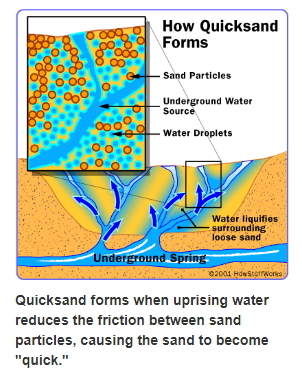 Quicksand is an interesting natural phenomenon -- it is actually solid ground that has been liquefied by a saturation of water. The "quick" refers to how easily the sand shifts when in this semiliquid state.
Quicksand is not a unique type of soil; it is usually just sand or another type of grainy soil. Quicksand is nothing more than a soupy mixture of sand and water. It can occur anywhere under the right conditions, according to Denise Dumouchelle, geologist with the United States Geological Survey (USGS).
Quicksand is created when water saturates an area of loose sand and the ordinary sand is agitated. When the water trapped in the batch of sand can't escape, it creates liquefied soil that can no longer support weight. There are two ways in which sand can become agitated enough to create quicksand:
(1)Flowing underground water - The force of the upward water flow opposes the force of gravity, causing the granules of sand to be more buoyant.
(2)Earthquakes - The force of the shaking ground can increase the pressure of shallow groundwater, which liquefies sand and silt deposits. The liquefied surface loses strength, causing buildings or other objects on that surface to sink or fall over.
Vibration tends to enhance the quickness, so what is reasonably solid initially may become soft and then quick, according to Dr. Larry Barron of the New South Wales Geological Survey.
The vibration plus the water barrier reduces the friction between the sand particles and causes the sand to behave like a liquid. To understand quicksand, you have to understand the process of liquefaction. When soil liquefies, as with quicksand, it loses strength and behaves like a viscous liquid rather than a solid, according to the Utah Geological Survey. Liquefaction can cause buildings to sink significantly during earthquakes.
While quicksand can occur in almost any location where water is present, there are certain locations where it's more prevalent. Places where quicksand is most likely to occur include:
- Riverbanks
- Beaches
- Lake shorelines
- Near underground springs
- Marshes
The next time you're at the beach, notice the difference in the sand as you stand on different parts of the beach that have varying levels of moisture. If you stand on the driest part of the beach, the sand holds you up just fine. The friction between the sand particles creates a stable surface to stand on.
If you move closer to the water, you'll notice that the sand that is moderately wet is even more tightly packed than the dry sand. A moderate amount of water creates the capillary attraction that allows sand particles to clump together. This is what allows you to build sand castles.
But beach sand could easily become quicksand if enough water were thrust up through it. If an excessive amount of water flows through the sand, it forces the sand particles apart. This separation of particles causes the ground to loosen, and any mass on the sand will begin to sink through it.
[How to log]
- The color of the water in the quicksand is relatively clear when you compare it with those of other lakes in the area. What do you think is the reason?
- Observe the quicksand and describe it in your word!
- There are five places where quicksand is most likely to occur. What category do you think this quicksand shall be classified into?
- How big is the quicksand? (About OO meters in diameter)
- Please send the answers(With Cache name and GC code on top) to me by message on my profile! Now you may log as 'Found'. If the answer is not correct, I will contact you.
Ref :
https://science.howstuffworks.com/environmental/earth/geology/quicksand1.htm
| I have earned GSA's highest level: |
 |
Congrats to leega305 & axell33 on their FTF!