To reach the cache zone, cross the Golden Gate Bridge. Exit right to Alexander Ave just after crossing the bridge. Cross under Hwy 1 and turn right on Conzelman Road. The coordinates will lead you to parking area off Conzelman Road.
*** Warning from the National Park Service
Enter only open areas when visiting the Golden Gate National Recreation Area, do not enter closed areas, because geologic conditions are ever changing. Obey and observe all signs and fencing erected by the park and do not put yourself at risk.
The reddish-brown, swirly rock in front of you is ribbon chert. This hard sedimentary stone started out in the Pacific as deep-sea clay full of the microscopic shells of radiolarians, lying on the volcanic rocks of the seafloor. It was once flat beds, but as the seafloor was subducted beneath California the chert was crumpled into a picturesque state. The crust itself was also crumpled, sliced into ribbons and stacked up.
Chert deposited
Chert is a sedimentary rock rich in silica. Franciscan chert is formed from the tiny silica shells (0.5-1 mm) of marine plankton called Radiolaria. Radiolarian chert forms where two conditions are met. First, a deep, open ocean setting is required where there is little continental mud or carbonate sediment to dilute the “rain” of dead radiolarian shells settling to the seafloor. Second, the upper ocean waters need to be relatively rich in nutrientsin order for abundant Radiolaria to thrive.
The radiolarian species in the Franciscan chert in the Marin Headlands lived and died to form the rocks during the period from about 200 million to 100 million years ago.
Most local chert is red and less commonly green, but it may be a range of colors. The color reflects the amount of oxygen present in the sediment when it became rock. If oxygen is plentiful in the sediment, it oxidizes small amounts of iron present and the chert is red. If oxygen is scarce, the iron is reduced and the chert is green or black.
Folded Chert
Many Franciscan chert beds are highly folded and contorted. Some scientists believe that this type of folding is the product of the slumping of the soft gelatinous silica-rich sediments, contorting them before they are fully hardened into rock. This slumping may have occurred on the flank of an oceanic mountain range as earthquakes shook the tectonically active mid-ocean ridge. Another theory is that the chert beds were folded by compressive forces developed as the Franciscan Complex was created by the scraping and addition of oceanic rocks to the western margin of North America.
Types of fold are as follows; 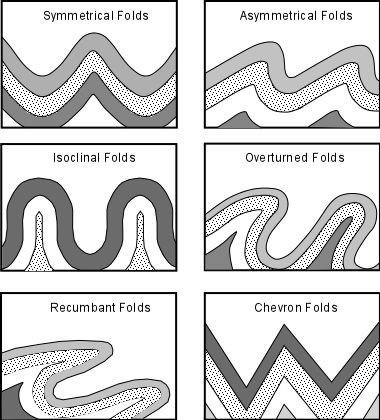
(1) A symmetrical fold is one in which the axial plane is vertical.
(2) An asymmetrical fold is one in which the axial plane is inclined.
(3) When the two limbs of a fold are essentially parallel to each other and thus approximately parallel to the axial plane, the fold is called isoclinal.
(4) An overturned fold, or overfold, has the axial plane inclined to such an extent that the strata on one limb are overturned.
(5) A recumbent fold has an essentially horizontal axial plane.
(6) Chevron folds are a structural feature characterized by repeated well behaved folded beds with straight limbs and sharp hinges.
[How to log]
- The cache zone was deep-sea clay long time ago.(True or False)
- When did the radiolarian species in the area live and die to form the rocks?
- What made the ribbon chert highly folded here? Mention at least one!
- What type of folds can you observe at the lower central part of the rock in front of you? What is the color of it? And why?
- Go to Waypoint 1! What type of folds can you observe there? Estimate the distance between A and B shown in the picture?
- Please send the answers(With Cache name and GC code on top) to me by message on my profile! Now you may log as 'Found'. If the answer is not correct, I will contact you.
Ref:
https://www.nps.gov/goga/learn/education/chert-faq.htm
https://www.britannica.com/science/fold#ref278145
https://www.tulane.edu/~sanelson/eens1110/deform.htm
| I have earned GSA's highest level: |
 |
Congrats to J5 Crew on FTF!