
Hallacas is the oldest food tradition in Venezuela and it is the most popular Christmas meal served during the holidays. It is still prepared in a similar fashion to colonial times with some modern refinements. The hallaca is also considered one of the most representative icons of Venezuelan multicultural heritage,as its preparation includes European ingredients (such as raisins, nuts and olives), indigenous ingredients (corn meal colored with annatto seeds), and African ingredients (smoked plantain leaves used for wrapping). Its name is pronounced "ah-ya-ka". Although there are many different stories about its origins, the most popular one states that it was created by the slaves during the colony times. During those days the slaves used to put the leftovers of their master's Christmas festivities in a bit of cornmeal dough, then they would wrap them with banana leaves and boil them to mix the flavors.
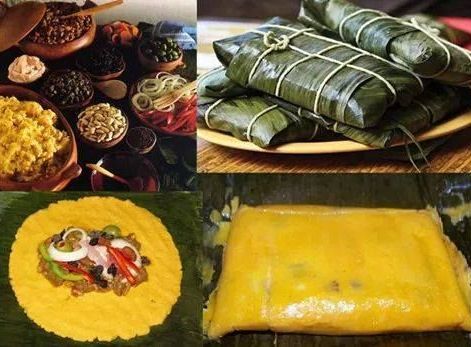
As many things in Venezuela, the hallaca has the influence of three cultures the white, the indian, and the african. The original hallaca is made with meat (pork, poultry and beef); for instance the andeans like to add boiled eggs into the mix, and every single region has its own different traditions and ways to give it their personal signature, as well as families. This is also the reason why they say: "No hallaca tastes the same as another". The hallaca tastes better once it has cooled down and settled in the fridge for at least one day. It requires hours to make them, but they are usually made by the whole family. Its preparation requires organization and dedication but still it is a celebration by itself. Holiday music (gaitas, villancicos, and aguinaldos) are heard during its making also Christmas drinks like Ponche Crema (eggnog) make up the festive atmosphere.
They say that back in the years of the revolution of independence, each Christmas eve, the wealthy families prepared huge banquets, an a selected variety of meats and stews adorned the Venezuelan tables. The next day the slaves who poked around, would collect the leftovers and wrapped them in corn dough and the covered them with banana leaves winding up straight into big pots boiling on wood. From this process, has evolved the recipe that has survived for centuries and until today is still maintained; is the recipe of our popular hallaca.
Ingredients:
- 1/4 cup plus 2 tablespoons olive oil, divided
- 1 (8-ounce) skinless, boneless chicken breast half, chopped
- 6 ounces beef sirloin, chopped
- 6 ounces pork tenderloin, finely chopped
- 1 1/2 cups finely chopped leek
- 1 cup finely chopped onion
- 1/3 cup chopped green onions
- 2 garlic cloves, minced
- 1 2/3 cups chopped green or red bell pepper
- 1/2 cup chopped seeded Cubanelle or Anaheim chile
- 3/4 cup chopped seeded tomato
- 2 1/2 cups fat-free, lower-sodium chicken broth, divided
- 1/3 cup red wine vinegar
- 2 tablespoons brown sugar
- 1 teaspoon smoked paprika
- 1/2 teaspoon salt
- 1/2 teaspoon ground red pepper
- 1/4 teaspoon black pepper
- 1/2 cup sliced shallots
- 1/2 cup sliced roasted red bell pepper
- 1/2 cup raisins
- 1/3 cup sliced pimiento-stuffed olives
- 1/2 cup finely chopped sweet pickles
- 1/2 cup small capers
- 1/2 cup sliced almonds
- 1/4 cup chopped fresh cilantro
- 1 tablespoon annatto (achiote) seeds
- 1 1/3 cups butternut squash puree (canned or fresh)
- 3 cups precooked white corn flour
- 1/2 teaspoon salt
- 16 (12-inch) squares foil
Directions:
- Heat a large nonstick skillet over medium-high heat. Add 1 tablespoon oil to pan; swirl to coat. Add chicken; cook 5 minutes or until done, stirring occasionally. Remove from skillet. Add 1 1/2 teaspoons oil to pan; add beef and pork, and cook 5 minutes or until done, stirring occasionally. Remove from skillet. Reduce heat to medium; add 1 1/2 teaspoons oil. Add leek, onion, green onions, and garlic; sauté 5 minutes. Add bell pepper and chile; sauté 5 minutes. Add tomato; cook 5 minutes or until tomato breaks down. Mash with a wooden spoon. Add 1 cup broth, vinegar, and next 5 ingredients (through black pepper); bring to simmer over high heat. Return meats to pan; reduce heat to medium-low, and simmer 30 minutes or until liquid almost evaporates and mixture is slightly thick. Remove from heat; cool slightly, and stir in next 8 ingredients (shallots through cilantro).
- Place remaining 1 1/2 cups broth in a large glass measure. Microwave at HIGH 1 to 2 minutes or until warm.
- Discard annatto seeds; reserve 1 tablespoon annatto oil. Scrape remaining annatto oil into a food processor using a rubber spatula. Add warm broth, squash puree, corn flour, and 1/2 teaspoon salt; process 2 minutes or until well blended and dough forms. Let stand in food processor, covered, 30 minutes..
- Shape dough into 16 (2-inch) balls with moist hands; place on a cutting board lined with damp paper towels (cover with plastic wrap to prevent drying).
- For each tamale, place 1 foil square, shiny side up, on work surface; lightly brush annatto oil down center of square. Place 1 dough ball in center of square over oil; pat dough into a 6-inch circle with moist fingers. Spoon about 1/3 cup filling onto dough circle, leaving a 1/2-inch. Top with an egg slice. Use foil to fold dough over filling, top to bottom then side to side, using moist fingers to seal the edges. Wrap foil over tamales top to bottom then side to side like a package. Steam tamales, covered, 1 to 1 1/2 hours or until dough is firm. Unwrap hallacas. Garnish with sour cream and cilantro, if desired.