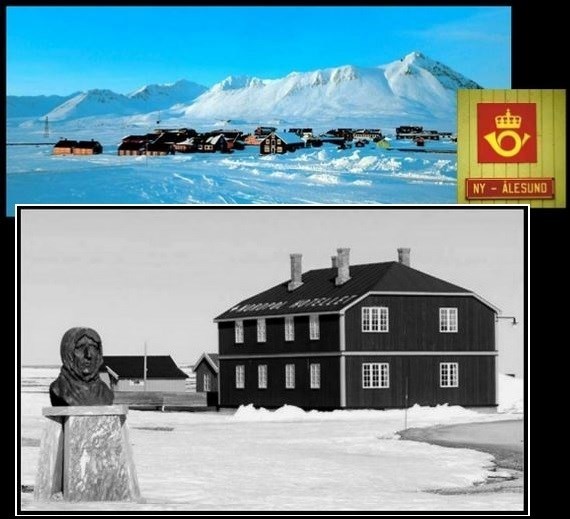
The intension of this earthcache is to get to know the marble stone better.
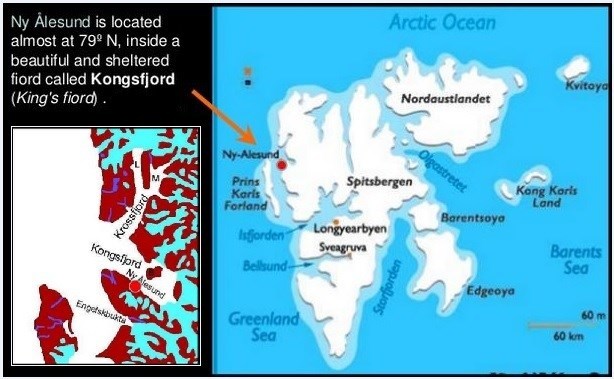
And at gz you will find a nice piece of sample from where the statue of Roald Amundsen is placed. He was a Norwegian explorer of arctic and antarctic regions, Amundsen was the first person to reach both the north and the south poles. And his startpoint 1926 to reach the north pole was here in Ny Ålesund.

Both limestone and marble (converted limestone) are a common rock in the Norwegian bedrock. Limestone is more widespread in the Oslo area, while marble is found in the bedrock mountain and the Caledonous rocks that have been exposed to high pressure and temperature in the Earth's crust. Marble is very common in the county of Nordland, and Norway’s upper part.
The limestone in the north norwegian area were deposited for a long period of time from late prehistoric era to silurian periode from (650-444 million years), but the actual transformation of marble occurred in the silurian time frace (444-416 million years).
Metamorphic rocks have been modified by heat, pressure, and chemical processes, usually while buried deep below Earth's surface. Exposure to these extreme conditions has altered the mineralogy, texture, and chemical composition of the rocks.
There are two basic types of metamorphic rocks. Foliated metamorphic rocks such as gneiss, phyllite, schist, and slate have a layered or banded appearance that is produced by exposure to heat and directed pressure.
Non-foliated metamorphic rocks such as hornfels, marble, quartzite, and novaculite do not have a layered or banded appearance.
Marble as mentioned above is a non-foliated metamorphic rock, it is produced from the metamorphism of limestone or dolostone. It is composed primarily of calcium carbonate.
The metamorphic rock is mostly made of the mineral calcite – (CaCO3) – That means that the rock contains a lot of calcium, carbon and oxygen. The starting point for such a rock is often the peel from shells and snails that have been deposited on the bottom of the ocean. Peel from shells and snails contains a lot of calcium and carbon. When shellsand petrifies limestone is formed. Furthermore, when a limestone undergoes metamorphosis, marble is formed. The crystals grow larger and become easily recognizable as interlocking crystals of calcite. Recrystallization obscures the sedimentary structures of the limestone. It also occurs without forming foliation, which normally is found in rocks that are altered by the directed pressure of a convergent plate boundary.
When the calcium minerals have recrystallized into new forms and done the process limestone till marble, all the rests and particles from fossils are wiped out. Limestone was made during the period of the Jurassic part, while Marble is older and found deeper down in the crust as mentioned at the top of the text.
Recrystallization is what marks the separation between limestone and marble. Marble that has been exposed to low levels of metamorphism will have very small calcite crystals. The crystals become larger as the level of metamorphism progresses. Clay minerals within the marble will alter to micas and more complex silicate structures as the level of metamorphism increases.
Mineralogy: 95% calcite (CaCO3) or dolomite Ca,Mg(CO3)2. Impurities may give rise to new minerals such as olivine.
Texture: medium to coarse grained, often showing a sugary texture.
Color: Marble is usually a light-colored rock. When it is formed from a limestone with very few impurities, it will be white in color. Marble that contains impurities such as clay minerals, iron oxides, or bituminous material can be bluish, gray, pink, yellow, or black in color.
Hardness: Being composed of calcite, marble has a hardness of three on the Mohs hardness scale. As a result, marble is easy to carve, and that makes it useful for producing sculptures and ornamental objects. The translucence of marble makes it especially attractive for many types of sculptures. Marble is softer than steel and therefore easy to process.
To log this cache.
To get to log this cache you will have to visit and answer the questions which are related to the coordinates given the earthcache.
When answers are collected, send them to CO for verification.
You can log immediately after answers are sent CO. If there are any questions about your answers CO will contact you.
Logs without answers to CO or with pending questions from CO will be deleted without any further notice.
Please do not include pictures in your log that may answer the questions.
Questions
1. Answer the questions under by visiting the Coordinates.
A. Marble is a metamorphic rock that forms when limestone is subjected to the heat and pressure of metamorphism. What can you say about the Marble at gz? And as Marble is formed from limestone, you often find fossils in these types of stones. Can any fossils be seen here?
B. Why is the stone color (light/medium colored/dark)?
C. What is it that the impurities in the marble stone may give rise to? What color do the impurities make in this stone?
D. How many % of calcite or dolomite would you guess is in this marble stone at gz?
2. (It’s voluntary to post a photo in your online log of your visit)
Without revealing any answers!
