Block Island - A Geological Moraine
First a brief history of the formation of Block Island:
In simple terms, 22,000 and 120,000 years ago 2 glaciers formed Block Island off the coast of Rhode Island. The older of the two brought boulders and sediment from the north, what is now known as Narragansett Bay. The second, more recent glacier came from the northwest, Connecticut and southwestern Rhode Island. This one deposited a finer, silty sediment to the existing rockier build up. This formation is called a moraine.
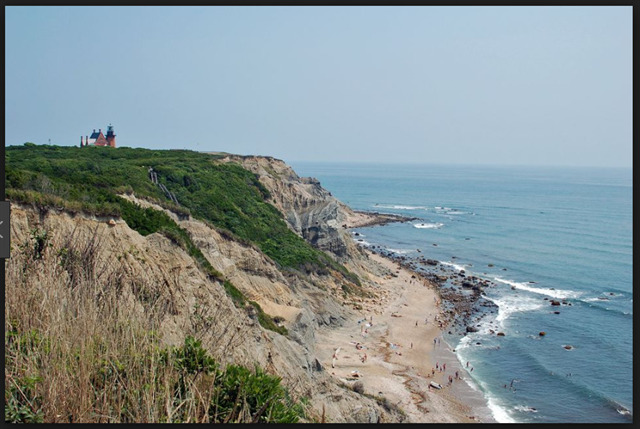
Moraine:
A moraine is any glacially formed accumulation of unconsolidated glacial debris (regolith and rock) that occurs in both currently and formerly glaciated regions on Earth (i.e. a past glacial maximum), through geomorphological processes. Moraines are formed from debris previously carried along by a glacier and normally consist of somewhat rounded particles ranging in size from large boulders to minute glacial flour.

Types of Moraines:
The National Geographic Society divides moraines into 4 categories: lateral moraines, medial moraines, supraglacial moraines, and terminal moraines.
Lateral Moraine
A lateral moraine forms along the sides of a glacier. As the glacier scrapes along, it tears off rock and soil from both sides of its path. This material is deposited as lateral moraine at the top of the glacier’s edges. Lateral moraines are usually found in matching ridges on either side of the glacier. If a glacier melts, the lateral moraine will often remain as the high rims of a valley.
Medial Moraine
Medial moraines are formed when two glaciers meet. Two lateral moraines from the different glaciers are pushed together. This material forms one line of rocks and dirt in the middle of the new, bigger glacier. If a glacier melts, the medial moraine it leaves behind will be a long ridge of earth in the middle of a valley.
Supraglacial Moraine
A supraglacial moraine is material on the surface of a glacier. Supraglacial moraines are made up of rocks and earth that have fallen on the glacier from the surrounding landscape. Dust and dirt left by wind and rain become part of supraglacial moraines. If a glacier melts, supraglacial moraine is evenly distributed across a valley.
Terminal Moraine
A terminal moraine is also sometimes called an end moraine. It forms at the very end of a glacier. At a terminal moraine, all the debris that was scooped up and pushed to the front of the glacier is deposited as a large clump of rocks, soil, and sediment.
The Geocache:
The listed coords will bring you to a double overlook. To log this geocache please send the answers to the following questions via email. Do not include your answers in your online log. After sending your answers, log the find. I will contact you if I have any questions about your responses.
1. Which type of moraine is Block Island?
2. In your own words describe why Block Island is the type of moraine that it is.
3. Describe the geological characteristic of the area around the overlooks.
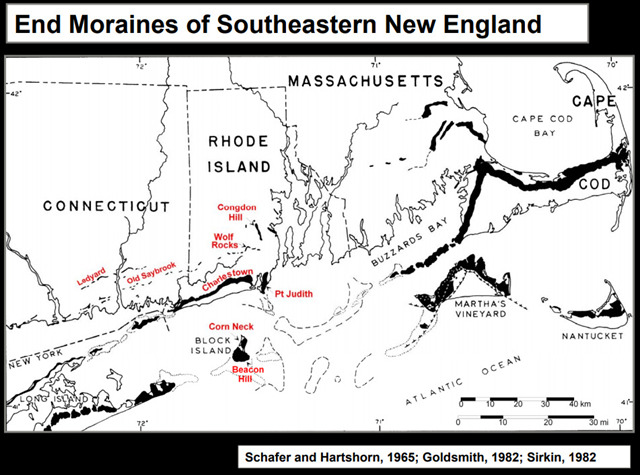
4. Looking at the above map, estimate how much of the moraine is actually underwater.
5. OPTIONAL: Post a picture of yourself at the overlook.
6. Favorite Points always enjoyed.
Resources:
1. https://www.nationalgeographic.org/education/teaching-resources/
2. https://en.wikipedia.org/wiki/Moraine
3. http://seagrant.gso.uri.edu/oceansamp/pdf/presentation/present_boothroyd_geological.pdf

Congrats to KeiPupule on FTF!