The Faroese basalts are remnants of a huge lava plateau that formed 60-54 Million years ago. The volcanic eruptions took place from several km long fissures. Eruptions of a similar scale are not known in historical times.
Two characteristic basalt lava types have been named on Hawai: Aa and pahoehoe. Both of which occur on the Faroese as well.
When the volcanic activity waned, subsidence of the plateau started. Release of stresses gave a rise to km long almost vertival fractures in the basalt. This created a new opening to the magma chamber and a pressure release, which provoked the magma (the sodawater effect). Basaltic melt could intrude, fill the fractures and form dikes.
An intrusive dyke is an igeneous body with a very high aspect ration, which means that its thickness is usually much smaller than the other two dimensions. Thickness can vary from sub-centimeter scale to many meters, and the lateral dimensions can extend over many kilometres. The forming of dykes implies that a dike is always younger than the rock that contain it.
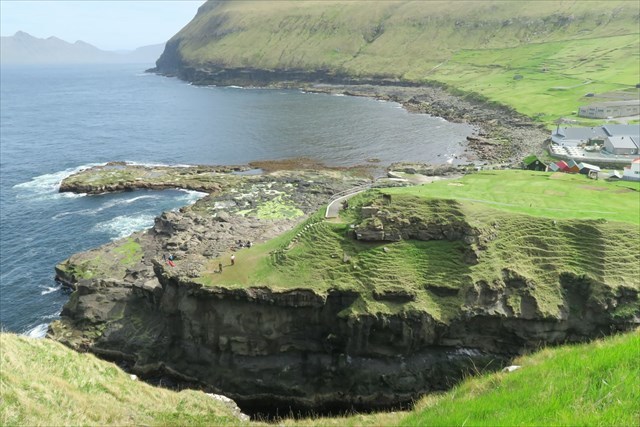
At the coordinates you will find a great field og pahoehoe-lava with a dike in it, which aligns roughly north-south direction.
To log this earthcache answer the following questions.
-
At first look at this dyke at the coordinates. Describes the structure and surface (colour, smooth, rough, friable, regular ...) Is there a concrete orientation of the position of the basalt columns? Are there clearly recognizable geometric shapes? Estimates the width of these columns. What is the reason for this orientation.
-
If you follow this stream in the direction of the sea, you will see a wall of basalt columns about 1.5 m high, while at the bottom it is almost level with the rest of the lava field. What is the reason for this. Describe the process with your words. With what would you compare the shape of the dyke yet?
-
Look to the opposite side (to the wall). What can you recognize there regarding the process described above?
You can imediately log this earthcache. I will contact you, if the answers will not fit.