

ESPAÑOL
El caché
Este caché está ambientado en la figura del sabio Eratóstenes, astrónomo, historiador, filósofo, matemático y poeta, que allá por el año 250 a. C. fue el primero que consiguió determinar de una manera muy aproximada las dimensiones de la Tierra.
Para obtener las coordenadas finales deberás realizar unos sencillos cálculos, similiares a los realizados en su día por Eratóstenes.
El caché está ubicado en una tranquila zona del centro de Zaragoza aunque muy frecuentada por geomugles, por lo que deberás extremar tu cuidado al cogerlo y dejarlo.
Las dimensiones de La Tierra
Eratóstenes vivió sobre el 250 a. C., fue astrónomo, historiador, filósofo, matemático y poeta, llegando a ser director de la biblioteca de Alejandría. Fue el primero que determinó con cierta precisión las dimensiones de La Tierra; para ello siguió un método que sorprende por su sencillez y genialidad, y que explicaremos a continuación.
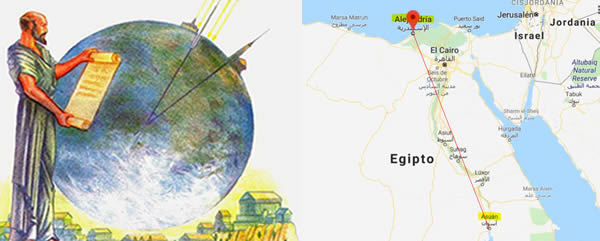
Eratóstenes y el cálculo de las dimensiones de la Tierra
En la biblioteca de Alejandría tuvo acceso a ciertos estudios en los que se indicaba que en la ciudad de Siena (la actual Asuán) los rayos solares en el solsticio de verano caían sobre una vara sin producir sombra alguna.
Eratóstenes reprodujo el mismo experimento en Alejandría, en la misma fecha, comprobando que sí se producía sombra, y midió el ángulo con el que incidían los rayos solares, que era de 7º y 12'. Considerando los rayos solares paralelos, debido a la enorme distancia del Sol, este fenómeno sólo podría ser explicado aceptando la esfericidad de la Tierra y rechazando, por tanto, el que fuera plana.
Alejandría y Siena se encuentran aproxidamente en el mismo meridiano y Eratóstenes conocía su distancia aproximada gracias a las informaciones de las caravanas de camelleros. Esta era de unos 5000 estadios, equivalentes a 790 kilómetros.
Con estos datos resolvió el problema con una sencilla regla de tres:
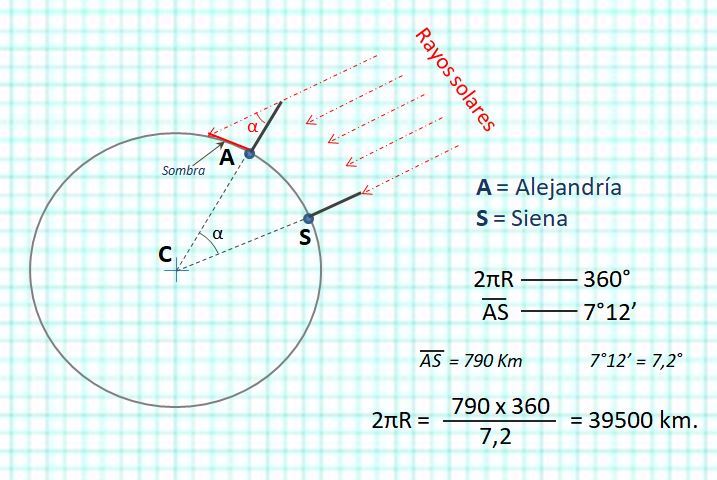
Resolución del problema
Cristobal Colón era conocedor por otros autores de la redondez de la Tierra, pero barajaba unas dimensiones inferiores a las calculadas por Eratóstenes. Si hubiera conocido los cálculos realizados por Erátostenes, más aproximados a la realidad, seguramente no se hubiera aventurado a realizar su viaje, ya que ningún barco de aquella época podía almacenar el agua y provisiones necesarias para una travesía de esa duración. Afortunadamente para él se encontró enmedio con un nuevo continente: América.
Resolución del caché
El caché se encuentra en las siguientes coordenadas:
N 41º 38.ABC' W 0º 53.DEF'
Siguiendo el mismo método que Eratóstenes deberás calcular el RADIO de un hipotético planeta totalmente esférico, con las siguientes consideraciones:
- El experimento se realiza en 2 puntos A y B , en el equivalente al solsticio de verano de este planeta. Ambos puntos se encuentran en el mismo meridiano.
- Los puntos A y B están separados una distancia de 214658,25 kilómetros.
- El experimento se realiza con una vara de 1 metro que se coloca verticalmente en ambos puntos, proyectando la siguiente sombra:
-
- En el punto A: 26,795 centímetros.
- En el punto B: 0 centímetros.
- Realiza las operaciones con PI = 3,14
Radio del planeta (en kilómetros) = ABCDEF

Puedes validar la solución a tu puzzle con certitude.
Otros cachés de la serie
ENGLISH
The caché
This cache is set in the figure of the wise Eratosthenes , astronomer, historian, philosopher, mathematician and poet, who lived about the year 250 a. C. was the first who was able to determine in a very approximate the dimensions of the Earth .
To obtain the final coordinates you will have to make some simple calculations, similar to those made in your day by Eratosthenes.
The cache is located in a quiet area of the center of Zaragoza but very frequented by geomugles, so you must take care when you pick it up and leave it.
The dimensions of the Earth
Eratosthenes lived about 250 a. C., was an astronomer, historian, philosopher, mathematician and poet, becoming director of the library of Alexandria. He was the first to determine with certain precision the dimensions of the Earth; for it followed a method that surprises by its simplicity and genius, and that we will explain next.
Eratóstenes y el cálculo de las dimensiones de la Tierra
In the library of Alexandria he had access to certain studies in which it was indicated that in the city of Siena (the current Aswan) the solar rays at the summer solstice fell on a stick without producing any shade.
Eratosthenes reproduced the same experiment in Alexandria, on the same date, proving that shade was produced, and measured the angle with which the solar rays affected, which was 7º and 12 '. Considering the parallel solar rays, due to the enormous distance from the Sun, this phenomenon could only be explained by accepting the sphericity of the Earth and rejecting, therefore, the one that was flat.
Alexandria and Siena are located approximately in the same meridian and Erat'ostenes knew its approximate distance thanks to the information of the camel caravans. This was about 5000 stadiums, equivalent to 790 kilometers.
With this data he solved the problem with a simple rule of three:
Resolution of the problem
Christopher Columbus was aware by other authors of the roundness of the Earth, but shuffled dimensions lower than those calculated by Eratosthenes. If he had known the calculations made by Eratosthenes, closer to reality, he surely would not have ventured to make his trip, since no ship of that time could store the water and supplies necessary for a voyage of that duration. Fortunately for him he found himself in the middle of a new continent: America..
Cache resolution
The cache is in the following coordinates:
N 41º 38.ABC' W 0º 53.DEF'
Following the same method as Eratosthenes you must calculate the RADIUS of a hypothetical planet totally spherical, with the following considerations:
- The experiment is done in 2 points A and B, in the equivalent to the summer solstice of this planet. Both points are on the same meridian.
- Points A and B are separated by a distance of 214658,25 kilometers.
- The experiment is carried out with a rod of 1 meter that is placed vertically in both points, projecting the following shadow:
-
- At point A: 26.795 centimeters.
- At point B: 0 centimeters.
- Value of PI = 3,14
Planet radius (in kilometers) = ABCDEF
You can validate the solution to your puzzle with certitude.
Other caches of the serie