The Event
Friday 27th July 8.30pm to 10.30pm
An informal event arranged to allow us to get together and witness a lunar eclipse (as well as all the usual chat, trackable sharing, and puzzle hint bribery).
This location has been chosen because it should give a clear view to the south-east where the moon will rise above the horizon.
This event is timed to coincide with the eclipse.
Approximate times:
2030 Event start
2050 The moon will rise over the horizon
2121 Maximum eclipse, the point at which the earth lies directly between the sun and moon
2213 The total eclipse ends but a partial eclipse will continue to be visible
2230 The official end time of the event
The Venue
The Captains Wife, Beach Rd, Swanbridge, Sully, Penarth CF64 5UG
The outoor area at The Captains Wife.
Food is available until 10pm if you wish to eat. Menu @ https://www.vintageinn.co.uk/restaurants/wales/thecaptainswifepenarth
Car parking is available at the pub.
If the skies are cloudy this natural phenomenon will be less visible - in the event the moon is not visible we will relocate indoors.
The Celestial Event
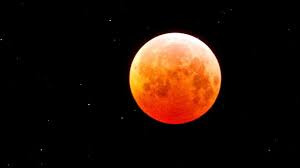
The Blood Moon eclipse:
The upcoming Blood Moon eclipse will rise on the night of Friday, July 27, over swathes of Central Asia, Africa, Europe, the Pacific and South America.
This July eclipse is touted as the longest lunar eclipse of the 21st century and its main phase will last around one hour and 43 minutes. From start to finish, the entire celestial event will last nearly 4 hours.
On the night of the eclipse, the full moon will pass through the centre of Earth’s darkest shadow, its umbra, which will turn Earth's natural satellite a spectacular red or ruddy-brown color from refracted sunlight.
The moon turns deep red or reddish brown during eclipses, instead of going completely dark. That's because some of the sunlight going through Earth's atmosphere is bent around the edge of our planet and falls onto the moon's surface. Earth's air also scatters more shorter-wavelength light (in colors such as green or blue); what's left is the longer-wavelength, redder end of the spectrum.
Unlike with solar eclipses, you need no special equipment to observe lunar eclipses. These events, which occur when the moon passes into Earth's shadow, are safe to view directly with the naked eye, telescopes or binoculars.