Welcome to Maumee Bay State Park.
Maumee Bay is a beautiful State Park located on Lake Erie. It's sand is soft and beautiful. This Earthcache will hopefully teach you a little on sand and it's sizes.
Definition: Sand is a naturally occurring granular material composed of finely divided rock and mineral particles. It is defined by size, being finer than gravel and coarser than silt.
Lake Erie was formed about 4000 years ago by glacial ice. The western side of Lake Erie is the shallowest part of the Lake. This is because more bedrock exists here than to the east end. The Eastern end of the Lake has more shale and is softer than the dolomite and limestone in the western part.
Lake Erie and its shoreline are a major source of many minerals. The largest sandstone quarry in the world is located in Amherst, Lorain County, Ohio. Sand, gypsum, and limestone used for construction purposes are found in abundance.
What is sand?
Sand is a loose granular material blanketing the beaches, riverbeds and deserts. In different areas sand has different components which makes the sand white, black, green or pink in color.
Sand is mostly composed of silicon dioxide in the form of quartz. Quartz is hard and don't decompose easily.
The Earth's landmasses is composed of rocks and minerals, including quartz, feldspar and mica. Weathering processes like wind, rain and freeze/thaw cycles break these rocks and minerals down into smaller grains.
Unlike other minerals quartz is hard, insoluble in water and won't decompose easily from weathering processes. Streams, rivers and wind transport quartz particles to the seashore where the quartz accumulates as light-colored Beach Sand.
SAND DEPOSITION & COMPOSITION.
Sand is transported by wind or water and deposited in the form of beaches, or dunes and sand bars. Some beaches have sand relocated there from other locations to form the beach.
The study of individual grains can reveal much historical and geological information as to the orgin and kind of transport of the grain. Sand that is RECENTLY weathered from larger rocks will be angular and be of drastically different sizes. It will feel rough to the touch. By contrast, sand that is transported long distances by water or wind will be rounded.
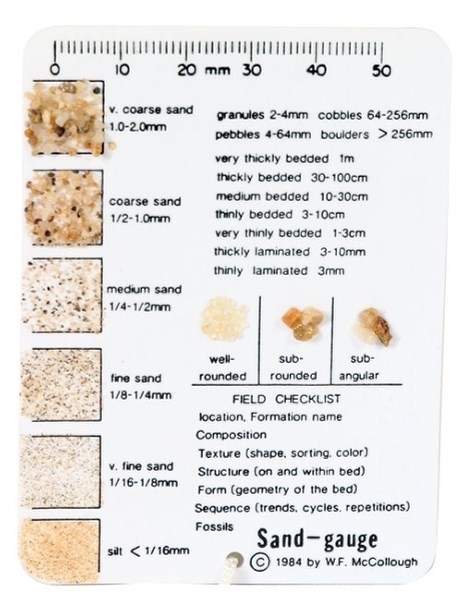
Sand comes in basically 5 sizes.
1) Very Coarse Sand 0.039 - 0.079 inches
2) Coarse Sand. 0.020 - 0.039 inches
3) Medium Sand. 0.010 - 0.020 inches
4) Fine Sand 0.0049 - 0.010 inches
5) Very Fine Sand 0.0025 - 0.0049 inches
Sand is measured using the Wentworth scale.
Sand Guage
To claim credit for this Earthcache email me the answers to the following questions within 5 days of your visit or your log, per EarthCache policy, must be deleted. DO NOT post your answers in your log.
1) Go to the posted coordinates N 41 41.158 W 083 22.751 Using the posted scale what size Sand is here? What color is it?
2) Go to N 41 41.158 W 083 22.751 Is the composition of the sand round or jagged?
3) Go to these coordinates N 41 41.043 W 083 22.631 Your feet should be on the beach sand. Using the scale above what size Sand is here? How does it differ from sand in question 1?
4) What color is the sand on the beach here?
5) Is the sand here round or jagged in composition?
Optional snap a photo of you or the beach. Or write you caching name in sand and snap a photo.
Placed with permission of Park manager permit number MBSP-2018-001