Cache Is Not At The Posted Coordinates
Mr. Toot is the mascot not only of the North Iowa Band Festival, but also for Mason City as a whole. His image has appeared on everything from T-Shirts to business cards to city light poles. Now his image also appears on the geocaching map just south of Mason City Iowa. Each of these puzzles will include a fact or story in theme with the art series. Some may also include a question or two for you to answer correctly to find the coordinates.
Music Man
Ya Got Trouble
In the song Professor Hill says
And listening to some big out-a town Jasper
Hearin' him tell about horse-race gamblin'.
Not a wholesome trottin' race, no!
But a race where they set down right on the horse!
Like to see some stuck-up jockey boy
Sittin' on Dan Patch? Make your blood boil?
First off, a Jasper would have been a stranger. But what we are going to talk about on this page is Dan Patch.
Weaving through the Minnesota State Fairgrounds, past Sweet Martha's Cookie Jar, the Grandstand, and the Corn Roast, is an avenue named after one of the biggest sports legends of the early 20th century: Dan Patch, the harness racehorse whose world record for fastest paced mile stood for 50 years.
When Dan Patch was born on April 29, 1896, his future looked bleak. The colt was born with crippled back legs; he couldn't even nurse on his own. Most agreed that the colt owned by Daniel Messner, Jr. should be euthanized. But not Messner and with help from some friends they helped lift up the newborn and helped Dan Patch Nurse.
Under the care of his first trainer, John Wattles, his legs straightened and he grew into a strong horse, known for his pleasant disposition and intelligence. Wattles conditioned Dan Patch for harness racing, teaching him to pull a two-wheeled cart, called a sulky, and a jockey behind him while pacing around the track - a gait requiring the horse to move the legs on the same side of their body in unison. At his inaugrural harness race in August 1900 at a county fair in Indiana, Dan Patch won his first three heats, bringing home a purse of $250 - (nearly $7,500 today.)
On March 1, 1902 Messner sold Dan Patch to Manley Sturgis for $20,000. Sturgis, a professional gambler in Brooklyn, New York, made his money through betting and by rigging races and fights. Some thought that Sturgis coerced Messner into the sale. Under new ownership Dan Patch continued to win every race he entered in 1902.
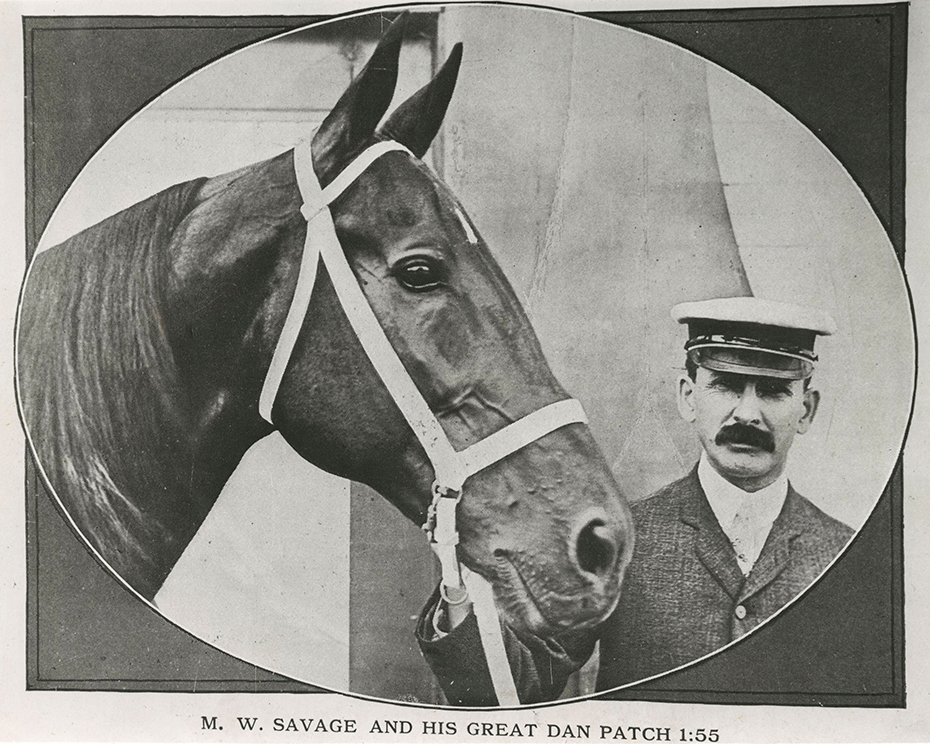
Meanwhile, in Minnesota, Marion Savage was making plans of his own for Dan Patch. Savage had been working as a clerk in a general store when, after observing farmers’ purchasing habits, he decided to try his hand at the animal feed supplement business. He hired scientists to develop a blend of roots and herbs, and began shipping his supplement across the Midwest. He founded the International Stock Food Company in 1890 and created a grandiose marketing plan for his supplement, dubbing it “3 Feeds for One Cent” (meaning it was good for horses, cows, and hogs). The strategy worked and Savage was soon able to purchase a warehouse in downtown Minneapolis in order to continue to expand his company. Beyond succeeding in business, Savage also aspired to be a well-known horseman. In the years leading up to 1902, he purchased three championship harness racers and built a world-class stable on the Minnesota River just south of the Twin Cities, near present-day Savage. He called it the International Stock Food Farm, but with beautiful domes reminiscent of the Taj Mahal, locals referred to it as “the Taj.” Throughout 1902, Savage tried to convince Sturgis to sell him Dan Patch, going so far as to send Robert F. Jones, who was the secretary of the Minneapolis Riding and Driving Club, and Harry Hersey, who ran Savage’s stables, to New York to confirm that the racehorse would be a good purchase. Finally, in December of that year, Sturgis accepted Savage’s offer of $60,000. The horse who could not lose was on his way to Minnesota.

N 43 04.636 W 93 08.531
Savage’s grand plan for Dan Patch involved branding as much as it did racing. Ahead of the horse’s arrival, Savage plastered billboards with pictures of the champion pacer and added his image to a range of International Stock Food products, from tobacco to pocket watches and washing machines. When he finally arrived on January 5, 1903, Dan Patch was celebrated with a parade down Nicollet Avenue in downtown Minneapolis. A band played while the horse, piled high with blankets to protect him against the cold, Savage, and Dan Patch’s new trainer, Harry Hersey, strode proudly through the heart of the city. Beyond using Dan Patch to advertise products, Savage also bred him and offered him up for photo opportunities. Because of the horse’s success at the track (in addition to winning every race he entered, he’d also tied the world record for the fastest mile), most owners by now refused to race their horses against him. Turning an obstacle into yet another money-making venture, Savage opted instead to have his horse race the clock. The duo began traveling around the country, visiting state fairs, putting on exhibitions and attempting to beat records. On October 26, 1904, Dan Patch set the world record for a paced mile at 1:56:00. Then, on September 4, 1906, in front of 90,000 people at the Minnesota State Fair Grandstand, the horse broke his own world record for a paced mile, clocking in at 1:55:00.
In 1910, Savage retired Dan Patch. The now world-famous racehorse spent the rest of his days on Savage’s farm, save for an appearance at the Minnesota State Fair each year. His world record remained unbroken for over a half-century, until Adios Butler finished a paced mile in 1:54:03 in Lexington, Kentucky in 1960. On July 11, 1916, 20-year-old Dan Patch collapsed and died of a massive heart attack; his heart was twice the size of a normal horse’s heart and had been weakened by years of racing. When Savage, who was in the hospital for a minor surgery, heard the news, he collapsed and died the following day.
The city of Savage, Minnesota, was renamed for Dan Patch's owner, Marion Willis Savage, in 1904. The city holds a celebration called "Dan Patch Days" annually in June. In the Heritage Room in the Savage Public Library are two display cases containing Dan Patch memorabilia and extensive records. Also, in 2004, Prior Lake High School, located in Savage, named its new stadium after the horse.