Cache Is Not At The Posted Coordinates
Mr. Toot is the mascot not only of the North Iowa Band Festival, but also for Mason City as a whole. His image has appeared on everything from T-Shirts to business cards to city light poles. Now his image also appears on the geocaching map just south of Mason City Iowa. Each of these puzzles will include a fact or story in theme with the art series. Some may also include a question or two for you to answer correctly to find the coordinates.
Music Man Trivia
Just prior to Professor Harold Hill singing of 76 Trombones he mentions a group of musicians all coming to town on the very same day. It goes like this.
And you feel something akin to the electric thrill I once enjoyed When Gillmore, Pat Conway, The Great Creatore, W.C. Handy, and John Phillip Sousa all came to town on the very same historic day.
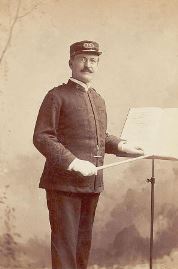
Patrick Sarsfield Gilmore (1829-92) was an Irish-born American cornet player, bandmaster, and composer. He also wrote the lyric to “When Johnny Comes Marching Home” and other songs. John Philip Sousa called him the Father of the American Band. He founded Gilmore’s Band in 1858, and at the start of the Civil War, enlisted in the army. After the war, he was asked to organize a huge peace celebration in New Orleans.
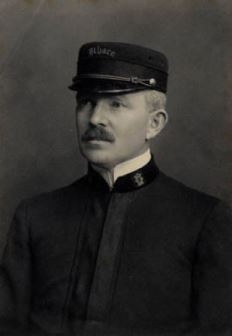
Patrick Conway (1865–1929) was one of America’s foremost bandleaders. He became director of the Ithaca, NY, Municipal Band, which later became the Conway Band. His band of professionals was as famous as John Philip Sousa’s band, playing throughout the country for state fairs, expositions, and concert series, and was featured on the General Motors Family Hour radio show. In the 1920s bands were declining in popularity, in part from competition from the phonograph and radio. With the establishment of school bands there was a demand for trained band teachers and musicians, yet little formal education for band musicians existed. Realizing this, Conway opened one of the first schools for the training of the band musician: the Conway Military Band School (1922-29).
 Giuseppe C. Creatore (1871-1952) was a trombonist, bandmaster, and showman; he became conductor of the Naples Municipal Band in 1887 when he was seventeen. He came to the United States in 1899 and formed his own band in 1901. Not satisfied with the quality of the musicians, he returned to Italy and recruited sixty musicians whom he brought back to the United States in 1902. His band was booked solidly, and their fee came to $5000 per performance. They made several tours on the Chautauqua circuit between 1910 and 1916, but with the decline of band popularity around the time of World War I, he formed an opera company, 1917-22. He conducted bands for the WPA, but resigned in a dispute with the government. He made his final public performance in 1947.
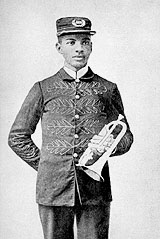
William Christopher Handy (1873-1958) was a black American musician, composer and bandmaster, known widely as “The Father of the Blues.” Handy’s father believed that musical instruments were tools of the devil, and when young Handy bought a guitar, his father made him take it back. His father enrolled him in organ lessons, but young Handy soon quit and began to take up the cornet. He played in a local band, but kept that fact secret from his parents. He worked at several odd jobs and at age 23 became bandmaster of Mahara’s Colored Minstrels. In 1900 he joined the faculty at Alabama A&M (then an all-black college), where he taught until 1902. Like Aaron Copland, he wanted to promote American music, but the faculty at the college considered American music to be inferior to European classical music. He also knew he could make more money playing in a band than teaching at the college. Traveling about the South he heard a lot of the local black folk music, which he began to systematize as “the blues”. In 1909 he wrote what became “Memphis Blues”, originally a campaign song for a victorious mayoral candidate, which was published in 1912. In the “Memphis Blues” he introduced the now-standard 12-bar blues style, which is also credited with the creation of the foxtrot, introduced by Vernon and Irene Castle. He went on to publish “St Louis Blues” and “Beale Street Blues”. He was unenthusiastic about the new style of jazz which was becoming popular, but many jazz bands began playing his music. He moved to New York City in 1917. He became a successful music publisher, unusual for a black person at that time.
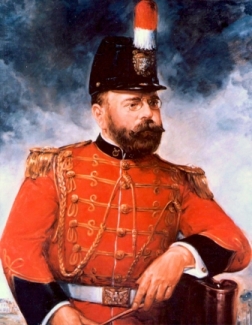
John Philip Sousa (1854-1932) was an American bandmaster and composer, known as “The March King”. He was born in Washington DC and began playing violin at age six. He was found to have perfect pitch. He studied voice, violin, piano, flute, cornet, baritone horn, trombone, and alto horn. When young Sousa was 13, his father, a trombonist in the Marine Band, enlisted him in the United States Marine Corps as an apprentice to keep him from joining a circus band. After serving his apprenticeship he joined a pit orchestra, where he learned to conduct. In 1880 he returned to the Marine band, “The President’s Own”, as its head, and remained as its conductor until 1892, serving under five presidents. In 1892, he organized the Sousa Band, which toured from 1892 to 1931, both in America and abroad. He wrote 136 marches, including “The Stars and Stripes Forever” (national march of the United States), “Semper Fidelis” (official march of the U. S. Marine Corps), “King Cotton”, “The Liberty Bell”, “El Capitan”, “The Thunderer”, and “The Washington Post”, as well as several operettas, and other works. He also wrote three novels. His autobiography is titled Marching Along. He was part of a committee that prepared the “official” version of “The Star-Spangled Banner“, which Congress made the national anthem in 1931. Meredith Willson toured with the Sousa Band from 1921 to 1923.
It is not possible that all five famous band leaders could come to town on the very same historic day: Gilmore died in 1892, and Creatore first came to the United States in 1899! (In 1892, Handy was 19 years old!)
More Information