Cache Is Not At The Posted Coordinates
Mr. Toot is the mascot not only of the North Iowa Band Festival, but also for Mason City as a whole. His image has appeared on everything from T-Shirts to business cards to city light poles. Now his image also appears on the geocaching map just south of Mason City Iowa. Each of these puzzles will include a fact or story in theme with the art series. Some may also include a question or two for you to answer correctly to find the coordinates.
Mason City
Other Mason Cityans distinguished themselves in battle. A first lieutenant in A Company on the Mexican Border duty, Hanford MacNider, was admitted to the first Reserve Officers Training Camp at Fort Snelling, Minn., May 15, 1917.
On completing this training he sailed to France with the Second Division on the following Sept. 17. For a time he served as instructor in the Army and on July 18, 1918, he was promoted to captain and detailed as adjutant of the 9th Infantry, serving in that capacity with it in the Aisne defensive, Chateau Thierry, Aisne Marne offensive, Marbache and Limey defensive sectors and the St. Miheil and Meuse Argonne offensives.
Capt. MacNider was wounded in action Sept. 12, 1918, in the St. Mihiel offensive. He was promoted to major Oct. 17, 1918. On Dec. 27, 1918, he was assigned as division adjutant of the 2nd Division, and was stationed with that unit in Germany until July, 1919, being promoted to lieutenant-colonel May 9 of that year.
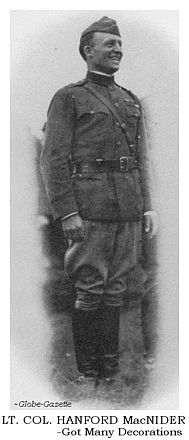
Col. MacNider became one of the most decorated soldiers of the war. He was awarded the distinguished service cross "for extraordinary heroism in action near Medeah Farm, France, Oct. 3-9, 1918." Mason Cityans were not only on the battlefields of Europe. Many were in the Navy, Marines and other services. Half of the 2,000 men who went into the service from Cerro Gordo County were members of the National Army, who responded to the calls of the selective service. In addition to the 19 in the 168th there were 23 who were killed in the war. Many others were wounded.
The first call was for three men: Perry Neilson, Clear Lake; Joel Randall, Rockford; and Seth Crabtree, Thornton, who entrained for Camp Dodge Sept. 8, 1917. From then until the end of the war they continued to leave in small groups until the morning of July 25, 1918, when the department of 452 men for Camp Gordon, Ga., left deep gaps in the community. While this was the largest group, there was scarcely a week of the time the war was in progress that the county did not send men to camps.