Introduction
For me EarthCaching is a double-edged sword. I love learning about geological things but it does mean that I find my attention diverted with great frequency to what geological bits-and-bobs there are to see, wherever I go.
Blackburn has become a place we visit on a regular basis and I think each time we go there I notice something new - which is what led me to this unusual form of granite. I say unusual but that's not to say that it's particularly rare - and I have seen granite like it before in other places - but it does look different to the sort of granite I see more often.
What's different about it is its texture and by texture I don't mean what it feels like to the touch. I've learned from people who know more about geology than me that in geological circles texture refers to the size, shape and arrangement of the grains (for a sedimentary rock) or crystals (for igneous and metamorphic rock).
This EarthCache takes you to an example of a type of granite which has come to be described as having a rapakivi texture. Some people refer to this sort of granite as a Rapakivi granite.
Logging Tasks
IN ORDER TO COMPLETE THESE LOGGING TASKS PLEASE SEND US YOUR ANSWERS USING THE Message this owner LINK AT THE TOP OF THIS PAGE OR USING THE MESSAGE CENTRE OR EMAIL VIA OUR GEOCACHING PROFILE BEFORE SUBMITTING YOUR LOG. PLEASE DO NOT INCLUDE ANSWERS OR SPOILERS IN YOUR ONLINE LOG. YOU CAN GO AHEAD AND LOG YOUR FIND AS SOON AS YOU HAVE SENT YOUR ANSWERS IN ACCORDANCE WITH GROUNDSPEAK GUIDELINES. LOGS WITHOUT ADEQUATE LOGGING TASK EVIDENCE MAY SUBSEQUENTLY BE DELETED.
Based on your on-site study of the building and using the information on the cache page please tell me:
- In this granite, what percentage of the large ovoidal orthoclase phenocrysts (the pink ones) are surrounded by a plagioclase mantle?
- Based on your answer to #1, is this granite pytorlitic or viborgitic?
- Take as long as you need to find the largest phenocryst you can and describe how it looks - is it solid pink? Does it have a mantle of plagioclase or not?
- Does Bowen's Reaction Series adequately explain how the rapakivi texture came to be?
- Optional task: feel free to add any photographs of your visit that do not show the specific features from the logging tasks - no spoilers please. In the interests of allowing everyone to experience the EarthCache fully for themselves obvious spoiler photographs will be deleted.
Background
At the given coordinates you will find a building clad in slabs of Rapakivi granite.
The texture of the granite is quite visible to the naked eye but if you have access to a magnifying glass or ideally a hand lens or jeweller's loupe you'll be able to get a really good, detailed view of the crystalline structure of the rock and the individual minerals within it.
This type of granite gets its common name from the place it was originally found in Finland but it has since been found in North and South America, South Africa, India and China.
Geologists believe that most Rapakivi granite is between 500 million and 2500 million years old and that there are both older and younger examples.
Granite
Granite is a common type of felsic intrusive igneous rock that is granular and phaneritic in texture. Granites can be predominantly white, pink, or grey in color, depending on their mineralogy. The word "granite" comes from the Latin granum, a grain, in reference to the coarse-grained structure of such a holocrystalline rock. Strictly speaking, granite is an igneous rock with between 20% and 60% quartz by volume, and at least 35% of the total feldspar consisting of alkali feldspar, although commonly the term "granite" is used to refer to a wider range of coarse-grained igneous rocks containing quartz and feldspar.
Or in other words...
Granite is a common type of igneous rock which has formed deep underground (intrusive) and is rich in the minerals feldspar (hence felsic) and quartz. Typically the amount of quartz is between 20% and 60% and at least 35% of the included feldspar is of the alkali type (rich in sodium and/or potassium).
Granite is made up entirely of mineral crystals (is holocrystalline) which are visible to the naked eye (has a phaneritic texture).
Granites can be predominantly white, pink, or grey in color, depending on the minerals they contain.
Textures of Igneous Rocks
Now remember, when we talk about texture here we're not talking about how the rock feels to the touch, we're using texture in the geological sense to describe the size, shape and arrangement of the crystals in an igneous rock - granite in this case.
-
Phaneritic - coarse grained - from the Greek phaneros meaning visible.
Igneous rocks with a phaneritic texture contain crystals which are clearly visible to the naked eye and all roughly the same size.
Rock crystals tend to grow very, very slowly - which means it takes a long, long time for the crystals to get to this size. This tells us that the magma which these rocks were formed from must have cooled very, very slowly at considerable depth beneath the Earth's surface.
Igneous rocks which form in this way are known as intrusive igneous rocks or plutonic igneous rocks (plutonic from Pluto, the Roman god of the underworld, as opposed to Mickey Mouse's dog).
-
Aphanitic - fine grained - from the Greek aphaneros meaning unseen.
Igneous rocks with an aphanitic texture are made up of crystals which are too small to be seen with the naked eye (typically less than 1mm).
The tiny crystals in this rock tell us that the magma it was formed from must have cooled relatively quickly and solidified before the crystals had time to grow large enough to be seen with the naked eye. This tells us that the magma this rock was formed from cooled at or close to the Earth's surface.
Igneous rocks which form in this way are known as extrusive igneous rocks.
-
Porphyritic - a mixture of fine and coarse - from the Greek porphúra meaning purple.
In the past the term porphyry applied exclusively to a specific type of purple coloured rock. Purple was the color of royalty, and the imperial porphyry was a deep purple igneous rock with large crystals of plagioclase feldspar.
Porphyry later came to be used as a term to describe rocks with the same sort of texture as that purple rock i.e. large crystals of feldspar surrounded by a groundmass of much smaller crystals, regardless of colour. The distinctively larger crystals in a porphyritic igneous rock are known as phenocrysts.
Igneous rocks with porphyritic texture are formed when a column of rising magma is cooled in two stages. In the first, the magma is cooled slowly deep in the crust, creating the large crystal grains (phenocrysts) with a diameter of 2 mm or more. In the second and final stage, the magma is cooled rapidly at relatively shallow depth, resulting in the much finer crystals of the groundmass.
So what is rapakivi texture?
Good question....
Rapakivi is a term that comes from the Finnish language and describes rotten or crumbled stone. The way the crystals of differing sizes and differing types of feldspar are arranged in this type of granite make it very susceptible, in its naturally occuring form, to weathering - to the degree that it breaks down very quickly and can become so fragile that it can be crushed in the hands.
Looking at the image shown below of a heavily weathered rapakivi granite boulder it's not difficult to see how it came to be named crumbly or rotten rock.

On the other hand, this next image shows rapakivi granite before the effects of weathering have had chance to break it down into crumbly / rotten rock. The texture you see here is the rapakivi texture.

Up close, the mantle of plagioclase feldspar surrounding the ovoidal orthoclase phenocryst can be very clearly seen. Outside the plagioclase mantle the surrounding groundmass of smaller crystals is also visible.
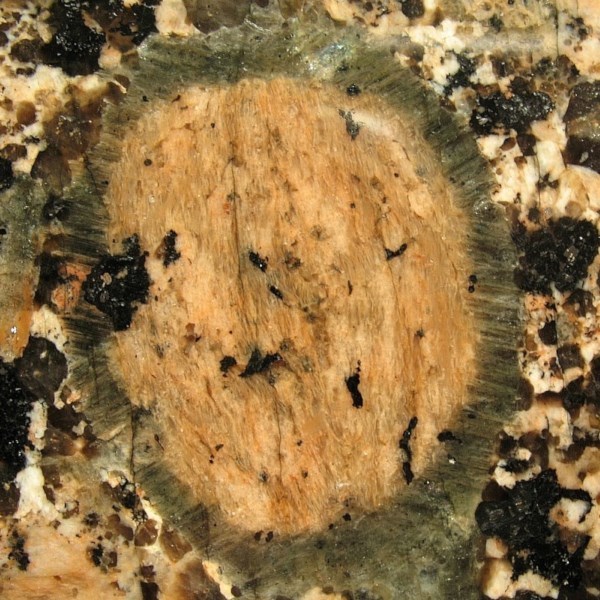
The key ingredient of the rapakivi texture is is the large ovoidal orthoclase phenocrysts surrounded by plagioclase mantles - which is where the little twist that makes this rock so interesting comes into play....
Imagine for a moment one of the large ovoidal phenocrysts found in the rapakivi granite as a section through an orange that has been cut in half, and remember that orthoclase is a potassium rich feldspar and that the plagioclase most commonly found in rapakivi granite is sodium rich...
... so our large ovoidal orthoclase phenocryst surrounded by a plagioclase mantle is a bit like half an orange, with orthoclase flesh surrounded by a skin of plagioclase. Seems simple enough- right? But there's just one problem...
May I present Bowen's Reaction Series - the work of petrologist Norman L. Bowen who determined that specific minerals are formed at specific temperatures as a parent magma is cooled.

An experiment was performed by Bowen in the early 1900s with powdered rock minerals heated until melting and allowed to cool to a target temperature. Then he observed the types of minerals formed. He repeated this process with progressively cooler temperatures and the results led him to formulate his reaction series which is still the most accepted theory today.
According to this reaction series, as a magma cools, plagioclase crystallises BEFORE orthoclase (Potassium feldspar). And we already know that crystals grow outwards from a central point...
... which, going back to our section-through-an-orange example above, would produce an orange with plagioclase on the inside (formed at a higher temperature) and a skin of orthoclase on the outside (formed at a lower temperature as the magma continued to cool) - the exact opposite of what we actually have...
This is one of the reasons why petrologists - scientists who study rocks and the conditions in which they form - have been debating for around 100 years as to how the large ovoidal orthoclase phenocrysts surrounded by a plagioclase mantles that we see in rapakivi granite today came to be.
One last thing...
The number of large ovoidal phenocrysts in rapakivi granite that are surrounded by a mantle of plagioclase varies considerably. In some granites the plagioclase mantles are quite rare - or there are none at all - while in others they are quite numerous.
Granites where plagioclase mantles are present are described as viborgitic. Granites where plagioclase mantles are absent are described as pyterlitic.
If you've carefully read and digested the information from this cache page your tasks at the cache location should prove relatively straight forward, although you may wish to take a printed copy of the page with you so that you can check your answers while there  .
.
Please submit your logging task responses before posting your log.