Introduction
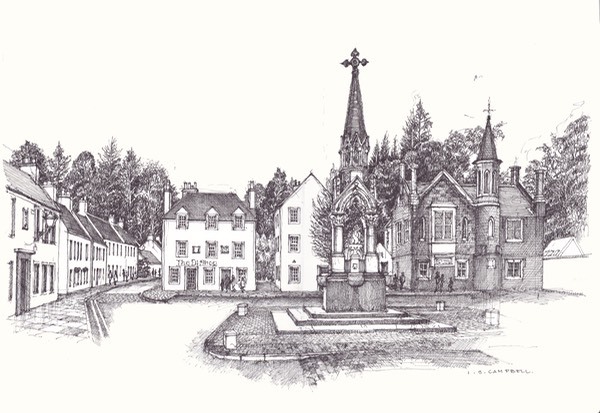
There are three very distinct different types of stone that were used to build the Atholl Memorial Fountain in Dunkeld and this EarthCache aims to explain how the differences in the way they were formed originally has affected their current condition. Therefore this EarthCache looks at
- rock formation - is the stone igneous, metamorphic or sedimentary
- why each rock type was chosen in terms of suitability for constuction/decoration
- how well the rocks have stood up to erosion forces over the years
History of the Water Fountain
The fountain was funded by public subscription and built in 1866 'to the memory of George Augustus Frederick John 6th Duke of Atholl'. The Duke had introduced a piped water supply to Dunkeld, prior to which all water had to be drawn from the River Tay - hence all the wynds leading to the water. The Fountain was designed by C S Robertson and erected on the site of the Market Cross. Several changes are apparent over the years, but there is fine detail in the carvings, which include native animals and birds. Masonic symbols are also incorporated - the 6th Duke was Grand Master Mason of Scotland from 1843 until his death in 1864.
Formation of the stone
Sedimentary - Sedimentary rocks are formed on the surface of the Earth, either in water or on land. They are called secondary, because they often result from the accumulation of small pieces broken off from pre-existing rocks. Most sedimentary rocks become cemented together by minerals and chemicals present when they are formed, and others are held together by electrical attraction. Some, however, remain loose, crumbly and unconsolidated. There are sedimentary rocks elsewhere in the valley, but they weren't used in any buildings. Sandstone and limestone are often used as external walls of buildings. These sedimentary rocks are well suited to carving into bricks of any shape or for decorative purposes on buildings where a craftsman can carve the stone. The softer the soft, the easier it is to carve but the more susceptible it will be to erosion or weathering.
Igneous - Igneous rocks get their name from the Latin word ignis, meaning "fire." They form from volcanic magma when a volcano erupts and are also referred to as volcanic rocks. Under the surface of the Earth the magna is kept liquid by high temperature and high pressure. As the volcano erupts hot magna reaches the surface. Afterward the lava rapidly cools down and solidifies. The crystals formed by cooling magma are usually small. Magma doesn't always reach the surface. Sometimes it is trapped underground in pockets of other rocks. In this case the magma cools down more slowly forming larger crystals and coarse-grained rocks. How the rocks form will depend not only on the different cooling temperatures of the magma but also its chemical composition. Headstones and other monuments are often made from granite that has been polished to give it a glossy finish and because the end product is extremely hard it usually lasts for long periods of time maintaining the original appearance.
Metamorphic - Sedimentary and igneous rocks which were subjected to intense pressure and/or heat and as a result underwent a complete change. Metamorphic rocks form deep within the Earth's crust. The process of metamorphism does not melt the rocks, but transforms them into other rocks which are denser and more compact. New minerals are created either by the rearrangement of a mineral's components or by reactions with fluids that enter the rocks. There are not any metamorphic rocks used in the construction of this fountain so we won't look at examples of their uses, but marble and slate are examples of metamorphic rock.
Erosion and Weathering
Erosion is all about movement - erosion is the process by which soil and rock particles are worn away and moved elsewhere. This transportation or movement is usually caused by either wind, water, ice or gravity. Weathering does not involve any movement - weathering is the breakdown of rocks at the Earth's surface, by the action of rainwater, extremes of temperature, and biological activity. It does not involve the removal of rock material. There are various types of erosion and weathering, however for the purpose of this EarthCache I am only going to list the ones that realistically may have affected the stone here and in the questions later you will be able to identify the damage you think each may have caused.
Erosion By Wind
Wind erosion is a serious environmental problem in the driest parts of the world, removing soil from farmland and covering whole towns with sand and dust. A strong breeze (wind speed 20 km/h) can easily pick up dry dust and fine sand. The lightest particles are swirled up into the air and carried in suspension for hundreds of kilometres, whilst sand grains bounce along the surface by saltation. Small pebbles can be moved along with the sand, a process called creep. Sand dunes form when wind-blown sand starts to pile up. Sand is eroded from the up-wind side of the dune and deposited on the down-wind side, so the whole dune gradually migrates down-wind. In this country, our peat moorlands have suffered greatly from wind erosion in the summer when they dry out and there is nothing growing in the peat to stop the peat simply being blown away when it has dried out. Most often, wind erosion occurs on flat land in dry or sandy areas. A rock that is exposed to wind over time could be gradually eroded, and the softer the rock is, the more likely this may be to occur.
Erosion By Liquid Water
Around the world, moving water picks up and transports millions of tonnes of sediment every day, along rivers, coasts, and even in the deep oceans. Sediment, whether picked up by flowing water or by waves, is moved along in one of four ways:
- Traction is the rolling or dragging of large grains along a river bed or shore, aided by the push of the smaller grains (below).
- Saltation is the bouncing of sand grains as they are picked up, carried along, and dropped repeatedly by flowing water.
- Fine particles (silt and clay) are carried in Suspension in the water – they will only settle out if the water is still.
- Soluble salts are carried in Solution in the water – the sea is obviously salty, but rivers contain dissolved salts, too.
The bed load of a river (pebbles and sand grains) helps to erode the river bed and banks by abrasion, especially when the river is in flood. In a similar way, waves cause cliffs to erode especially during storms. As the pebbles and sand grind away the river bed or sea shore, they also become smaller and more rounded, a process called attrition. The fountain here has never been under the river or hit by any waves, however, it will have been subjected to heavy rain.
Physical (Mechanical) Weathering
Physical or mechanical weathering takes place when rocks are broken down without any change in the chemical nature of the rocks. The rocks are essentially torn apart by physical force.
The most common type of physical weathering is the constant freezing, and thawing of water, known as freeze thaw. In liquid form, water is able to penetrate the many holes, joints, and fissures within a rock. As the temperature drops, this water freezes. As water freezes, it expands, becoming about 10% larger than it was in liquid form. The result is that the holes and cracks in rocks are pushed outward. Even the strongest rocks are no match for this force. As the water thaws, it is then able to penetrate further into the widened space, where it later freezes yet again. The expansion of holes and cracks is very slow. Month after month, year after year, water freezes and thaws over and over, creating larger and larger holes and cracks in the rocks.
Another important type of mechanical weathering is salt wedging. As water enters the holes and cracks in the surface of rocks, it often carries salt with it. As the water later evaporates, the salt is left behind. Over time, these salt deposits build up, creating pressure that can cause rocks to split and weaken. Temperature changes also effect mechanical weathering. As temperatures heat up, the rocks themselves expand somewhat. As the temperatures cool down, rocks contract slightly. The effect can be the weakening of the rock itself.
Chemical Weathering
Chemical weathering is caused by rain water reacting with the mineral grains in rocks to form new minerals (clays) and soluble salts. These reactions occur particularly when the water is slightly acidic. These chemical processes need water, and occur more rapidly at higher temperature, so warm, damp climates are best. Chemical weathering (especially hydrolysis and oxidation) is the first stage in the production of soils.
There are different types of chemical weathering, the most important are:
- Solution - removal of rock in solution by acidic rainwater. In particular, limestone is weathered by rainwater containing dissolved CO2, (this process is sometimes called carbonation).
- Hydrolysis - the breakdown of rock by acidic water to produce clay and soluble salts.
- Oxidation - the breakdown of rock by oxygen and water, often giving iron-rich rocks a rusty-coloured weathered surface.
Biological Weathering
Living organisms contribute to the weathering process in many ways. Trees put down roots through joints or cracks in the rock in order to find moisture. As the tree grows, the roots gradually prize the rock apart. Many animals, such as Piddock shells, bore into rocks for protection either by scraping away the grains or secreting acid to dissolve the rock. Even the tiniest bacteria, algae and lichens produce chemicals that help break down the rock on which they live, so they can get the nutrients they need.
Logging Requirements
As this is an EarthCache there is nothing hidden here to find, please don't search. Instead, you must answer a number of questions in order to log your find. You are not expected to have any previous knowledge of geology or rocks, so please do give it a try. All the information you need to answer the questions is found by reading the information above and I only ask you make an attempt at answering the questions. If you don't send in any answers at all, your log may be deleted.
Please note, this is an observational EarthCache. This means you should read the relevant information and then look for actual evidence on the rocks (for example shapes, cracks or growth) that match with the descriptions. No hypothetical guesses are required so please only base your answers on what you see - this should make it easier but please take a little time to look around.
Question 1)
Firstly look at stone used for the pillars on the fountain.
1a) Is the stone used for the pillars igneous or sedimentary?
1b) Why do you think they chose to use this type of stone here?
1c) Can you see any damage to the stone? Describe what you see.
1d) From the options outlined above, what erosion/weathering processes do you think have caused the damage you have outlined?
1e) Rate the condition of the stone between 1 and 10 (1 being extremely badly eroded, 10 being 'as new')
Question 2)
Now turn your attention to the stone used for the main fountain construction, both above and below the pillars. This includes most of the carvings, but not the fish in the centre.
2a) Is the stone used here igneous or sedimentary?
2b) Why do you think they chose to use this type of stone here?
2c) Can you see any damage to the stone? Describe what you see.
2d) From the options outlined above, what erosion/weathering processes do you think have caused the damage you have outlined?
2e) Rate the condition of the stone between 1 and 10 (1 being extremely badly eroded, 10 being 'as new')
Optionally, please include a photo if you wish but please take it from a distance; avoid any photos showing too much detail that might be spoilers. Thanks.
Thank you for visiting the Atholl Memorial Fountain in Dunkeld