The container IS NOT at the posted coordinates. But they are available here.
This geoart series will be somewhat different from others. Because of our interest in the Oklahoma Land Run we've compiled quite a bit of history from the Oklahoma Historical society. It's loosely laid out in a chronological order through the series from the O to the L finally to the R. The Oklahoma outline portion of the art will be general history questions and state facts. We hope you enjoy the history lesson and journey.
Many of the containers are preforms, some are not. Most are up off the ground, some are not. Some have parking pull offs, some do not. Some are on paved roads, many are not. Please use common sense during periods of inclement weather.
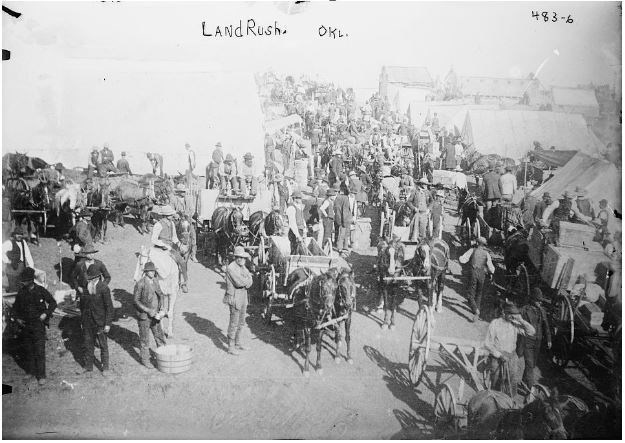
American Indians viewed the land run very differently than settlers. While those who made the run saw the situation as an opportunity to claim free land, American Indians feared they may soon again lose even more of their land. In varying times during the nineteenth century, tribes had been forced from their ancestral homelands to reservations in present-day Oklahoma. Then, tribes were forced to accept individual allotments with the Dawes Act in 1887, which again reduced their land. Some of the land taken from tribal ownership became available for white settlement in various land openings.
After boomers, such as David Payne, continually violated Indian treaties by encroaching on their land, the United States government finally relented and, in 1885, passed an Indian Appropriations Act to allow natives to sell their unoccupied land. Furthermore, in 1889, President Grover Cleveland passed a new Indian Appropriations Act, which opened up these Unassigned Lands to settlers, which was distributed in the land runs.
Elias C. Boudinot. Raised in New England following his father’s assassination, Elias C. Boudinot studied law and dabbled in politics. This background proved instrumental in Boudinot’s future. A loss in a Supreme Court case in 1868 led Boudinot to believe that American Indians should seek the protection of the United States Constitution and property rights as individuals rather than through tribal ownership. During the 1870s, Boudinot worked as a railroad attorney and spent much of his time in Washington.
On February 17, 1879, in a letter to the Chicago Times, Boudinot espoused his claim that fourteen million acres of Indian Territory, including the Unassigned Lands, should be considered public domain and opened to non-Indian settlers. Boudinot’s letter spread to other papers throughout the United States, motivating David Payne and other homesteaders to seek land in the territory.
Boudinot died in Fort Smith on September 27, 1890, just a year after the first land run.
Continued in Chapter 20.
Material and photos all courtesy of: Oklahoma Historical Society Research Center
N 35 17.536, W 096 31.570