The container IS NOT at the posted coordinates. But they are available here.
This geoart series will be somewhat different from others. Because of our interest in the Oklahoma Land Run we've compiled quite a bit of history from the Oklahoma Historical society. It's loosely laid out in a chronological order through the series from the O to the L finally to the R. The Oklahoma outline portion of the art will be general history questions and state facts. We hope you enjoy the history lesson and journey.
Many of the containers are preforms, some are not. Most are up off the ground, some are not. Some have parking pull offs, some do not. Some are on paved roads, many are not. Please use common sense during periods of inclement weather.
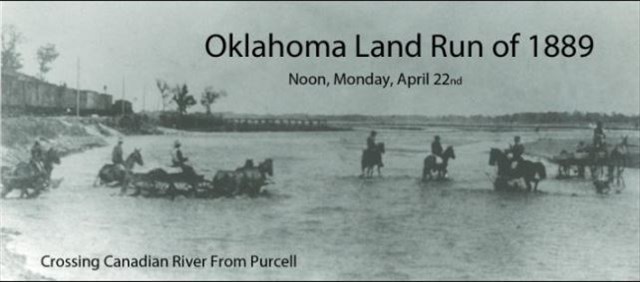
Settlement patterns are determined by many factors. Geography, land policy, sociological circumstances, economics, ethnicity, even religion, readily come to mind. In all of these areas but religion (Oklahoma is overwhelmingly composed of "Bible Belt" churches), Oklahoma is a border region, neither North nor South, East nor West, neither all humid nor all arid, but rather like an old-fashioned quilt, made of many pieces, some complementary and some contrasting.
Geographically, the state is bisected roughly into east and west halves by the 98th Meridian. The climate varies from the humid southeast coastal plains with its cypress wetlands and southern pines to the semi-aridity of the rolling and High Plains short-grass lands of the northwest. Topography ranges from the Ozark Plateau of the northeast to the gypsum hills and breaks of the Red River and its tributaries in the southwest. Soils vary from the red clay of much of central and western Oklahoma to the dark, rich bottomlands of the Red River Valley. The differences in the length of growing seasons and nighttime temperatures between southern and northern areas create ideal conditions for growing cotton in the south but limiting its expansion into northern Oklahoma. The topography is broken by several mountain ranges, including the Wichitas in the southwest, Arbuckles in the south, Ouachitas in the southeast, and Cookson Hills (the Oklahoma extension of the Ozark Plateau) in the northeast. Various geographic conditions set the stage for different agricultural economies. The types of crops also depended upon different cultural groups. Midwesterners sowed wheat in the north, southerners planted cotton in the south, and plainsmen from Texas and western Kansas raised cattle in the west.
Some ethnic settlement patterns are also found in Oklahoma. In some areas ethnic groups clustered around mineral wealth. The coal fields opened by J. J. McAlester near the city bearing his name attracted European ethnic groups, including the Welsh, Irish, Poles, Russians, Italians, French, and Lithuanians, making McAlester and its environs the most cosmopolitan part of Oklahoma. Later this region would become the state's bastion of organized labor. Other ethnic groups created their own towns and farming communities. German Mennonites from Russia, carrying small sacks of Crimean hard wheat, created farming communities such as Corn, Colony, and Bessie in western Oklahoma. Czechs from the Midwest founded Prague, Yukon, and Mishak. Several solidly African American towns, including Boley, Red Bird, Rentiesville, Taft, and Langston, were created by freedmen of the southeastern Indian nations or by later arrivals from the South searching for economic opportunities.
Continued in Chapter 21.
Material and photos courtesy of: Oklahoma Historical Society Research Center
N 35 17.395, W 096 31.360