The container IS NOT at the posted coordinates. But they are available here.
This geoart series will be somewhat different from others. Because of our interest in the Oklahoma Land Run we've compiled quite a bit of history from the Oklahoma Historical society. It's loosely laid out in a chronological order through the series from the O to the L finally to the R. The Oklahoma outline portion of the art will be general history questions and state facts. We hope you enjoy the history lesson and journey.
Many of the containers are preforms, some are not. Most are up off the ground, some are not. Some have parking pull offs, some do not. Some are on paved roads, many are not. Please use common sense during periods of inclement weather.
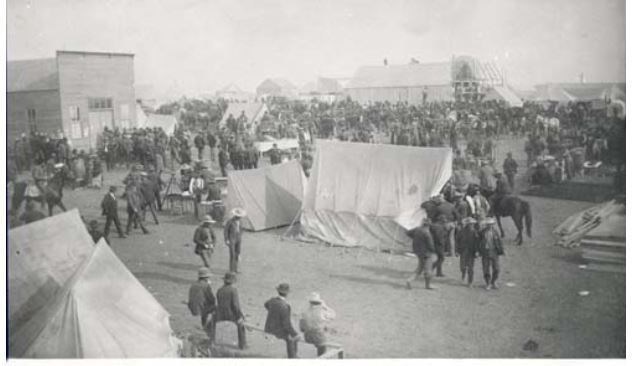
American Indians generally opposed federal attempts to organize them as a territory or a state. They wanted to retain their tribal governments and to continue their communal land ownership. Prior to the agitation for statehood in the 1890s, events in Indian territory caused distress among the Five Civilized Tribes. As early as 1854 Arkansas Sen. Robert W. Johnson introduced a bill calling for the division of the Five Civilized Tribes' domain into three territories, allotting land in severalty to the American Indians, and selling surplus lands to non-Indian settlers. Later the three territories would be joined to form the state of Neosho. In the 1860s the federal government initiated steps toward governing the American Indians. Because some members of the Five Civilized Tribes supported the Confederacy during the Civil War, the tribes were required to sign new treaties with the United States after the war. The Reconstruction Treaties of 1866 and federal Indian policy envisioned the formation of an Indian territorial government. To thwart this, representatives of the Indian territory nations met at Okmulgee, Creek Nation, in 1870 and drafted the Okmulgee Constitution, which provided for an elected governor, a bicameral legislature, and a court system. Although Indian territory voters did not ratify the document, the event gave American Indian leaders experience that they applied during the future Sequoyah Convention.
As whites continued to move into Indian territory, their numbers increased from 110,254 in 1890 to 302,680 in 1900. They outnumbered American Indians by a ratio of 3 to 1 in 1890 and a ratio of 6 to 1 in 1900. While the Five Civilized Tribes retained their sovereignty, whites could not own land or vote. Whites complained of an inadequate justice system. Generally, no education for their children was available other than through subscription schools. Whites continued to follow party politics and attended national conventions, because they believed that Indian territory would soon become a state. With statehood, a number of political offices would be offered to prominent party leaders.
Continued in Chapter 37.
Material and photos courtesy of: Oklahoma Historical Society Research Center
N 35 18.273, W 096 30.657