This Earthcache is only accessible by an easy kayak paddle along the peaceful and seldom travelled Eramosa river from the community of Everton. After completing this earthcache you can either paddle back to where you started in Everton or continue along the river and take out in the town of Rockwood. Note that if you do decide to paddle all the way to Rockwood, that the river becomes unpredictable after you've finished playing with the serpent, ranging from having to potentially walk your kayak in the summer months, to class I and II rapids in the early Spring.
In order to log your find, determine the following:
1) How long is the meander here between the 2 waypoints (posted and Tail of Serpent).
2) Why do you think the serpent has a 25m long crown/horn on it's head and a 125m arm protruding from its belly?
3) Is it likely that an oxbow lake will form here over time and if so how long do you think it will take?
4) Which part of the meander by the force of the current river flow appears to have the most impact on the formation of the river? Take and send me the coords.
5) Estimate the maximum depth of the river that you encounter along this meander. Does the water flow faster or slower at this point?
6) What is located at the end of the serpent's tale and how might that affect the river?
7) Take a look at the map of the Eramose River from where you put in in Eramosa to where it joins the Speed River in Guelph. Are there are larger meanders with tighter turns?
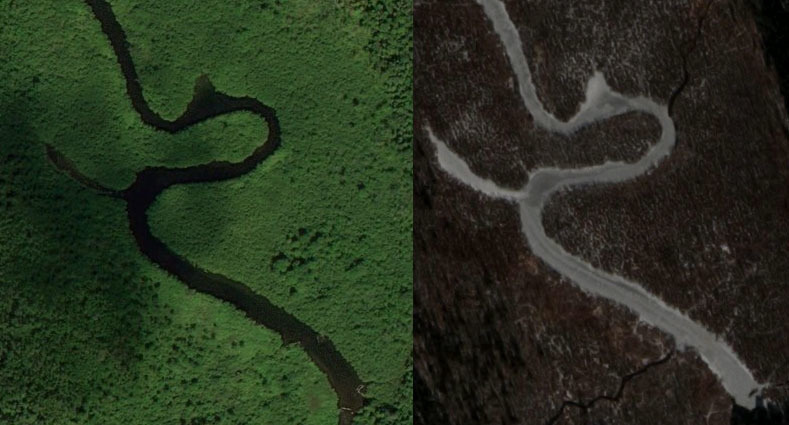
The Eramosa River here gives way to soft soils allowing it to shift its banks and set its own ever changing course that almost never runs straight at least not for long. All it takes to turn a straight river into a bendy one is a little disturbance and a lot of time and in nature there is plenty of both.
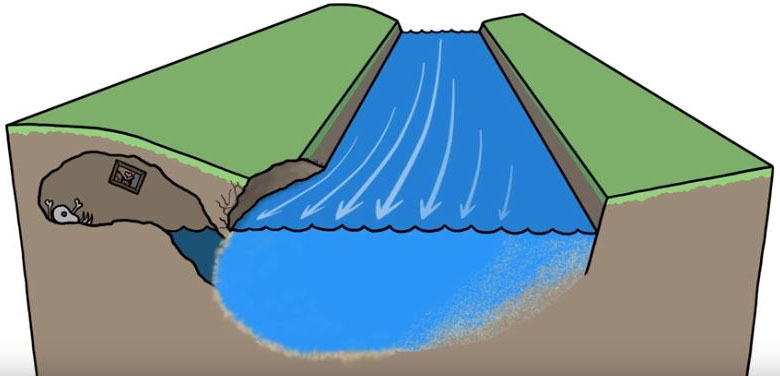
Say for example a muskrat burrows herself a den in one bank of the river. Although it makes for a cozy home, they also weakens the bank which eventually begins to crumble and slump into the river. Water rushes into the newly formed hollow, sweeping away loose dirt and making the hollow even hollower which lets the water rush a little faster and sweep away a little more dirt and so on and so on. As more of the river's flow is diverted into the deepening hole on one bank and away from the other side of the river, the flow there weakens and slows. And since slow moving water can't carry the sand sized particles that fast moving water can the dirt drops to the bottom and builds up to make the water there even shallower and slower and then keeps accumulating until it becomes new land on the inside bank.
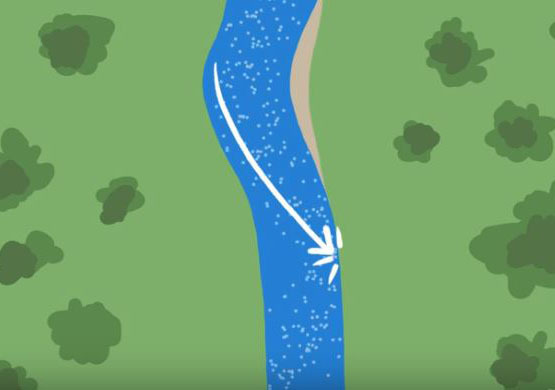
Meanwhile the fast moving water near the outside bank sweeps out of the curve with enough momentum to carry it across the river and slam it into the other side where it starts to carve another curve and then another and another.
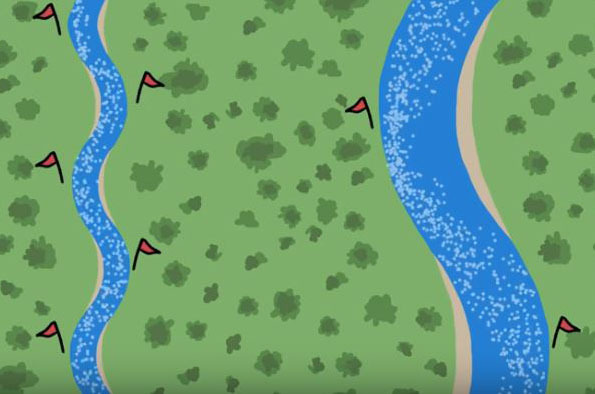
The wider the river, the longer it takes for the slingshotting current to reach the other side and the greater the downstream distance to the next curve.
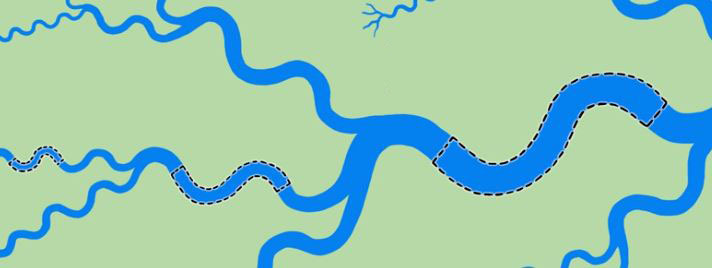
Measurements of meandering streams all across the world reveal a strikingly regular pattern. The length of one S-shaped meander tends to be about 6 times the width of the stream. So little tiny meandering streams tend to look just like miniature versions of their bigger relatives.
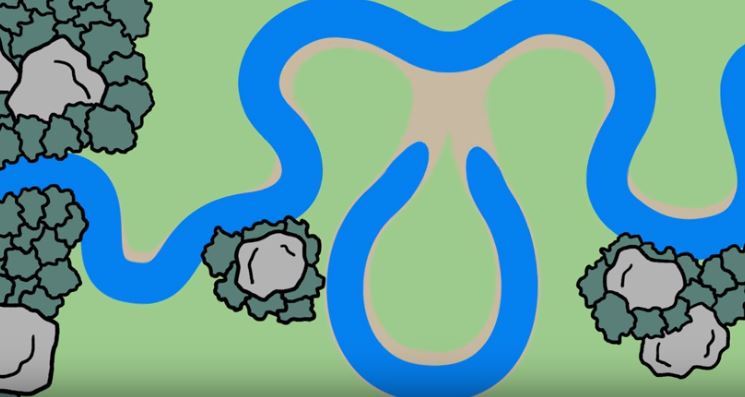
As long as nothing gets in the way of a river's meandering, its curve will continue to grow curvier and curvier until they loop around and bumble into themselves. When that happens, the river's channel follows the straighter path leaving behind a crescent shaped remnant called an oxbow lake or a billabong or a lago en herradura or a bra mort. There are lots of names for these lakes since they can pretty much occur anywhere where liquid flows or used to. This brings up an interesting questions. What do the Martians call them?
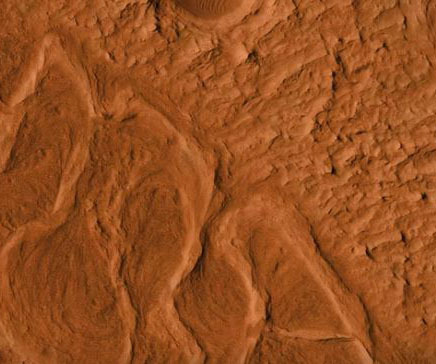
The process creating an oxbow lake is as follows:
The river is meandering across the valley
The river is eroding laterally (from side to side)
The river erodes the outside of the bends and deposits on the inside so its course is changing
This erosion narrows the neck of the meander
Often during a flood the river will cut through the neck
The river continues in the new bed and the meander is abandoned
New deposition seals off the ends and the cut-off becomes an ox-bow lake
Although no oxbow lake is currently present along the Eramosa River, with the effects of mother nature or even man, this could happen at any time, whether it is a few years from now or even hundreds or thousands of years.