Millennium Stone, Indiana Limestone
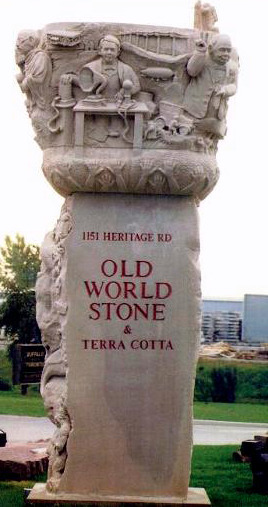
Erected on the front lawn at Old World Stone in 2000, to commemorate the Millennium, this 40 ton limestone monument depicts humankind’s most significant achievements and outstanding humanitarian figures of the 20th century. The images include the flight at Kitty Hawk, the Model T Ford assembly line, the first landing on the moon, and the Canada Arm. The figures of Winston Churchill, Martin Luther King, Mother Theresa, and Mahatma Gandhi grace the four corners.
INDIANA LIMESTONE
Official Name: Salem Formation
Source: Monroe and Lawrence counties, Indiana
Age: Middle Mississippian (335-340 Ma)
The Salem Formation (a.k.a. Indiana Limestone) crops out along a thin, irregular arcuate band in south-central Indiana (Monroe and Lawrence counties). Most quarries lie between the cities of Bloomington and Bedford.

Quarrying of Indiana Limestone began in 1827 with the opening of the Richard Gilbert Quarry. The quarried stone was produced for local use only prior to the building of railways in the 1850's. However, by 1900, Indiana limestone represented 1/3 of the total U.S. dimension limestone industry, and increased to 80% by 1920. There are currently 9 active quarries that produce 76,000 cubic meters of Indiana Limestone each year.
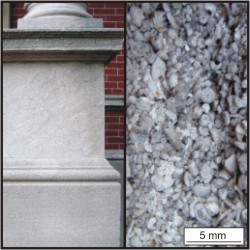
The limestone is soft and easily worked when quarried, but once the quarried rock dries it becomes case-hardened, that is, its surface becomes harder and more resistant to weathering. Indiana Limestone is a freestone, which means that it has no preferential direction of splitting. It can be planed, turned on a lathe, sawed, and hand worked, making it highly versatile.
Where quarried, the Salem Formation varies from 8 to 18 meters (25 to 60 feet) in thickness, and is unusually massive (i.e., lacks partings and stylolites). For a rock, the Indiana Limestone is chemically pure and consistent, being composed of >97% calcite. The combination of these physical and chemical characteristics make the Indiana Limestone well-suited to building because:
It is more durable than a typical limestone
It can be cut into very large blocks
It can hold fine detail when carved
GEOLOGICAL FEATURES OF INDIANA LIMESTONE
The building stone quarried from the Salem Formation consists of light-grey to bluish-grey limestone (calcarenite) that has oxidized locally to a light tan. It is medium to coarse grained, well sorted, and porous. It consists mostly of small fossils and fossil fragments.
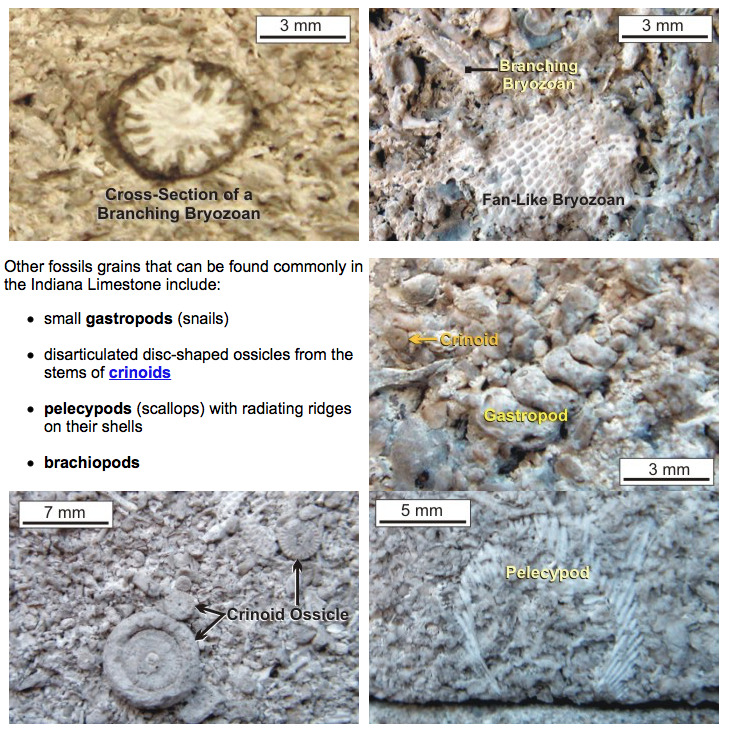
The most abundant fossil is the foraminiferid Endothyra baileyi that is up to 1 mm in length. Foraminifera (forams for short) are marine single-celled protists with shells that are commonly divided into chambers which are added during growth.
Endorytha appears as small, simple, smooth, ellipsoidal grains. The complex, chambered structure of its shell (or test) is apparent only under the microscope.
Fragments of bryozoans are also common in the Salem Formation. Bryozoans are tiny aquatic organisms (rarely larger than a millimeter) that live in colonies of interconnected individuals. Some bryozoans encrust hard surfaces such as rocks or shells. Other bryozoans formed tree-like branching colonies. The most abundant bryozoans in the Indiana Limestone formed fan-like colonies that left behind lacy, net-textures fossils. Each window-like hole in the net once housed an individual bryozoan animal. "Fenestra" is latin for "window", and so this type of organism is referred to as a fenestrate bryozoan.
Larger-scale sedimentary features that are commonly found in blocks of Indiana Limestone, include cross-bedding, and sinuous trace fossils on bedding planes.
ENVIRONMENT OF FORMATION
During the Middle to Late Missisippian (335-340 million years ago), most of what is now the USA was covered by shallow seas that straddled the equator. Limestone accumulated on the seafloor below these warm, tropical waters.
The Indiana Limestone formed far enough offshore that very little continentally-derived siliciclastic sediment was available to mix with the carbonate sediment that was forming in the immediate area.
Despite being 10's to 100's of kilometers offshore, the water was shallow enough for waves to move coarse carbonate sand across the seafloor. The constant wave action washed away the smallest particles, whereas the larger fossils were battered and broken. The result was a rock consisting of well sorted grains that consist of small fossils and fossil fragments.
Like modern-day fan corals, fan-like fenestrate bryozoans lived in quiet, low energy environments. Thus the abundant fragments of these fossils must have been transported from their original setting, but could not have been moved too far or else these delicate fossil fragments would have been completely destroyed.
Indiana Limestone has been used in many well known buildings:
The Pentagon - headquarters to the United States - Department of Defense
Washington National Cathedral - second-largest church building in the United States, and the fourth-tallest structure in Washington
Lincoln Memorial - an American national monument built to honor the 16th President of the United States, Abraham Lincoln
United States Holocaust Memorial Museum - official memorial to the Holocaust
Empire State Building - 102-story Art Deco skyscraper in Midtown Manhattan
Rockefeller Center - a large complex consisting of 19 commercial buildings covering 22 acres
Biltmore Estate - America's largest home, built by George Vanderbilt
Grand Central Station - a intercity railroad terminal in Midtown Manhattan

To claim this EarthCache, please send the answers to the following questions to the CO at the top of the page:
Questions to answer:
1) Estimate the height of the Millennium Stone, and provide the weight and other measurement that are carved into the nearby stone.
2) Take a close look at the Millennium Stone, what evidence do you see of fossil remains?
3) What are some of the characteristics of Indiana Limestone that made it the ideal choice for the Millennium Stone (cache description will help).
4) Compare the “Typical Limestone” found at the reference point provided, to the Indiana Limestone used in the Millennium Stone.
Optional (Please include with your log):
5) What is your favourite carvings on the Millennium Stone?
Things to look for:
North Face - Edison, Wright Brothers, Ford, Winston Churchill
East - Pasteur, cloning, Berlin wall, computer networks, Ghandi
South - United Nations, end of apartheid, Terry Fox, human organ transplants and joint replacement,
West- Television, Elvis, lunar landing, Martin Luther King
6) Photos, please include photos lots of photos
Source of Information:
http://academic.brooklyn.cuny.edu/geology/powell/613webpage/NYCbuilding/IndianaLimestone/IndianaLimestone.htm
http://www.oldworldstone.com/monuments
Related Page:
https://youtu.be/DSsNXeWT8GY
https://youtu.be/RSejxl80CwU